Wifi Security - Nick Kartsioukas
Explore WiFi security types, their strengths, and vulnerabilities. Learn about WEP, WPA, WPA2, and enterprise-level security measures for protecting your wireless network.
IMSI Catchers - Maria Pikusova
Explore IMSI Catchers: cell phone communication interceptors. Learn about their history, uses, detection methods, and legal implications. Discover an open-source app for identifying these devices.

Reverse Engineering with Ghidra
Explore software reverse engineering fundamentals, x86_64 architecture, and Ghidra basics in this comprehensive introduction to analyzing and understanding compiled code.

FPGA Glitching & Side Channel Attacks
Explore side channel analysis and fault injection attacks on modern systems using low-cost hardware like FPGAs. Learn about powerful techniques once reserved for governments and researchers.

Replicating a Secure Telephone Key
Reverse engineering and replicating a secure telephone key: from mechanical design to electrical reproduction, overcoming manufacturing challenges for the Motorola Sectel 9600.
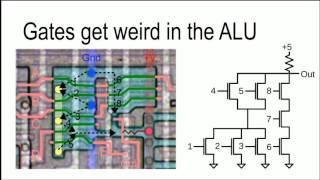
Reading Silicon - How to Reverse Engineer Integrated Circuits
Explore integrated circuit reverse engineering with Ken Shirriff. Learn techniques to decipher chip layouts, from classic processors to analog components, using die photos and analysis methods.

Reverse Engineering with Ghidra - Class 4
Explore advanced Ghidra features: external libraries, patch diffing, checksums, memory management, PCODE, SLEIGH, extensions, and scripting for enhanced reverse engineering capabilities.

Reverse Engineering with Ghidra - Class 3
Explore advanced reverse engineering techniques using Ghidra, covering structs, pointers, enums, system calls, and file operations. Gain practical tips for efficient analysis and code manipulation.

Reverse Engineering with Ghidra
Dive deep into assembly language concepts for reverse engineering, covering control flow, loops, variables, functions, and memory management using the Ghidra software suite.
Code Forensics - Analyzing High-Level Languages and Compilers
Explore code forensics techniques for analyzing high-level languages, compilers, and architectures. Learn debugging and tracing methods to uncover hidden software behaviors and vulnerabilities.
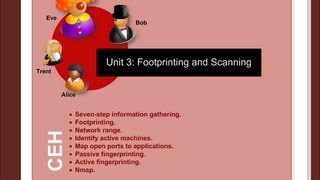
CeH Unit 3: Footprinting and Scanning - Information Gathering and Network Mapping
Explore footprinting and scanning techniques for ethical hacking, including passive information gathering, DNS analysis, port scanning, and network mapping tools.

CeH Unit 1 - Business Aspects of Penetration Testing
Explore business aspects of penetration testing, including key terms, threats, data protection, and security procedures. Learn about ethical hacking and its role in cybersecurity.
Introduction to Security and Network Forensics: Web Infrastructures - Chapter 11
Explore web infrastructure essentials: HTTP, LDAP, authentication methods, federated identity, and access control. Gain insights into security principles for robust online systems.
Data Hiding and Obfuscation in Security and Network Forensics - Lecture 10
Learn data hiding techniques including encryption, hashing, encoding, and steganography. Explore file allocation tables, naming conventions, and signatures for forensic analysis.
Intro to Security and Network Forensics - Threat Analysis
Comprehensive overview of security threats, including penetration testing, vulnerability analysis, and common attack methods like phishing and SQL injection, with practical demonstrations.
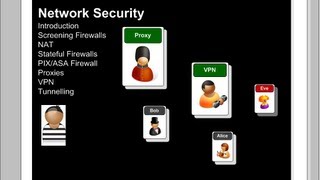
Introduction to Security and Network Forensics - Network Security Elements
Comprehensive overview of network security elements, covering firewalls, NAT, VPNs, and IPSec. Ideal for those seeking to understand fundamental security concepts and technologies.
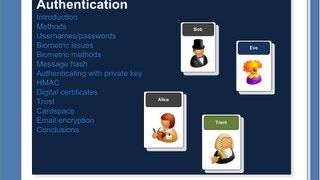
Introduction to Security and Network Forensics: Authentication - Lecture 4
Explore authentication methods, biometrics, digital certificates, and encryption in network security. Learn key principles and practical applications for secure communication and identity verification.
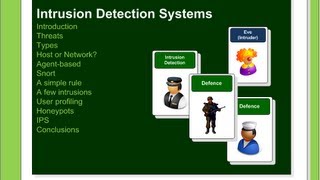
Introduction to Security and Network Forensics - Intrusion Detection Systems
Explore intrusion detection systems, security agents, and network forensics techniques. Learn about policy definition, user profiling, and honeypots in this comprehensive security overview.
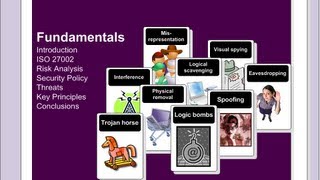
Introduction to Security and Network Forensics - Lecture 1
Comprehensive overview of security fundamentals, covering threats, defense strategies, and network models for a solid foundation in cybersecurity principles.
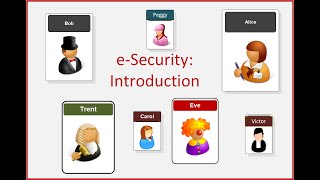
Introduction to e-Security
Comprehensive overview of e-security fundamentals, covering operating systems, key exchange, trust infrastructure, and tunneling. Ideal for those seeking a solid foundation in cybersecurity concepts.
Tokenization
Learn about tokenization techniques for data protection, including surrogate identifiers, currency tokenization, and pseudonymization. Explore best practices and advanced concepts like Feistel structures and honey encryption.