Lessons from the Buzz
Explore insights and key takeaways from the Buzz phenomenon, examining its impact and implications for technology and society.
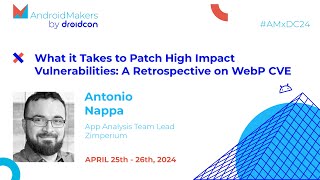
What it Takes to Patch High Impact Vulnerabilities: A Retrospective on WebP CVE
Explore WebP CVE vulnerabilities in Flutter, assess impact across Android apps, and learn effective strategies for staying updated and implementing robust security measures.

Installing and Using Jackalope Fuzzer on MacOS - Finding Vulnerabilities in Simple Programs
Install and use jackalope fuzzer on MacOS to find vulnerabilities in binary programs. Learn cloning, compilation, command options, and practical fuzzing techniques.
Less Power for More Learning - Restricting OCaml Features for Effective Teaching
Explore a framework for sandboxing OCaml features to automate grading of programming exercises, including feature restriction, mock IO system, and security considerations.
Runtime Detection of Data Races in OCaml with ThreadSanitizer
Explore runtime detection of data races in OCaml using ThreadSanitizer. Learn core principles, challenges, adaptations, and practical application for reliable parallel code development.

A Grounded Conceptual Model for Ownership Types in Rust
Explore a systematic approach to teaching Rust's ownership types, featuring a new assessment tool, conceptual model, and visualizations to improve learner understanding of memory safety concepts.

Verus: Verifying Rust Programs Using Linear Ghost Types
Explore Verus, an SMT-based tool for formally verifying Rust programs. Learn how it leverages Rust's linear types and borrow checking to prove functional correctness in low-level, high-assurance systems.

Accelerating Fuzzing through Prefix-Guided Execution
Explore prefix-guided execution for accelerating coverage-guided fuzzing, improving bug detection and code coverage in software testing through early termination of unlikely tests.
Indexed Types for a Statically Safe WebAssembly - POPL 2024
Explore Wasm-prechk, a WebAssembly extension using indexed types for enhanced static safety. Learn about performance gains, type safety proofs, and implementation trade-offs in this innovative approach.
Flux: Liquid Types for Rust
Explore Flux, a refined type system for Rust that enhances verification of low-level pointer programs. Learn how it combines logical refinements with Rust's ownership mechanisms for efficient and ergonomic type-based verification.
Taype: A Policy-Agnostic Language for Oblivious Computation
Explore Taype, a novel language for secure multiparty computation that decouples security policies from program logic. Learn about oblivious algebraic data types and tape semantics for flexible, policy-agnostic development.
Obtaining Information Leakage Bounds via Approximate Model Counting
Explore a sound symbolic quantitative information flow analysis for bounding information leakage in programs using approximate model counting and symbolic execution.
Towards Secure MicroPython on Morello - Work in Progress
Explore porting MicroPython to Arm Morello, examining hardware capabilities' impact on embedded runtime security and outlining potential improvements for MicroPython's security.
RefinedRust: A Type System for High-Assurance Verification of Rust Programs
Explore RefinedRust, a novel type system for verifying both safe and unsafe Rust code. Learn about its implementation, evaluation, and potential impact on high-assurance software development.
Supporting Trusted Virtual Machines with Hardware-based Secure Remote Memory
Explore hardware-assisted secure memory disaggregation, combining trusted VMs with a dedicated engine for efficient isolation and protection of remote memory pages, ensuring confidentiality and integrity.
Descend: A Safe GPU Systems Programming Language
Explore Descend, a safe GPU programming language enforcing memory management through type systems. Learn about its holistic model, extended Borrow checking, and competitive performance against CUDA.
jGuard - Programming Misuse-Resilient APIs
Explore jGuard, a Java extension enabling API designers to encode specifications directly, preventing misuse without additional tooling for users. Enhance API resilience effortlessly.
HasTEE: Programming Trusted Execution Environments with Haskell
Explore HasTEE, a Haskell-embedded DSL for programming Trusted Execution Environments. Learn how it simplifies TEE application development with automatic partitioning and enhanced security features.
Don't Go Down the Rabbit Hole: Reprioritizing Enumeration for Property-Based Testing
Explore an innovative approach to property-based testing, integrating LazySearch with NIST's ACTS for significantly faster and more effective testing in functional programming.

Borrow Checking in Hylo - A High-Level Systems Programming Language
Explore Hylo's innovative approach to safe, efficient systems programming using mutable value semantics and abstract interpretation for lifetime verification.
Does Rust SPARK Joy? Safe Bindings from Rust to SPARK, Applied to the BBQueue Library
Explore safety guarantees in Rust-SPARK language bindings, focusing on the BBQueue circular buffer library. Learn about maintaining compile-time safety across language boundaries in embedded systems.