BlueMirror - Reflections on Bluetooth Pairing and Provisioning Protocols
Explore Bluetooth pairing and provisioning protocols, focusing on security vulnerabilities and potential exploits in wireless communication systems.

Ethics in Security and Privacy Research Panel
Explore ethical considerations in security and privacy research through expert insights and discussions on best practices, challenges, and future directions.

Birds of a Feather - A Hardware & Security Panel
Engaging panel discussion on hardware security and defense strategies, featuring industry experts debating apocalypse preparedness in the context of cybersecurity.
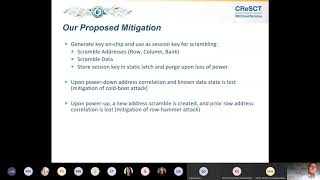
On-Chip Randomization for Memory Protection Against Hardware Supply Chain Attacks to DRAM
Explore innovative techniques for safeguarding DRAM against hardware supply chain attacks through on-chip randomization, enhancing memory protection in modern computing systems.
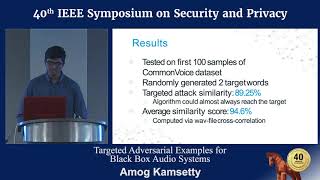
Targeted Adversarial Examples for Black Box Audio Systems
Exploring techniques to generate adversarial examples for audio systems, combining genetic algorithms and gradient estimation to achieve high attack success rates while maintaining audio similarity.
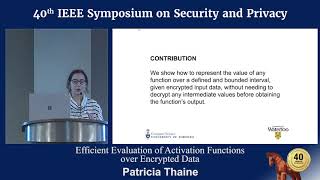
Efficient Evaluation of Activation Functions over Encrypted Data
Explore techniques for approximating activation functions on encrypted data, with applications in secure machine learning for image classification and representation learning.
Deep in the Dark - Deep Learning-based Malware Traffic Detection without Expert Knowledge
Explores deep learning models for malware traffic detection using raw network data, comparing performance to traditional approaches and evaluating different input representations.
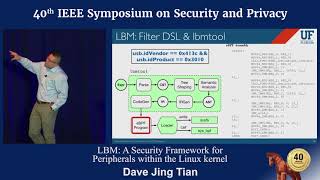
LBM - A Security Framework for Peripherals within the Linux Kernel
Unified security framework for Linux kernel to protect against malicious peripherals, leveraging eBPF for efficient packet filtering across USB, Bluetooth, and NFC protocols.
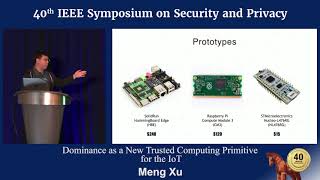
Dominance as a New Trusted Computing Primitive for the IoT
Introduces Cider, a system for rapid recovery of compromised IoT devices in large deployments, minimizing manual intervention and addressing unique security challenges in IoT environments.
PhishFarm - A Scalable Framework for Measuring the Effectiveness of Evasion Techniques Against Browser Phishing Blacklists
Explore a framework for testing anti-phishing systems against evasion techniques, revealing vulnerabilities in browser blacklists and mobile security infrastructure.
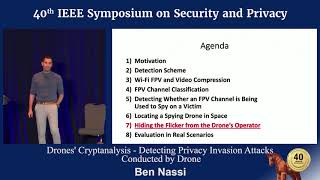
Drones' Cryptanalysis - Detecting Privacy Invasion Attacks Conducted by Drone
Explore a novel method for detecting privacy invasion attacks by drones using encrypted video traffic analysis and physical stimuli, with practical applications and performance evaluations.
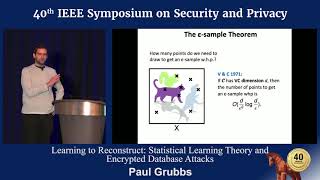
Learning to Reconstruct - Statistical Learning Theory and Encrypted Database Attacks
Explores the connection between statistical learning theory and encrypted database attacks, presenting novel approaches for database reconstruction from access pattern leakage with improved efficiency and broader applicability.
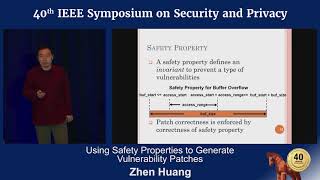
Using Safety Properties to Generate Vulnerability Patches
Innovative approach to automatic program repair using safety properties for precise and complete vulnerability fixes, demonstrated on 32 real-world vulnerabilities across diverse applications.
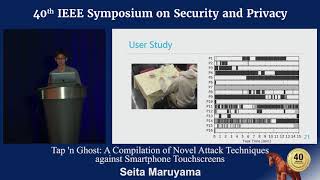
Tap 'n Ghost - A Compilation of Novel Attack Techniques against Smartphone Touchscreens
Novel attack techniques targeting NFC-enabled smartphone touchscreens, combining device fingerprinting and ghost touch generation to manipulate user interactions and potentially gain remote control.

Synesthesia - Detecting Screen Content via Remote Acoustic Side Channels
Explore acoustic side channels in screens, revealing how subtle noises can expose displayed content and user inputs, posing privacy risks in various scenarios.
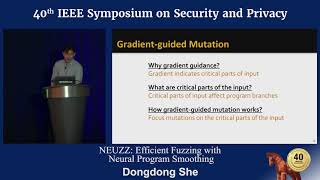
NEUZZ - Efficient Fuzzing with Neural Program Smoothing
Innovative fuzzing technique using neural networks to approximate program behavior, enabling more efficient bug discovery and higher code coverage in software testing.
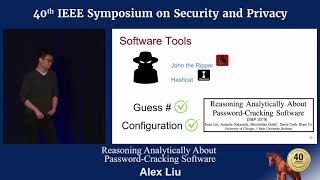
Reasoning Analytically About Password Cracking Software
Efficient techniques for analyzing transformation-based password cracking software, enabling improved attack configurations and scientific reasoning about real-world password-guessing attacks.
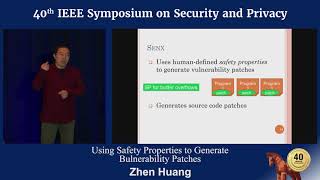
Using Safety Properties to Generate Vulnerability Patches
Explores a novel approach to automatic program repair using safety properties to generate precise and comprehensive vulnerability patches, avoiding limitations of example-based methods.
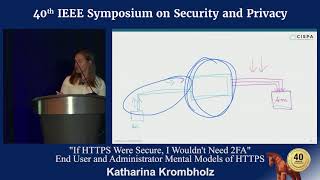
If HTTPS Were Secure I Wouldn't Need 2FA - End User and Administrator Mental Models of HTTPS
Explores misconceptions about HTTPS security among end users and administrators, revealing gaps in understanding and providing recommendations for improved protocol design and user interfaces.

Does Certificate Transparency Break the Web? Measuring Adoption and Error Rate
Exploring Certificate Transparency adoption, challenges, and impact on web security. Analyzes deployment strategies, error rates, and lessons for future large-scale security implementations.
RIDL - Rogue In-Flight Data Load
Unveiling RIDL: a new class of speculative execution attacks that leak arbitrary data across boundaries, bypassing existing mitigations and posing significant security risks for modern processors.