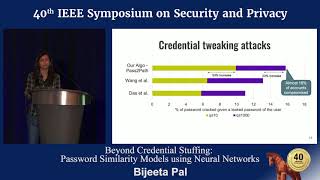
Beyond Credential Stuffing - Password Similarity Models Using Neural Networks
Explore advanced password security using neural networks to model similarities, revealing vulnerabilities in current systems and proposing innovative defenses against targeted attacks.
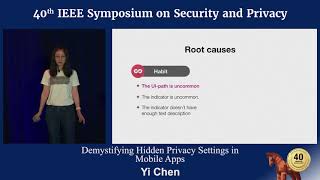
Demystifying Hidden Privacy Settings in Mobile Apps
Uncover hidden privacy settings in mobile apps, learn about their impact on user data sharing, and explore strategies for improving privacy control usability.

Characterizing Pixel Tracking through the Lens of Disposable Email Services
Explores disposable email services and email tracking, revealing security risks and prevalent third-party tracking methods. Analyzes a large-scale dataset to uncover tracking ecosystem dynamics.
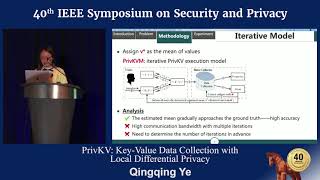
PrivKV - Key Value Data Collection with Local Differential Privacy
Explores local differential privacy for key-value data collection, proposing PrivKV, PrivKVM, and PrivKVM+ solutions to improve estimation accuracy while preserving user privacy in distributed data collection.
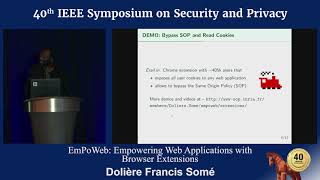
EmPoWeb - Empowering Web Applications with Browser Extensions
Explores security risks of browser extension APIs, revealing how web apps can exploit them to bypass SOP, access sensitive user data, and perform privileged actions on users' devices.
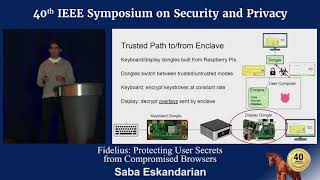
Fidelius - Protecting User Secrets from Compromised Browsers
Innovative architecture using trusted hardware enclaves to protect sensitive user data during web browsing, even in fully compromised environments. Offers secure form data, JavaScript, XMLHttpRequests, and storage solutions.
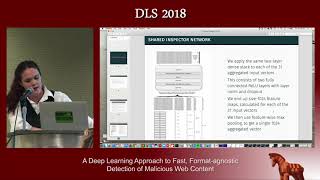
A Deep Learning Approach to Fast, Format-Agnostic Detection of Malicious Web Content
Innovative deep learning method for detecting malicious web content, operating on token streams from static HTML files. Achieves high accuracy and speed without complex parsing or emulation.

Secure Device Bootstrapping without Secrets Resistant to Signal Manipulation Attacks
Explores VERSE, a physical-layer group message integrity verification primitive for secure wireless device bootstrapping without prior associations, addressing MitM attacks and key management challenges.

Tracking Certificate Misissuance in the Wild
Explore certificate misissuance trends, introducing ZLint tool to analyze CA errors. Discover improvements, persistent issues, and correlations with mismanagement in the Web PKI ecosystem.
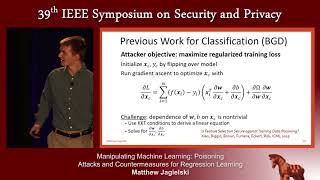
Manipulating Machine Learning - Poisoning Attacks and Countermeasures for Regression Learning
Explore poisoning attacks on linear regression models, their impact on automated decisions, and effective countermeasures. Learn about optimization frameworks and statistical attacks in machine learning security.
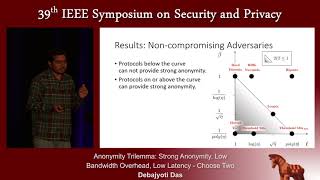
Anonymity Trilemma - Strong Anonymity, Low Bandwidth Overhead, Low Latency - Choose Two
Explores fundamental constraints in anonymous communication protocols, analyzing trade-offs between anonymity, bandwidth, and latency against global passive adversaries.
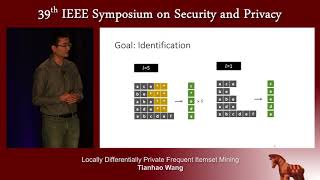
Locally Differentially Private Frequent Itemset Mining
Explore techniques for mining frequent itemsets while preserving user privacy through Local Differential Privacy. Learn about PSFO protocols and the SVIM method for improved efficiency and accuracy.
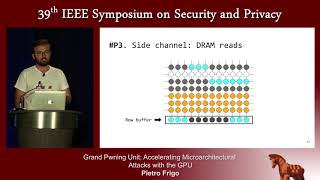
Grand Pwning Unit - Accelerating Microarchitectural Attacks with the GPU
Explores how integrated GPUs can accelerate microarchitectural attacks, bypassing mitigations and compromising mobile browsers. Demonstrates novel reverse engineering techniques for GPU cache architecture.
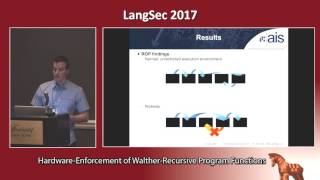
Hardware-Enforcement of Walther-Recursive Program Functions
Explore hardware-enforced restrictions on computational complexity using JIT compilation and Intel's Processor Tracing to improve security through limited return-oriented programming.

Machine-Checked Proofs of Privacy for Electronic Voting Protocols
Explore machine-checked proofs for privacy in electronic voting, focusing on the Helios protocol family. Learn about computational model analysis and formalization challenges.
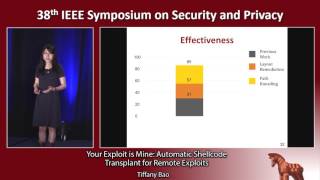
Your Exploit is Mine - Automatic Shellcode Transplant for Remote Exploits
Innovative technique for automatic shellcode transplantation in remote exploits, enabling efficient reuse and adaptation of existing exploits with new shellcode through symbolic tracing and layout remediation.

Password Typos and How to Correct Them Securely
Explore secure methods for correcting password typos, improving login success rates without compromising security. Insights from user studies and Dropbox data reveal common errors and potential solutions.
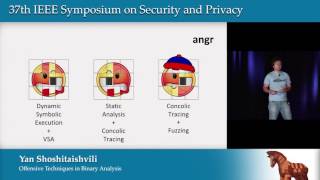
SoK - The Art of War - Offensive Techniques in Binary Analysis
Comprehensive overview of binary analysis techniques for vulnerability detection, comparing approaches and discussing their effectiveness using a standardized framework and dataset.
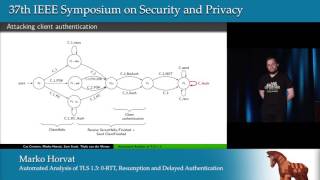
Automated Analysis and Verification of TLS 1.3 - 0-RTT, Resumption and Delayed Authentication
Explore automated analysis of TLS 1.3, focusing on 0-RTT, resumption, and delayed authentication. Learn about security verification using the Tamarin prover for this crucial protocol.
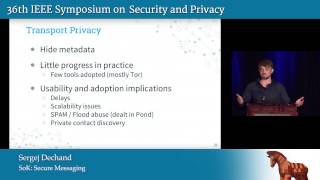
SoK - Secure Messaging
Evaluation of secure messaging solutions, proposing a framework for assessing security, usability, and adoption. Explores trust establishment, conversation security, and transport privacy challenges.
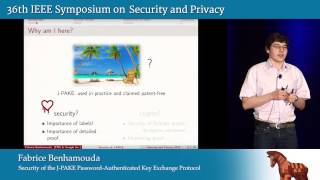
Security of the J-PAKE Password-Authenticated Key Exchange Protocol
Comprehensive security analysis of J-PAKE protocol, proving its robustness against various attacks and demonstrating its suitability for practical use in password-authenticated key exchange.