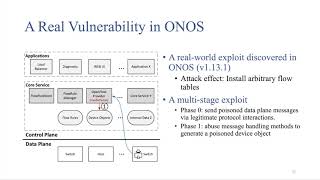
Unexpected Data Dependency Creation and Chaining - A New Attack to SDN
Explores a novel attack on Software-Defined Networking, demonstrating unexpected data dependencies and their chaining effects. Covers attack mechanics, impacts, and potential countermeasures.

Plundervolt - Software-Based Fault Injection Attacks against Intel SGX
Explore software-based fault injection attacks on Intel SGX, focusing on the Plundervolt technique that exploits voltage scaling interfaces to compromise enclave computations and cryptographic algorithms.
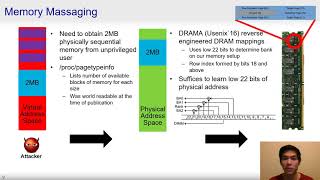
RAMBleed - Reading Bits in Memory Without Accessing Them
Explores RAMBleed, a novel Rowhammer-based side-channel attack that can read sensitive data from DRAM without accessing it, demonstrating security implications for confidentiality even with ECC memory.

The Many Kinds of Creepware Used for Interpersonal Attacks
Explores the landscape of "creepware" apps used for interpersonal attacks, introducing CreepRank algorithm to identify such apps. Discusses various types and implications for cybersecurity and personal safety.
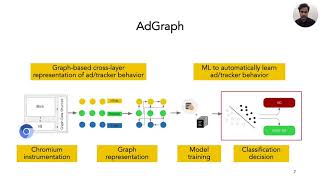
AdGraph: A Graph-Based Approach to Ad and Tracker Blocking
Innovative graph-based machine learning approach for detecting online ads and trackers, offering improved accuracy and performance compared to traditional filter list methods.
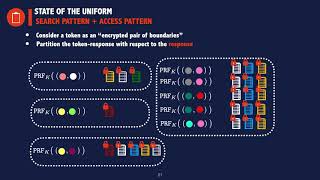
The State of the Uniform - Attacks on Encrypted Databases Beyond the Uniform Query Distribution
Explores novel value reconstruction attacks on encrypted databases, leveraging search-pattern leakage to succeed without prior knowledge of query or data distribution for range and k-NN queries.
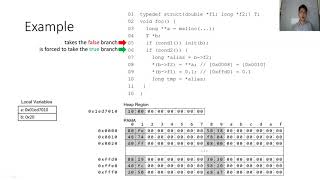
PMP - Cost-Effective Forced Execution with Probabilistic Memory Pre-planning
Explores a cost-effective forced execution technique for malware analysis, using probabilistic memory pre-planning to expose hidden behaviors and overcome self-protection mechanisms.
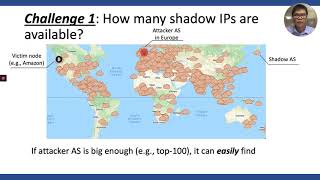
A Stealthier Partitioning Attack Against Bitcoin Peer-to-Peer Network
Explores a stealthy partitioning attack on Bitcoin's P2P network, exploiting network topology to influence node connections without routing manipulation, posing risks for cryptocurrency security.

Can Voters Detect Malicious Manipulation of Ballot Marking Devices?
Explores voter detection of ballot marking device manipulation, examining review rates and effectiveness of interventions to improve verification in electronic voting systems.

Formal Modelling and Proof in the CHERI Design and Implementation Process
Explore rigorous engineering methods for developing secure processor architecture, focusing on CHERI's hardware capabilities for fine-grained memory protection and secure compartmentalization.
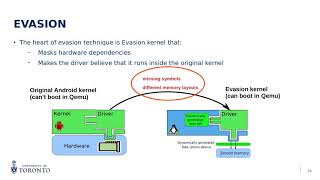
Ex-Vivo Dynamic Analysis Framework for Android Device Drivers
Framework for off-device analysis of Android drivers, enabling efficient vulnerability detection without hardware emulation. Evades dependencies, initializes drivers ex-vivo, and scales with commodity CPUs for improved security research.
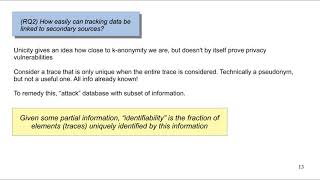
Browsing Unicity - On the Limits of Anonymizing Web Tracking Data
Explores limits of anonymizing web tracking data, revealing vulnerabilities in current methods and challenges in protecting user privacy while maintaining data utility for audience measurement.
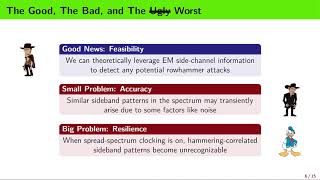
Leveraging EM Side-Channel Information to Detect Rowhammer Attacks
Explore a novel approach to detect rowhammer attacks using electromagnetic signals, overcoming challenges like spread-spectrum clocking for effective and robust defense without system performance overhead.
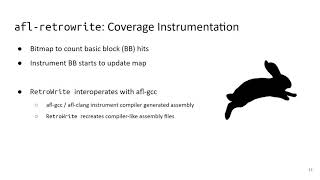
RetroWrite- Statically Instrumenting COTS Binaries for Fuzzing and Sanitization
Explore static instrumentation of COTS binaries for enhanced fuzzing and sanitization using RetroWrite, a framework for rewriting position-independent code.

Dragonblood - Analyzing the Dragonfly Handshake of WPA3 and EAP-pwd
Analyze vulnerabilities in WPA3 and EAP-pwd protocols, exploring attacks on clients and access points, information leakage, and potential solutions for Wi-Fi security.
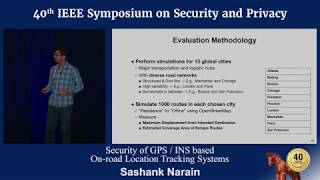
Security of GPS - INS Based On-Road Location Tracking Systems
Explores vulnerabilities in GPS/INS location tracking for road transport, demonstrating how adversaries can spoof routes to reach alternate destinations undetected. Proposes countermeasures to enhance system security.

SensorID - Sensor Calibration Fingerprinting for Smartphones
Exploring smartphone sensor calibration fingerprinting as a novel device identification method, demonstrating high effectiveness and potential privacy implications for iOS and Android users.
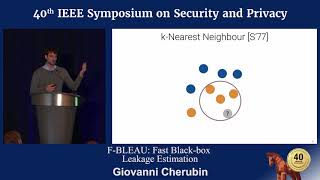
F-BLEAU - Fast Black-Box Leakage Estimation
Innovative method for estimating information leakage in black-box systems using machine learning techniques, improving efficiency and applicability to continuous output spaces.
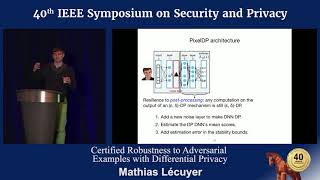
Certified Robustness to Adversarial Examples with Differential Privacy
Explore certified defense against adversarial examples using differential privacy. Scalable solution for large networks and datasets, providing robustness guarantees for various model types.
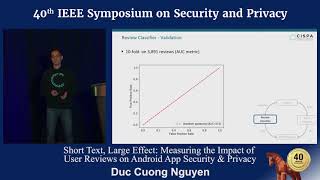
Short Text, Large Effect - Measuring the Impact of User Reviews on Android App Security & Privacy
Exploring the impact of user reviews on Android app security and privacy, analyzing 4.5M reviews to identify concerns and measure developers' responses through code changes.

The 9 Lives of Bleichenbacher's CAT - New Cache Attacks on TLS Implementations
Explores novel cache-based attacks on TLS implementations, demonstrating vulnerabilities in popular systems and introducing a parallelization technique for padding oracle attacks against RSA.