Securing Your Containerized Applications with NGINX
Explore NGINX's role in securing containerized apps as a sidecar reverse proxy, covering TLS, HTTP, authentication, authorization, and traffic control.
Take Your Projects to the Next Level with the Docker-Sponsored Open Source Program
Explore Docker's Open Source Program: Collaborate, innovate, and advance projects with enhanced benefits and criteria. Featuring insights from NYPL, Intel Owl, Jenkins, and nf-core.
Docker and Pyrsia - Securing the Software Supply Chain
Explore securing the open-source software supply chain with Pyrsia and Docker. Learn about vulnerabilities, exploits, and innovative solutions to enhance security in modern application development.
Dynamic Management of Docker Containers in Multi-Cloud and Edge Using MiCADO
Explore MiCADO: an open-source framework for dynamic management of Docker containers across multi-cloud and edge environments, built on Kubernetes. Learn about its components, policies, and applications in various scenarios.
Keylime - An Open Source TPM Project for Remote Trust of IoT
Explore remote trust for IoT devices using Keylime, an open-source project leveraging TPM technology. Learn about measured boot, continuous attestation, and secure device management.
Authenticated and Encrypted Storage on Embedded Linux
Explore Linux kernel's storage authentication and encryption mechanisms, focusing on embedded systems. Learn trade-offs, limitations, and best practices for secure and efficient storage design.
Enabling the TPM2.0 Ecosystem in Linux
Explore TPM2.0 in Linux: Learn about security chip functionality, use cases, and the tpm2-software stack. Discover how to enhance system security using TPM in various applications.
Keylime - An Open Source TPM Project for Remote Trust
Explore Keylime, an open-source project for remote trust using TPM technology. Learn about its architecture, operations, and applications in securing hardware roots of trust and continuous remote attestation.
Kernel Runtime Security Instrumentation
Explore extensible Linux security with Kernel Runtime Security Instrumentation, enabling dynamic threat response through eBPF programs attached to security hooks without kernel modifications.

Exploiting Race Conditions Using the Scheduler
Explore techniques for exploiting race conditions in Linux and Android using scheduler manipulation, focusing on real-world vulnerabilities and practical exploitation strategies.
Upcoming x86 Technologies for Malicious Hypervisor Protection
Explore AMD SEV-SNP, the next-gen x86 virtualization isolation tech, designed to protect VMs from malicious hypervisors. Learn about new security features, threat models, and impacts on open source ecosystems.
Deep Analysis of Exploitable Linux Kernel Vulnerabilities 2017-2019
Comprehensive analysis of Linux kernel vulnerabilities, exploring exploitation techniques, mitigation bypasses, and in-depth case studies from 2017-2019. Focuses on improving security understanding.

The Aftermath of a Fuzz Run - What to Do About Those Crashes?
Explore tools and techniques for analyzing crashes from fuzz runs, focusing on reducing, triaging, and finding root causes to fix vulnerabilities in software applications.
Securing Embedded Linux Systems with TPM 2.0
Explore TPM 2.0 for securing embedded Linux systems. Learn threat modeling, Intel's TPM2 software stack, and implementation using Open Embedded layer for enhanced system integrity and security.
Running KubeVirt Workloads with No Additional Privileges
Explore running VMs on Kubernetes without root privileges using KubeVirt. Learn about security practices, SELinux integration, and the journey to achieve rootless VM execution.
Container Security - Theory & Practice at Netflix
Explore Netflix's container security journey, covering theory, architecture, and practical lessons learned as container usage rapidly expanded across the organization.
Avoiding an Identity Crisis - Authentication with Windows Server Containers
Explore authentication methods for .NET applications in Windows Server containers, covering Active Directory integration, gMSAs, and modern protocols like OAuth for secure identity management.
Don't Have a Meltdown - Practical Steps for Defending Your Applications
Practical steps to defend applications against common attacks, covering authentication, injection, updates, sensitive data, and configuration. Learn to mitigate key security risks in containerized environments.

Dynamic Authorization and Policy Control for Docker Container Environments
Explore fine-grained policy enforcement in Docker container environments using Open Policy Agent. Learn to balance security requirements with rapid application deployment and developer productivity.

Docker Container Security
Learn to create a secure software supply chain using Docker Enterprise, focusing on image signing, scanning, and automated policies for compliant application development.
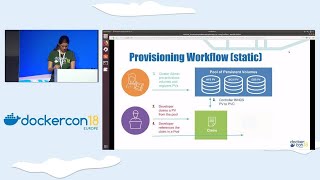
Provisioning and Managing Storage for Docker Containers
Explore Docker container storage concepts, focusing on provisioning, management, and advanced features for stateful applications. Learn about persistent volumes, data availability, and monitoring.