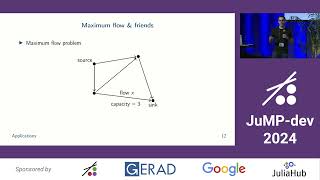
Convex Network Flows - Optimization Framework and Applications
Introducing a general framework for modeling flow problems over hyper graphs, with applications in network optimization, power flow, and wireless networks. Includes fast, parallelizable algorithm implementation in Julia.

Wolfram's Hypergraphs - A New Approach to Unified Physics Theory
Explore how Stephen Wolfram's revolutionary approach using hypergraphs and computer code could potentially unify fundamental physics laws and resolve conflicts with Einstein's theories.
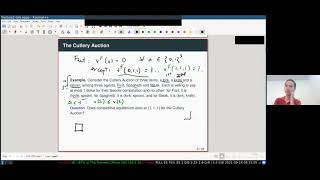
Tropical Solutions to Hard Problems in Auction Theory and Neural Networks - Lecture II
Explore tropical mathematics and its applications in neural networks, auction theory, and more, focusing on key ideas of tropical objects as limits and their polyhedral geometry.
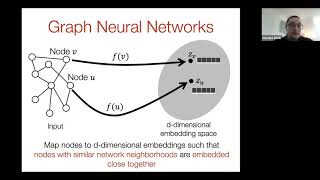
Graph Representation Learning and Its Applications to Biomedicine
Graph representation learning techniques for biomedical applications, focusing on SubGNN for disentangled subgraph embeddings and their use in predicting disease treatments and safe drug combinations.
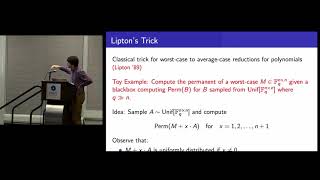
The Average-Case Complexity of Counting Cliques in Erdos-Renyi Hypergraphs
Explore average-case complexity of counting cliques in Erdos-Renyi hypergraphs, covering proof techniques, random KQ accounting, and binary expansions.
Performance and Limitations of QAOA at Constant Levels on Large Sparse Hypergraphs and Spin Glass Models
Delve into quantum algorithm analysis, exploring QAOA's performance limitations on large hypergraphs and spin glass models through theoretical frameworks and mathematical proofs.

Formal Probabilistic Methods for Combinatorial Structures using the Lovász Local Lemma
Explore formal probabilistic methods for combinatorial structures, focusing on the Lovász Local Lemma and its application to hypergraph coloring in Isabelle/HOL.
Geometry of Nonequilibrium Reaction Networks
Explore geometric interpretations of nonequilibrium reaction networks, extending Hill-Schnakenberg theory to hypergraphs and analyzing cycles, cocycles, and stochastic models.