The Remarkable Platonic Solids I - Universal Hyperbolic Geometry
Explore the fascinating world of Platonic solids, their symmetry, history, and mathematical properties. Learn about Euclid's contributions and Euler's fundamental relation for polyhedra.
Trigonometric Dual Laws and the Parallax Formula - Universal Hyperbolic Geometry
Explore trigonometric dual laws and the Right parallax formula in Universal Hyperbolic Geometry. Learn about Pythagoras' theorem, Cross dual law, and zero quadrance/spread theorems.
Hyperbolic Geometry Is Projective Relativistic Geometry - Full Lecture
Explore hyperbolic geometry as projective relativistic geometry, covering key concepts, models, and theorems. Gain insights into quadrance, spread, trigonometry, and unique results like the Jumping Jack theorem.
Triangle Geometry Old and New - An Introduction to Hyperbolic Triangle Geometry
Explore classical and hyperbolic triangle geometry, covering perpendicularity, midpoints, and bilines. Learn about orthocenters, incenters, circumcenters, and more through visual illustrations without complex formulas.
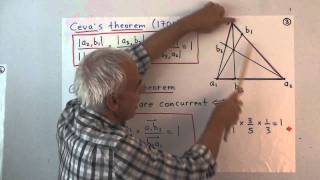
Menelaus, Ceva and the Laws of Proportion - Universal Hyperbolic Geometry
Explore classical theorems of Menelaus and Ceva in universal hyperbolic geometry, along with new results on triangle proportions and alternate spreads. Learn about ratios, distances, and quadrances in triangular geometry.
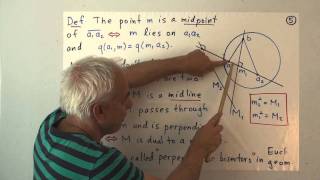
Isosceles Triangles in Hyperbolic Geometry - Universal Hyperbolic Geometry - NJ Wildberger
Explore isosceles triangles in hyperbolic geometry, including special formulas, midpoint construction, and related theorems. Gain insights through proofs, exercises, and applications of the cross law.
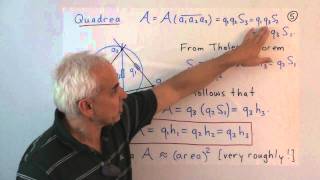
Thales' Theorem, Right Triangles + Napier's Rules - Universal Hyperbolic Geometry
Explores Thales' theorem and Napier's rules in universal hyperbolic geometry, focusing on right triangles. Covers key concepts like quadrea, spreads, and proofs, with practical exercises for deeper understanding.
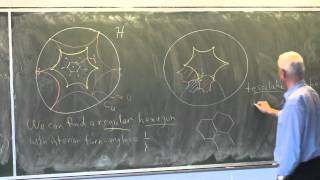
The Two-Holed Torus and 3-Crosscaps Surface - Algebraic Topology - NJ Wildberger
Explore hyperbolic geometric structures of two-holed torus and 3-crosscaps surface through tessellations, hexagons, and the Beltrami Poincare model in this advanced algebraic topology lecture.
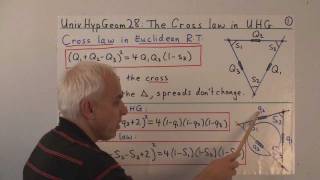
The Cross Law in Universal Hyperbolic Geometry - Universal Hyperbolic Geometry - NJ Wildberger
Explores the Cross law in Universal Hyperbolic Geometry, proving it with a polynomial identity and demonstrating its application to equilateral triangles. Includes exercises and comparisons to Euclidean geometry.
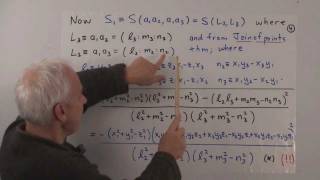
The Spread Law in Universal Hyperbolic Geometry - Universal Hyperbolic Geometry
Explores the Spread law in universal hyperbolic geometry, including its definition, relation to Euclidean geometry, proof, and implications. Covers key concepts like quadrance, spread duality, and quadrea.
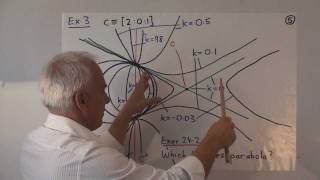
Visualizing Quadrance with Circles - Universal Hyperbolic Geometry - NJ Wildberger
Explore quadrance in universal hyperbolic geometry through circles, examining their appearance as ellipses, parabolas, or hyperbolas with different centers, enhancing understanding of this fundamental concept.
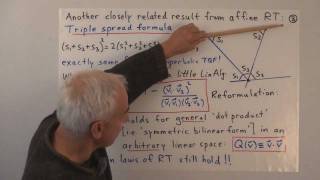
The Triple Quad Formula in Universal Hyperbolic Geometry
Explores the Triple quad formula in hyperbolic geometry, its proof, and related concepts. Compares with Euclidean geometry and discusses algebraic challenges, providing exercises for deeper understanding.
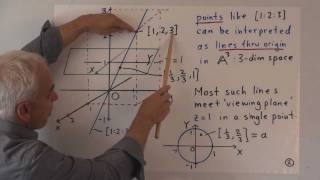
Pythagoras' Theorem in Universal Hyperbolic Geometry
Explore the hyperbolic version of Pythagoras' theorem, its importance in geometry, and the concept of quadrance. Learn about planar coordinates, formulas, and proofs in Universal Hyperbolic Geometry.
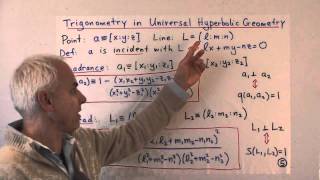
Quadrance and Spread - Universal Hyperbolic Geometry
Introduces algebraic definitions of quadrance and spread in Universal Hyperbolic Geometry, comparing with Rational Trigonometry and exploring main laws and exercises in this advanced mathematical framework.
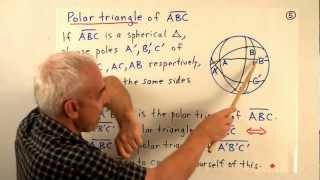
Perpendicularity, Polarity and Duality on a Sphere - Universal Hyperbolic Geometry
Explore perpendicularity, polarity, and duality on a sphere, including polar triangles and point-plane duality. Gain insights into elliptic geometry and the relationships between geometric elements.
The J Function, SL(2) and the Jacobi Identity - Universal Hyperbolic Geometry
Explores connections between hyperbolic geometry, matrix algebra, and Lie theory, demonstrating how the Jacobi identity proves the concurrence of triangle altitudes in projective geometry.
Parallels and the Double Triangle - Universal Hyperbolic Geometry
Explores parallels, double triangles, and perspective centers in Universal Hyperbolic Geometry, offering new insights into Euclid's parallel postulate and its historical implications.
Medians, Midlines, Centroids and Circumcenters - Universal Hyperbolic Geometry
Explore triangle geometry in universal hyperbolic geometry, covering medians, midlines, centroids, and circumcenters. Discover unique properties and connections in this algebraic framework.
Reflections and Projective Linear Algebra - Universal Hyperbolic Geometry
Explore reflections in hyperbolic geometry through projective linear algebra. Learn about null points, reflection matrices, and the sl(2) Lie algebra. Gain insights into fundamental symmetries and their mathematical representations.
Midpoints and Bisectors - Universal Hyperbolic Geometry
Explore midpoints and bisectors in hyperbolic geometry, including reflections, perpendicularity, and geometric constructions. Learn key differences from Euclidean geometry in this advanced mathematical exploration.
Apollonius and Polarity Revisited - Universal Hyperbolic Geometry
Explores Apollonius' polarity in hyperbolic geometry, focusing on null points, quadrangles, and the relationship between poles and polars. Includes explicit formulas and computational examples.