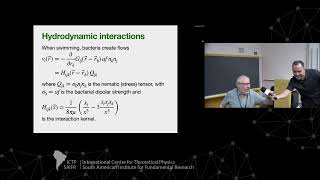
Computational Modeling of Active Systems - Class 4
Explore computational modeling techniques for active systems, focusing on advanced concepts and practical applications in the field of active matter.
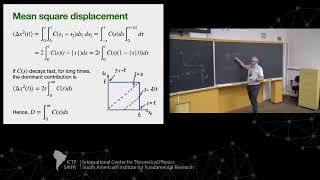
Computational Modeling of Active Systems - Class 3
Explore computational modeling techniques for active systems, focusing on advanced concepts and practical applications in the field of active matter.
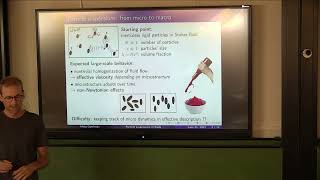
Effective Description of Particle Suspensions in Fluids
Explorez les théories effectives des systèmes de particules classiques et quantiques dans les suspensions fluides.
Hydrodynamics: From Relativistic to Carroll - Lecture
Explore hydrodynamics as an effective field theory, focusing on symmetries and their role in constructing Euclidean thermal partition functions for exotic field theories.
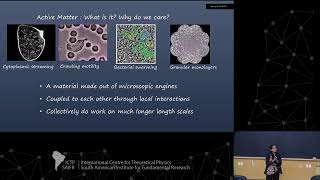
Theoretical Foundations of Active Matter: Lessons from Ideal Microscopic Models - Class 1
Explore theoretical foundations of active matter through ideal microscopic models, gaining insights into this dynamic field of physics and biology.
Computational Modeling of Active Systems - Class 1
Explore computational modeling techniques for active systems, focusing on fundamental principles and practical applications in the field of active matter.
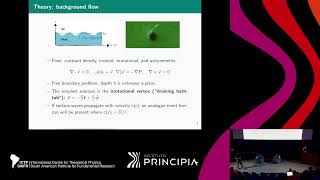
Superradiance and Ergoregion Instabilities in Vortices
Explore superradiance and ergoregion instabilities in vortices, examining quantum aspects of gravity and their potential laboratory observations.
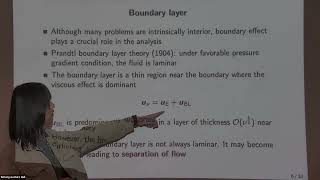
Energy Dissipation of Navier-Stokes Equation with Non-Characteristic Boundary
Explore energy dissipation in Navier-Stokes equations with non-characteristic boundaries, presented by Jincheng Yang from the Institute for Advanced Study.
Yudovich Theory for Rough Path Perturbations of Euler's Equation - Lecture 5
Explore Yudovich Theory for rough path perturbations of Euler's equation, delving into advanced fluid dynamics concepts and mathematical techniques.
Yudovich Theory for Rough Path Perturbations of Euler's Equation - Lecture 4
Explore Yudovich Theory for rough path perturbations of Euler's equation, delving into advanced fluid dynamics concepts and mathematical techniques for analyzing fluid flow.

A Short but Up-to-Date Introduction to Partially Parabolic Systems - Lecture 4
Explore advanced concepts in fluid mechanics, focusing on Euler and Navier-Stokes equations. Gain insights into recent breakthroughs and cutting-edge techniques in this field of mathematical physics.

Simulating Universes
Explore computational simulations of cosmic structure formation, revealing the Universe's evolution through dark matter dynamics, galaxy formation, and comparison with observations.

Grow Your Own Planet
Explore how simulations advance our understanding of the Universe, from basic orbits to complex gas flows. Learn about state-of-the-art hydrodynamics programs and their applications in astronomy.
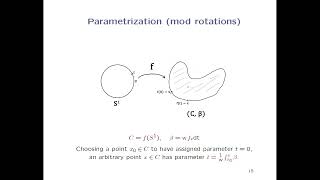
A Discrete Version for Vortex Loops in 2D Fluids
Explore a discrete model for vortex loops in two-dimensional fluid dynamics, examining mathematical concepts and computational applications.
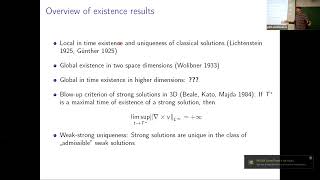
Conserved Quantities and Regularity in Fluid Mechanics
Explore conserved quantities and regularity in fluid mechanics, gaining insights into fundamental principles and advanced concepts in this field.
Hamiltonian Geometry of Fluids
Explore Hamiltonian geometry of fluids, covering Arnold's group-theoretic approach, compressible fluids, optimal mass transport, and Newton's equations on diffeomorphism groups and probability densities.
On the Motion of Water Waves with Angled Crests
Explore recent findings on 2D water wave dynamics with angled crests, delving into their unique motion and characteristics.
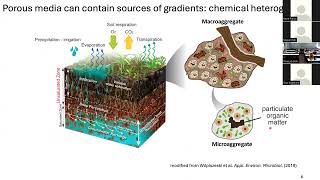
Microbial Behavior in Porous Media: Hydrodynamics Control on Bacterial Chemotaxis and Biofilm Morphogenesis
Explore microbial behavior in porous media, focusing on bacterial chemotaxis and biofilm formation. Discover how fluid flow and chemical landscapes impact microbial life and applications in bioremediation and biomineralization.
Odd Fluids - Mathematical Analysis of Non-Standard Fluid Dynamics
Explore odd fluids and their mathematical properties in this conference talk by Francesco Fanelli at CIRM's MathFlows meeting.
Large Deviations of Time-Integrated Quantities in Active and Passive Matter
Explore large deviations in particle movement models, analyzing entropy production and dynamical activity. Discover various phase transitions and their implications for rate function scaling.
A Large Deviation Perspective on Nanoscale Transport Phenomena
Explore nanoscale transport phenomena through large deviation theory, examining current fluctuations in nonequilibrium states and their relation to nonlinear responses in complex systems.