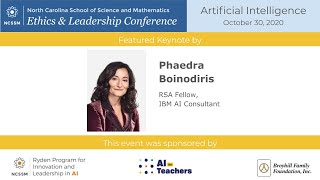
Ethics and Leadership in AI: Addressing Bias and Shaping the Future - 2020 NCSSM Conference Keynote
Explore AI ethics, bias, and societal impact with tech leader Phaedra Boinodiris. Gain insights on data privacy, future skills, and the role of education in shaping ethical AI development and implementation.
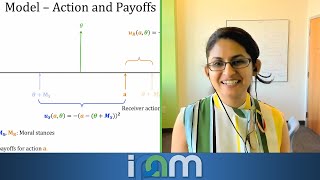
Learning and Persuading with Anecdotes - IPAM at UCLA
Explore learning and communication dynamics using anecdotal evidence, examining strategic behaviors, biases, and implications for opinion formation and collective intelligence.
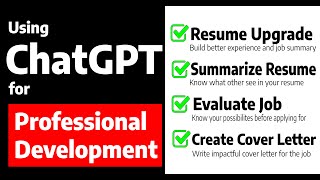
How ChatGPT Can Improve Your Career and Professional Prospects and Land a New Job
Leverage ChatGPT to enhance your resume, explore career options, evaluate job prospects, and craft compelling cover letters for improved professional opportunities.
Deep Learning with Neural Networks and TensorFlow Introduction
Introduction to deep learning with neural networks, covering theory, models, optimization, and TensorFlow. Explore biologically-inspired machine learning techniques and their evolution in the field of artificial intelligence.
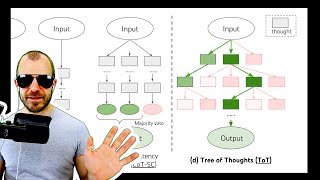
Tree of Thoughts - Deliberate Problem Solving with Large Language Models
Explores Tree-of-Thoughts prompting, enhancing language models' problem-solving abilities through strategic exploration, evaluation, and backtracking across multiple reasoning paths.
GPT-3 Tutorial: Building Projects for Email Writing and Ad Slogan Generation
Hands-on tutorial exploring GPT-3's capabilities through practical projects, including LaTeX translation, email composition, and ad slogan generation. Covers API setup, model parameters, and unexpected results.
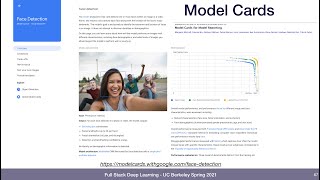
Ethics - Full Stack Deep Learning - Spring 2021
Explore AI ethics, covering long-term challenges, hiring practices, fairness, representation, and best practices. Gain insights into crucial ethical considerations for AI development and implementation.
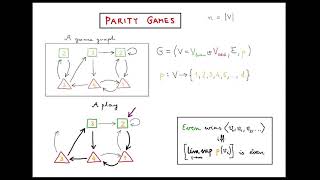
Games: From Logic and Automata to Algorithms
Explore the intersection of logic, automata, and algorithms through game theory, focusing on theoretical foundations and computational applications.
AI and Shared Prosperity
Exploring AI's role in promoting shared prosperity, addressing sociotechnical challenges, and fostering equality in technology benefits and risks across society.
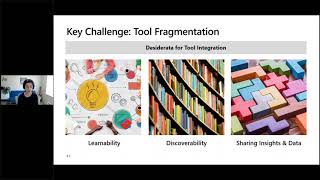
Responsible AI Dashboard - A Tool for Operationalizing Responsible AI
Explore Microsoft's Responsible AI Dashboard, an open-source framework integrating tools for error analysis, interpretability, fairness, and causal decision-making to build reliable and responsible AI products.
Boundary Conditions for Language in Biological and Artificial Neural Systems
Explore computational requirements for language processing in neural systems, focusing on hierarchical structures, neural oscillations, and integrating linguistic insights with neural computation principles.
Money, Circuits, Mythic Figures, and More - Theory in the Allen School
Diverse theoretical computer science research: algorithms, data structures, complexity, combinatorics, and economics. Insights from UW Allen School's theory group on cutting-edge topics.
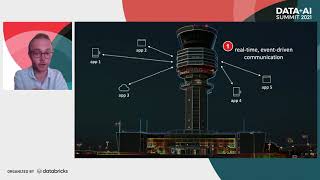
Building the Foundations of an Intelligent, Event-Driven Data Platform at EFSA
Designing an intelligent, event-driven data platform for EFSA's digital transformation, enhancing transparency in food safety risk assessment through Azure and Databricks technologies.
Great Ideas in Theoretical Computer Science: Deductive Systems
Explore deductive systems in theoretical computer science, covering topics like Hilbert's 10th problem, binary trees, propositional logic, and logical equivalence.
SIG Contributor Experience Deep Dive - Kubernetes Community Programs and Participation
Explore Kubernetes Contributor Experience SIG's programs for developing a healthy community, including mentoring, infrastructure, events, and more. Learn how to get involved and contribute to the project.
Spicing up Container Image Security with SLSA and GUAC
Explore SLSA and GUAC tools to enhance container image security, verify build provenance, and understand artifact composition for safer deployments in production environments.
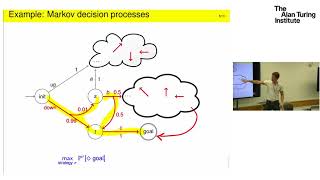
Fast Learning of Small Strategies - Jan Křetínský, Technical University of Munich
Discover fast learning techniques for small strategies in Markov decision processes, combining verification precision with machine learning scalability for ε-optimal strategies and concise representation.

AI - Where Science Meets Science Fiction
Exploring the intersection of AI and sci-fi, examining real-world tech advancements, societal implications, and ethical considerations through expert perspectives on robotics, data, and futurism.
Alan Turing and the Other Theory of Computing and Can a Machine Be Conscious?
Explore neuroscience advances in understanding consciousness, including the Global Workspace Model and its computational implications, with insights on free will and determinism.
Can Machines Think Like Humans? - Dr Mateja Jamnik
Explore the fascinating question of machine cognition and its comparison to human thought processes in this engaging seminar by Dr Mateja Jamnik from the Alan Turing Institute.
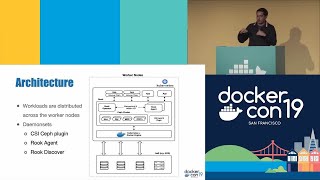
Kubernetes Updates: Container Storage Interface, Windows Support, and Stateful Applications
Explore Kubernetes updates, including CSI, Windows support, and Istio as an Ingress Controller. Learn about stateful applications with Rook and participate in a community discussion.