
Intercolonial Relations in Pre-Revolutionary America - Lecture 4
Explore intercolonial relations in pre-Revolutionary America, examining regional differences, early attempts at unity, and the challenges of localism in shaping colonial cooperation and conflict.
Syphilis: From the "Great Pox" to the Modern Version - Epidemics in Western Society
Explore syphilis' history, origins, symptoms, and societal impact from the 16th century to modern times. Delve into debates surrounding its emergence and spread across Europe.

The Sanitary Movement and the 'Filth Theory of Disease' - Epidemics in Western Society Since 1600
Explore the 19th-century sanitary movement's impact on public health, urban planning, and social reform, focusing on key figures and cities that shaped modern approaches to disease prevention.

Plague Responses and Public Health Measures in Western Society - Lecture 4
Explores community responses to bubonic plague, from panic and persecution to religious revivals and the emergence of public health programs, examining their effectiveness in combating the pandemic.

Evolution of Pesticide Regulation in the United States - Lecture 9
Explore the evolution of pesticide regulation in the US, from early food laws to modern risk assessment, reflecting changes in scientific understanding and societal values over time.
Terrible Swift Sword: The Period of Confederate Ascendency, 1861-1862 - Civil War and Reconstruction
Explore the early Civil War: expectations, advantages, and the Battle of Bull Run. Gain insights into military strategies and the conflict's initial phase.
Andrew Johnson and the Radicals - A Contest over the Meaning of Reconstruction
Explore the complex debates and legislation shaping post-Civil War Reconstruction, including Lincoln's Ten-Percent Plan, the Wade-Davis Bill, and the 13th Amendment's impact on American society.
Introductions - Why Does the Civil War Era Have a Hold on American History?
Explore the enduring fascination with the Civil War era, its impact on American history, and its relevance to modern society in this thought-provoking lecture.
Constitutional Crisis and Impeachment of a President - The Civil War and Reconstruction - Lecture 22
Explore the political dynamics of Reconstruction, focusing on President Johnson's policies, Congressional opposition, and the passage of pivotal amendments and acts shaping post-Civil War America.
Slavery and State Rights - What Caused the Civil War?
Explores five theories on Southern secession, including slavery preservation and fear, and examines how historians have interpreted the Civil War's causes, from Rhodes to the Beards' economic perspective.
Black Reconstruction in the South - The Freedpeople and the Economics of Land and Labor
Explore the pivotal events of 1868 in American Reconstruction, including the Reconstruction Acts, Johnson's impeachment, Grant's election, and the struggles of freed African Americans amid political upheaval and violence.
Lincoln, Leadership, and Race - Emancipation as Policy
Explore Lincoln's evolving views on slavery, the Battle of Antietam's impact, and the Emancipation Proclamation's significance in shaping the Civil War's meaning and outcome.

Introduction to John Milton: Man, Poet, and Legend - Lecture 1
Explore John Milton's literary influence, examining his power as a poet and its impact on feminist writers, while analyzing the construction of divine might in Paradise Lost.
Paradise Lost: The Fall and Its Consequences - Books IX-X
Explore Milton's "Paradise Lost" Books IX-X, focusing on the Fall's impact on language, wandering, and gender dynamics. Gain insights into Milton's motivations and the poem's literary context.
Paradise Lost, Book I - Analysis and Context
Explore Milton's Paradise Lost Book I: radical poetics, monism, and theological insights. Analyze the invocation, historical context, and unique literary techniques in this epic poem.

Blood Meridian by Cormac McCarthy - Literary Influences and Historical Context - Lecture 1
Explore Blood Meridian's literary influences and historical context, examining how McCarthy engages with tradition, questions origins, and pushes narrative boundaries in this provocative meditation on American history.
The American Novel Since 1945 - Final Exam Review
Comprehensive review session for American Novel Since 1945 final exam, covering question types, passage identification, essay construction, and addressing student queries.
The American Novel Since 1945 - Marilynne Robinson's Housekeeping and Student Novel Pitches - Lecture 16
Explore student pitches for contemporary American novels and delve into the theme of loss in Marilynne Robinson's Housekeeping, examining its "anorexic aesthetic" and feminist implications.
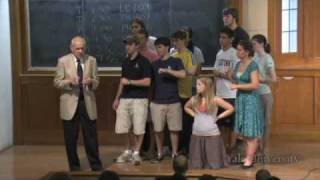
The Greek Renaissance - Colonization and Tyranny - Hoplite Warfare and the Phalanx
Explore ancient Greek warfare, focusing on the hoplite phalanx. Learn about soldier equipment, fighting techniques, and the phalanx's impact on Greek society and military strategy.
Game Theory: Understanding Others' Perspectives and Strategic Decision-Making - Lecture 2
Explore game theory concepts like dominant strategies, rationality, and common knowledge through real-world examples. Gain insights into strategic decision-making and player interactions.
Mixed Strategies in Game Theory - Applications in Sports, Dating, and Taxation
Explore mixed strategies in game theory through real-world examples like sports, dating, and taxes. Learn three interpretations and their implications for decision-making and policy applications.