Toward a Formal Model of Free Will
Explores a formal model of perceived free will using statistical emergence, offering concrete measures for analyzing choice ensembles and free will.
Structure Invention by Conscious Agents
Explore consciousness as fundamental and the physical world as emergent. Learn about Interface Theory of Perception, Conscious Realism, and evolutionary game theory in this thought-provoking talk.
On the Mathematical Basis of Models of Consciousness
Explore the mathematical foundations of consciousness models, examining structures to describe experience and developing a systematic framework based on philosophical concepts.
Talking Space - Inference from Spatial Linguistic Meanings
Explore how physical space and language interact to create meaning, using formal mechanisms to model spatial-linguistic relationships and draw inferences from our embodied experiences.
The Strange Loops Inside Our Brains
Explore the intriguing connection between Gödel's Incompleteness Theorem and consciousness, critically examining Hofstadter's analogies and their implications for understanding the mind-body problem.
Larissa Albantakis – Why a Little Bit of Causal Structure Is Necessary... Even for Functionalists
Explores why causal structure is essential for theories of consciousness, using thought experiments to argue that functionalist accounts lacking causal analysis are inadequate for identifying conscious individuals.
No Substitute for Functionalism
Explores types of variations in consciousness models, proving broad functionalist theories immune to substitution arguments. Discusses implications for consciousness science and functionalism.
A Vector Model of How Consciousness as Integrated Information Makes a Causal Difference
Explore a vector model of consciousness based on Integrated Information Theory, examining how phenomenal experiences can exert causal influence on physical substrates.
Towards a Category-Theoretic Framework for Phenomenal Holism
Exploring phenomenal holism through category theory, examining color experiences across the visual field and addressing theoretical concerns about inverted qualia and experience-substrate relationships.
Automata-Theoretic Approach to Modelling Consciousness Within Mental Monism
Automata-theoretic approach to modeling consciousness in mental monism, exploring constraints and implications for substrate-free models of the mind's structure and dynamics.
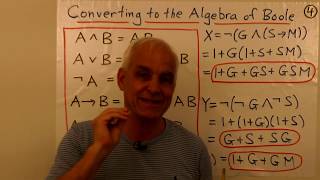
The Holy Grail of Propositional Logic - MathFoundations - N J Wildberger
Explore mechanized reasoning in propositional logic through Boole's Algebra, featuring two solutions to a Sir Galahad puzzle: Boole Reduction and Boole-Mobius transform.
The Silver Crash and Long Depression of 1873 - Wild West Banking
Explores the global financial crash of 1873-1879, its causes, and long-lasting effects. Examines historical parallels to modern economic challenges and discusses the impact on banking practices.
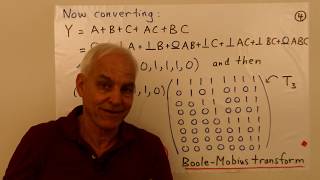
A Systematic Approach to Logical Deduction and the Boole-Mobius Transform II - N J Wildberger
Explore the Boole-Mobius transform as an alternative method for validating propositional logic implications, linking Boolean functions and Boole polynumbers through practical examples.
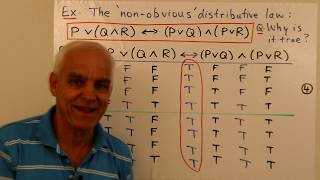
Replacing Truth Tables and Boolean Equivalences - N J Wildberger
Explore the Algebra of Boole as a mathematical framework for propositional logic, replacing truth tables with simpler computations using 0's and 1's to verify logical statements.
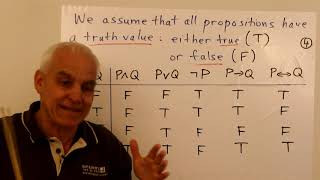
Propositional Logic and the Algebra of Boole - N J Wildberger
Overview of propositional logic, exploring atomic statements, connectives, truth values, and techniques for analysis. Covers tautologies, contradictions, truth tables, and equivalences, with a focus on Boole's algebraic approach.
Turing Award Recipient Dana S. Scott - Reflections on Logic and Computer Science - Part 4
Explore Dana S Scott's contributions to computer science, including his work on LCF, Scott Domains, and Category Theory Type Theory, in this insightful interview segment.
Pattern & Texture
Explore visual elements in art through illuminated manuscripts, marble, frottage, and trompe l'oeil techniques. Discover pattern types and their impact on artistic expression.
Roman Art
Explore the rich legacy of Roman art, from Augustus to Constantine, covering architecture, sculpture, and painting across key historical periods.
Scale, Repetition, and Unity
Explore scale, repetition, and unity in art through famous works, analyzing techniques used by renowned artists to create visual impact and meaning.

Pablo Picasso
Explore Picasso's life, artistic evolution, and influential works, from early drawings to Cubism, examining his relationships, patrons, and historical context.
Sculpture
Explore diverse sculptural techniques, from ancient to contemporary, covering subtractive and additive processes, relief types, and environmental installations.