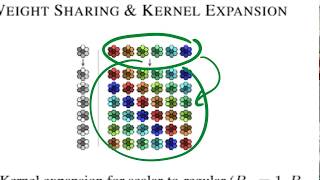
Gauge Equivariant Convolutional Networks and the Icosahedral CNN
Explore gauge equivariant CNNs on manifolds, focusing on icosahedral surfaces. Learn how this approach improves image segmentation and climate pattern analysis with enhanced efficiency and performance.
Teaching Contemporary Math - Modeling Cancer Treatment
Explore innovative approaches to teaching math through real-world applications in cancer treatment, data modeling, and error analysis with Helen Moore.
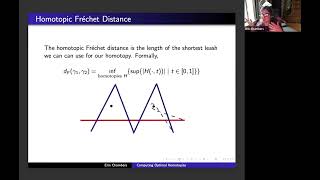
Computing Optimal Homotopies
Explore optimal curve similarity measures using homotopy-based approaches, examining structural properties, algorithms, and open questions in topology and computational geometry.
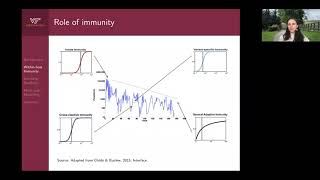
Modelling Immunity to Malaria
Explore mathematical models of malaria immunity, examining within-host dynamics, antigenic variation, and population-level impacts to enhance understanding and control strategies.
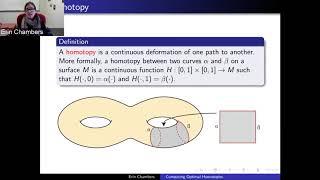
Computing Optimal Homotopies
Explore curve similarity measures and homotopy-based deformations in GIS, medical imaging, and graphics. Survey geometric and topological metrics, algorithms, and open questions in optimal homotopy computation.
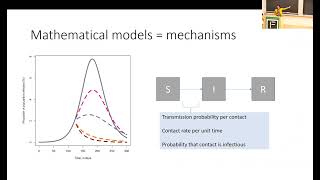
Mathematical Modeling of Epidemics - Are We Confronting or Amplifying Health Inequities?
Explores how mathematical models of epidemics impact public health decisions and their potential to address or exacerbate health inequities, using examples from HIV, COVID-19, and mpox.
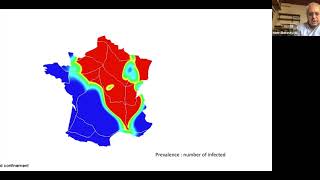
Mathematics for Public Health - Inaugural Lecture by Henri Berestycki
Exploring diffusion in epidemiology models, including SIR equations and reaction-diffusion systems, with applications to COVID-19 spread and the impact of individual behaviors on epidemic dynamics.
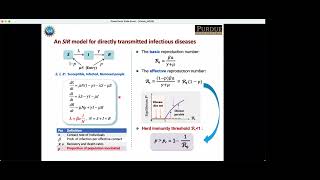
Mathematical Models of Infectious Diseases - Consequences of Underlying Assumption
Explore the impact of underlying assumptions in mathematical models of infectious diseases, examining their consequences for disease dynamics and control strategies.
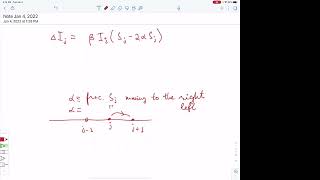
Modelling of Disease Spread Through Heterogeneous Population
Explore spatial variability in disease spread using PDEs with state-dependent diffusion. Examine density-dependent infection rates and super-diffusive propagation, with a case study on coronavirus in Nova Scotia.
Investigating Transmission-Blocking Anti-malarial Drugs: A Mathematical Modelling Approach
Explore mathematical models assessing transmission-blocking antimalarial drugs' impact on disease control, focusing on treatment coverage, drug efficacy, and protective effects in malaria hotspots.
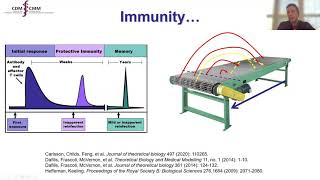
Modelling Immunity
Explore mathematical models of immunity generation and waning, fitted to data for estimating seroprevalence in Canadian jurisdictions, with applications to COVID-19 vaccination programs.
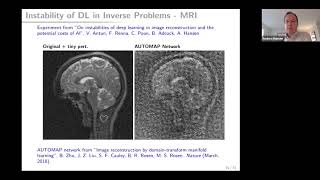
Foundations of Deep Learning and AI: Instabilities, Limitations, and Potential
Exploring deep learning's instability, AI limitations, and potential impacts on scientific computing and medical imaging. Compares AI's current state to early 20th-century mathematics, predicting similar foundational challenges.
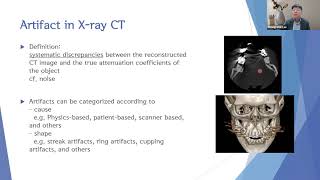
Artifact Suppression in X-ray CT Images - SIAM-IS Virtual Seminar
Explore X-ray CT imaging, artifact suppression techniques, and recent advancements in metal and scattering artifact reduction for improved medical and industrial applications.
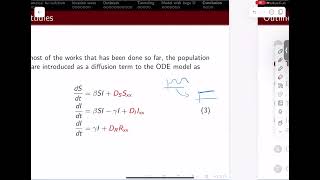
Modelling of Spatial Infection Spread Through Heterogeneous Population
Explore spatial infection spread modeling in heterogeneous populations, examining key factors and methodologies for understanding disease transmission dynamics.
The Calderon Problem: 40 Years Later - Seminar in the Analysis and Methods of PDE
Explore Calderon's inverse problem, its applications in medical imaging and geophysics, recent developments, and open questions with expert Gunther Uhlmann in this insightful seminar.
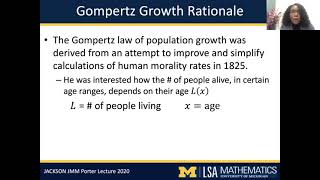
Turning Cancer Discoveries into Effective Treatments with Mathematical Modeling
Explore how mathematical modeling aids in transforming cancer research into effective treatments, bridging the gap between scientific discoveries and clinical applications.

Oxford Mathematician Explains SIR Travelling Wave Disease Model for COVID-19
Explore the SIR Travelling Wave model for disease spread, focusing on COVID-19. Learn how population movement affects epidemic dynamics, including spread speed and severity, and the importance of social distancing measures.

Oxford Mathematician Explains SIR Disease Model for COVID-19
Explore the SIR disease model's application to COVID-19, covering its derivation, spread prediction, peak infection, and total cases. Learn how social distancing impacts these factors.
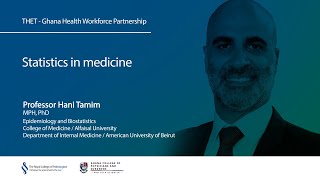
Statistics in Medicine - Introduction to Clinical Research Analysis
Explore key statistical concepts in clinical research, including descriptive and inferential statistics, confidence intervals, p-values, and various statistical tests used in medical studies.
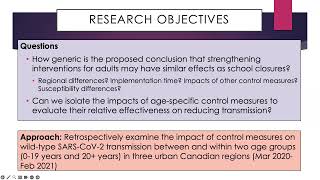
Retrospective Modelling Analysis on the Effects of Control Measures on COVID Transmission in Canada
Explore the impact of COVID-19 control measures in Canada through retrospective modeling analysis, examining transmission patterns and effectiveness of interventions.
Understanding Tumour Responses to Radiotherapy Using Mathematical Models - Lecture 2
Explores mathematical modeling of tumor responses to radiotherapy, focusing on theoretical approaches to understand and predict treatment outcomes in cancer progression.