Pathogen Evolution in the Context of Host and Environmental Adaptation
Explore pathogen evolution, host adaptation, and environmental factors shaping disease dynamics. Gain insights into emerging infectious diseases and their ecological impacts.
Host Traits and Pathogen Prevalence
Explore host traits influencing pathogen prevalence in animal populations. Learn about disease ecology, ecological processes, and their impact on disease dynamics and ecosystems.
Models to Understand Drivers of Pathogen Prevalence
Explore mathematical models to analyze factors influencing pathogen prevalence in populations, enhancing understanding of disease dynamics and ecological impacts.
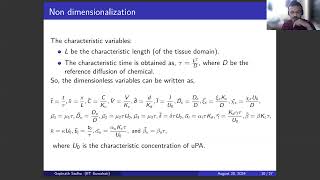
Exploring the Effects of Heat Therapy-Driven Inosine Generation on Tumor Recurrence
Investigates heat therapy's impact on inosine production and its potential influence on tumor recurrence, offering insights into innovative cancer treatment approaches.

Research Directions: Is There an Ideal One Health Curriculum?
Explore the concept of One Health and its role in addressing global challenges through a discussion on curriculum development for optimal practitioners in this field.
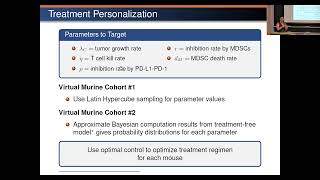
Optimal Control of Combination Immunotherapy for a Virtual Murine Cohort in a Glioblastoma-Immune Dynamics Model
Explore optimal control strategies for combination immunotherapy in glioblastoma treatment using mathematical modeling and virtual murine cohorts.
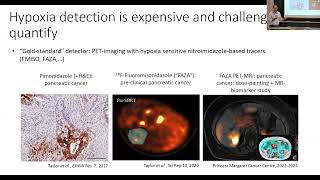
Integrating a Model of Tumor Energy Transport and Consumption with Routine Clinical Imaging
Explore tumor energy dynamics through mathematical modeling, integrating clinical imaging for enhanced cancer treatment insights.
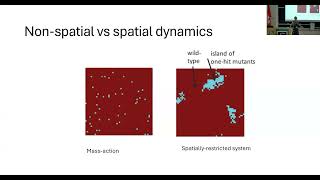
From Cell Evolution to Cancer Epidemiology: The Role of Aspirin in Colorectal Cancer Prevention - Lecture 2
Explore the role of aspirin in colorectal cancer prevention through mathematical modeling of cell evolution and cancer epidemiology.
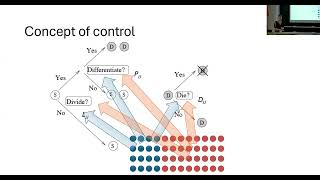
Stem Cells, Tissue Architecture, and Cancer Evolution - Lecture 1
Explore stem cells, tissue architecture, and cancer evolution in the hematopoietic system through mathematical modeling and applications.
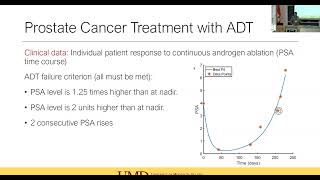
Leveraging Macroscopic Preclinical Data to Simulate Trials on Truly Heterogeneous Populations
Explore macroscopic preclinical data simulation for heterogeneous population trials in cancer treatment research and optimization.
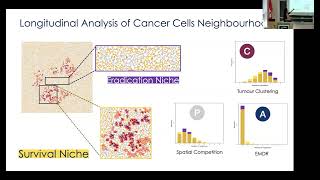
A Modelling-Informed Picture of Residual Disease in Environmentally Mediated Drug Resistance
Explore environmentally mediated drug resistance in cancer through mathematical modeling, focusing on residual disease and its implications for treatment strategies.
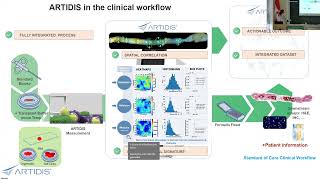
Probing Spatial Patterns in Breast Cancer via Affinity Matrices
Explore spatial patterns in breast cancer using affinity matrices, uncovering insights into tumor structure and progression.
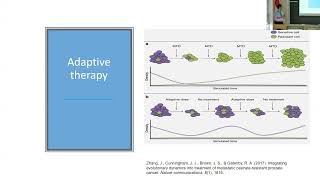
Incorporating Drug Toxicity into Models of Adaptive Therapy
Explore adaptive therapy models integrating drug toxicity, enhancing cancer treatment strategies and optimizing patient outcomes.
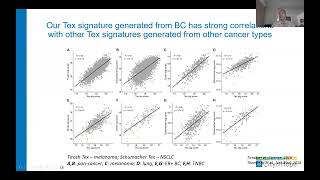
What Makes Tumors Hot? Insights from Experimental-Computational Integration
Explore experimental-computational integration to understand tumor characteristics and their impact on treatment effectiveness.
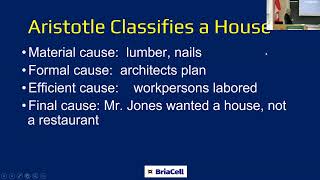
Determining Causation in Immunotherapy
Explore methods for determining causation in immunotherapy, focusing on analytical techniques and challenges in evaluating treatment effectiveness.
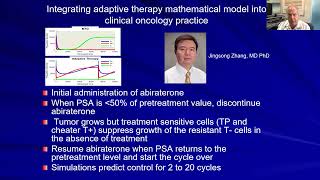
Mathematically Guided Clinical Trials for Metastatic Cancer Treatment - Integrating Evolutionary Dynamics
Explore evolutionary dynamics in cancer treatments through mathematical modeling for optimized clinical trials and metastatic cancer control.
Phase I Study of a Novel Glioblastoma Radiation Therapy Schedule Exploiting Cell-State Plasticity
Explore a novel radiation therapy approach for glioblastoma, leveraging cell-state plasticity to enhance treatment efficacy and patient outcomes.
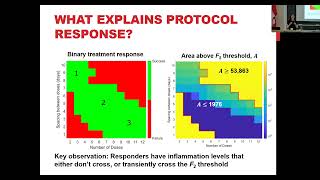
Phase I Study of a Novel Glioblastoma Radiation Therapy Schedule Exploiting Cell-State Plasticity
Explore innovative glioblastoma radiation therapy schedules leveraging cell-state plasticity in this cutting-edge Phase I study presentation.
A Mathematical Model of TCR-T Cell Therapy for Cervical Cancer
Explore a mathematical model for TCR-T cell therapy in cervical cancer treatment, focusing on its applications and implications in oncology research.
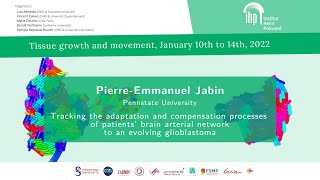
Tracking the Adaptation and Compensation Processes of Patient's Brain Arterial Network to Evolving Glioblastoma
Explore automated methods for analyzing brain arterial networks and blood flow dynamics in glioblastoma patients using MR imaging, revealing disease progression and compensatory mechanisms.
Tree-Free Phylodynamic Inference for Emerging Viral Pathogens and Lineages
Explore tree-free phylodynamic methods for analyzing emerging viral pathogens and lineages, focusing on innovative approaches to study viral evolution and spread.