Looking Back and Ahead in a Spiral
Explore the cyclical nature of scientific progress with Stéphane Mallat's insightful analysis of past discoveries and future directions in mathematics and physics.
On the Fourier Weight of F2 Polynomials
Explore Fourier weight of F2 polynomials, focusing on level k and degree d relationships. Gain insights into pseudorandom generators and recent mathematical proofs.
Sharp Restriction Theory - Part 1
Explore advanced concepts in sharp restriction theory, focusing on key principles and applications in mathematical analysis.
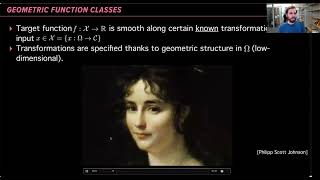
On the Role of Data Structure in High-Dimensional Learning
Explores high-dimensional learning challenges, focusing on geometric function classes, optimization aspects, and computational hardness. Discusses algorithmic approaches and implications for deep learning.
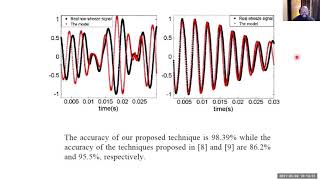
Quasiperiodicity and Persistent Kunneth Theorems
Explore quasiperiodicity in signals, persistent homology, and Kunneth theorems. Learn applications in time series analysis and computational chemistry through topological data analysis.
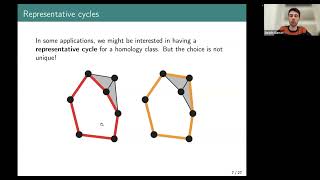
Harmonic Persistent Homology for Disentangling Multiway Interaction in Data
Explore Harmonic Persistent Homology for analyzing multi-omics data, uncovering hidden patterns in complex diseases, and identifying biomarkers associated with latent biological pathways.
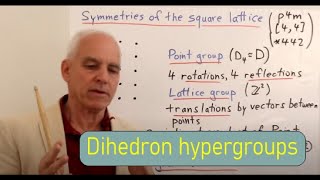
The Square Lattice via Group D4 and Its Hypergroups - Diffusion Symmetry
Explore hypergroups and their connection to symmetry in the square lattice, focusing on the D4 group and its character table. Learn about orthogonality relations in hypergroup character tables.
Carlos Pérez- Fractional Poincaré Inequalities for Doubling and Non-Doubling Weights
Explore fractional Poincaré-Sobolev inequalities using Harmonic Analysis, unifying and improving known results for doubling and non-doubling weights in mathematical analysis.
Harmonic Analysis Techniques for -Almost- Minimizers
Explore harmonic analysis techniques for (almost-)minimizers, focusing on free boundary theory and calculus of variations. Learn about applications to geometric measure theory and domain geometry.
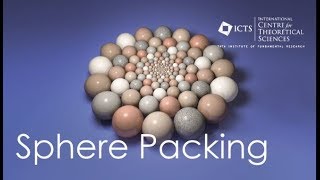
Modular Forms by Mahesh Kakde
Comprehensive exploration of modular forms, covering definitions, properties, and applications. Delves into Eisenstein series, theta functions, and related mathematical concepts for advanced learners in number theory.
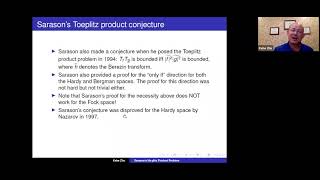
Sarason's Ha-plitz Product Problem
Explore Sarason's Ha-plitz product problem, its implications in analytic function spaces, and recent developments in this challenging mathematical area.

Data-Driven Discovery of Linear Dynamical Systems Over Graphs via Dynamical Sampling
Explore linear dynamical systems on graphs through data-driven discovery, focusing on efficient recovery of missing information and optimal sampling strategies for graph signal processing.
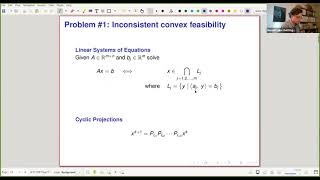
Structured -In-Feasibility- Nonmonotone Operator Splitting in Nonlinear Spaces
Explore nonmonotone operator splitting in nonlinear spaces, covering optimization theory, convergence, and applications in harmonic analysis with Professor Russell Luke.
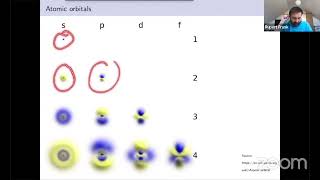
Lieb-Thirring Inequalities: What We Know and What We Want to Know
Explore Lieb-Thirring inequalities, their applications in mathematical physics, PDEs, and functional analysis, and recent developments in harmonic analysis with orthonormal functions.
Jonathan Hickman- On Littlewood-Paley Theory for Space Curves
Explore Littlewood-Paley inequalities for functions with Fourier transforms near submanifolds, focusing on space curves and applications in harmonic analysis, PDE, and number theory.
Some Sharp Strichartz Inequalities
Explore sharp Strichartz inequalities for Schrödinger equations, focusing on planar power curves and extremizers. Gain insights into concentration-compactness and fourth-order equations in one dimension.
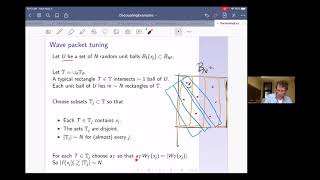
Sharp Examples for Decoupling and Related Questions
Explore open questions in decoupling, examining sharp examples and their connections to number theory and harmonic analysis. Gain insights into current challenges in the field.
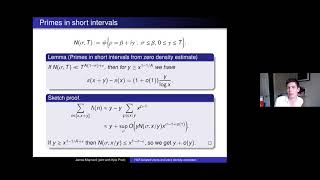
James Maynard: Half-Isolated Zeros and Zero-Density Estimates
Innovative method for detecting zeta function zeros, improving classical zero density results and providing insights into prime number distribution in short intervals.
Basic Notions Seminar on Fourier Optimization and Number Theory
Explore the intersection of harmonic analysis and analytic number theory, including problems related to the Riemann hypothesis, in this advanced mathematics seminar.
Automorphic Forms and Representation Theory - Introduction to the Langlands Program
Explore the Langlands Program, connecting automorphic forms and representation theory in advanced mathematics, with insights from James Arthur of the University of Toronto.
Automorphic Forms and Representation Theory - Introduction to the Langlands Program - Lecture 18
Explore the Langlands Program through automorphic forms and representation theory, delving into advanced mathematical concepts and their interconnections.