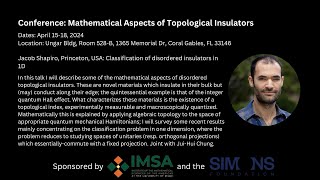
Classification of Disordered Insulators in One Dimension
Explore mathematical aspects of disordered topological insulators, focusing on 1D classification and the application of algebraic topology to quantum mechanical Hamiltonians.

Classification of Disordered Insulators in One Dimension
Explore mathematical aspects of disordered topological insulators, focusing on 1D classification and the application of algebraic topology to quantum mechanical Hamiltonians.
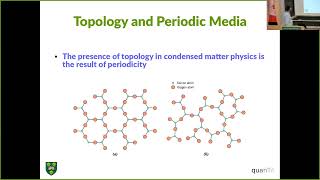
Quantum Matter, Hyperbolic Band Structures, and Moduli Spaces
Explore hyperbolic band structures in quantum matter and their connections to moduli spaces, delving into advanced concepts in mathematical physics and geometry.

Coalgebra Symmetry and Discrete Time Integrable Systems - Lecture 2023
Explore coalgebra symmetry and discrete time invariant systems through advanced mathematical concepts and their applications in physics and engineering.
Hamiltonian Systems and Dubrovin-Frobenius Manifolds - Lecture 2
Explore Hamiltonian systems and Dubrovin–Frobenius manifolds in this advanced mathematics lecture, part of the TRSalento 2022 school series.
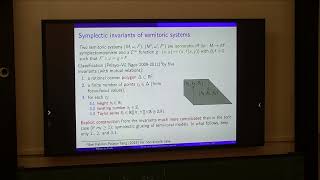
Families of Hyper-Semitoric Systems in Mathematical Physics
Explore finite dimensional integrability in mathematical physics, focusing on families of (hyper)semitoric systems. Gain insights from Y. Le Floch's research at IRMA.
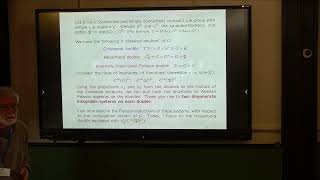
Poisson-Lie Analogues of Spin Sutherland Models
Explore finite dimensional integrability in mathematical physics, focusing on Poisson-Lie analogues of spin Sutherland models.
Computational Complexity of Quantum Systems - From Theory to Ground State Analysis
Delve into quantum systems' computational complexity, exploring ground states, quantum computing challenges, and algorithmic approaches for simulating quantum phenomena.
Quantum 2-SAT on Low Dimensional Systems is QMA_1-Complete
Delve into groundbreaking research exploring quantum satisfiability problems, examining complexity transitions in low-dimensional quantum systems and their computational implications for quantum information theory.
Local Random Quantum Circuits Form Approximate Designs
Delve into the mathematical foundations of random quantum circuits on arbitrary graphs, exploring how they form approximate unitary designs with polynomial-size circuits and bounded spectral gaps.
Hamiltonian Property Testing - Testing Locality and Structural Properties
Explore groundbreaking research in Hamiltonian property testing, examining efficient algorithms for quantum systems and the fundamental differences between testing and learning approaches.
An SU(2)-symmetric Semidefinite Programming Hierarchy for Quantum Max Cut
Explore advanced quantum physics through SU(2)-symmetric semidefinite programming hierarchies, focusing on Quantum Max Cut problem and its applications in approximating extremal energy states of local Hamiltonians.
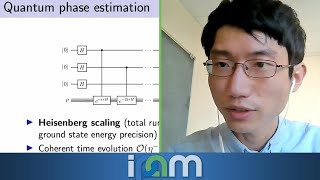
Heisenberg-Limited Ground State Energy Estimation for Early Fault-Tolerant Quantum Computers
Explore Heisenberg-limited ground state energy estimation for early fault-tolerant quantum computers, featuring a simplified circuit and classical post-processing for improved efficiency.
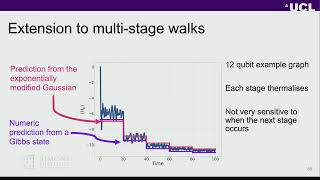
Continuous-Time Quantum Walks for MAX-CUT Optimization
Explore quantum walks for MAX-CUT optimization, linking Hamiltonians to thermalization. Discover novel insights into unitary dynamics for combinatorial problems using multi-stage walks and Floquet systems.
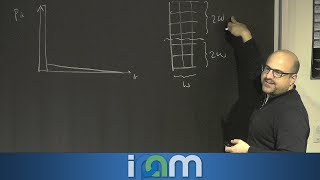
Tensor Networks and the Negative Sign Problem
Explore tensor networks and the negative sign problem in quantum systems, examining simulation challenges and correlation implications for systems with negative Hamiltonian entries.
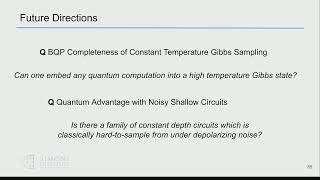
Quantum Computational Advantage With Constant-Temperature Gibbs Sampling
Explore quantum computational advantage through constant-temperature Gibbs sampling, examining thermalization processes and their implications for quantum systems and classical algorithms.
Qubit-Efficient Randomized Quantum Algorithms for Linear Algebra
Explore quantum algorithms for matrix sampling and linear algebra operations using minimal qubits, focusing on efficient methods without quantum data structures for practical quantum computing applications.
Optimizing Fermionic Encodings for Both Hamiltonian and Hardware
Discover a method for generating optimized fermionic encodings that map Majorana monomials to Pauli operators, tailored for specific target operators and hardware connectivity through systematic search algorithms.
Improved Approximations for Extremal Eigenvalues of Sparse Hamiltonians
Discover advanced approximation techniques for eigenvalues in sparse Hamiltonians, exploring new methods for quantum systems with q-local terms and improved mathematical approaches for k-sparse configurations.
Perturbative Quantum Simulation: Theory and Applications
Explore perturbative quantum simulation techniques that combine classical perturbation theory with quantum computing to solve large quantum problems using limited quantum hardware resources.
Classical Simulation of Short-Time Quantum Dynamics
Explore classical algorithms for simulating quantum dynamics, focusing on local observables and Loschmidt echo calculations in polynomial time for short-time quantum systems.