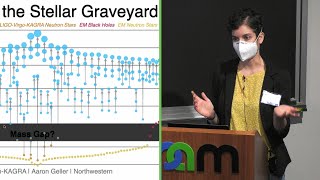
Black Hole Astrophysics With Gravitational-Wave Catalogs - IPAM at UCLA
Explore black hole astrophysics through gravitational-wave data, uncovering insights on mass distribution, spin, and redshift evolution. Learn about pair-instability mass gap and formation-to-merger time delays.
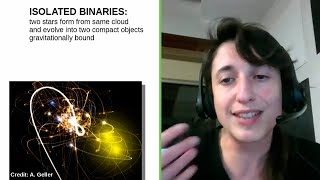
Astrophysical Models of Binary Compact Objects - IPAM at UCLA
Explore astrophysical models of binary compact objects, their formation, and implications for gravitational wave astronomy. Discuss key uncertainties and future challenges in the field.
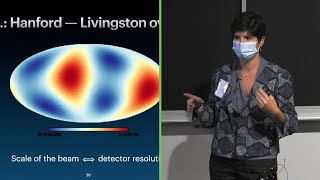
Stochastic Background Searches in GW Experiments - IPAM at UCLA
Explore stochastic gravitational wave backgrounds, their characteristics, detection methods, and future prospects in ground-based and space-borne observatories with insights from recent LVK collaboration searches.
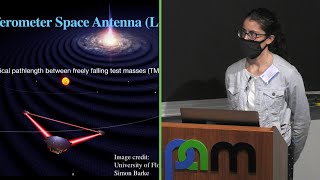
LISA and the Global Analysis of Galactic Binary Gravitational Wave Signals
Explore LISA's role in detecting galactic binary gravitational waves, including data analysis challenges, global fitting techniques, and future prospects for multi-source gravitational wave detection.
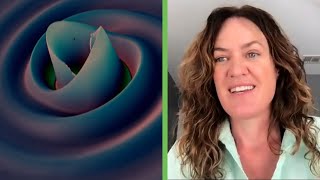
Numerical Relativity and the Next Generation of Gravitational Wave Detections
Explore numerical relativity's role in gravitational wave astronomy, its impact on understanding gravity, and future challenges as detectors improve. Insights into computational and data hurdles in this evolving field.
Introduction to Modelling Gravitational Waves from Compact Binaries
Explore gravitational wave modeling techniques for compact binary systems, covering inspiral, merger, and ringdown phases. Learn about semi-analytic models crucial for detection and analysis.
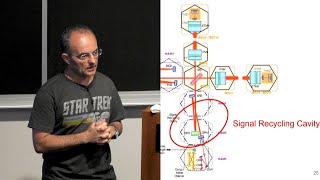
Characterization of Ground-Based Gravitational-Wave Detector Data - IPAM at UCLA
Explore techniques for distinguishing gravitational wave signals from noise in detector data, including traditional methods and innovative approaches to improve data quality and reduce search backgrounds.
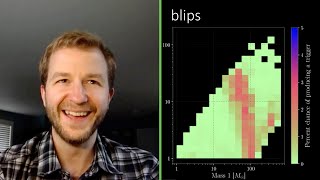
Nobody Likes a Glitch - IPAM at UCLA
Explore transient noise artifacts in gravitational wave astronomy, their impact on signal detection, and innovative approaches for understanding and mitigating these glitches in data analysis.
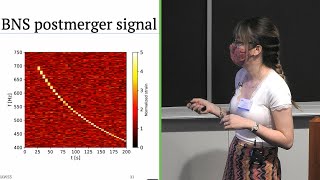
Power Spectral Density Uncertainty and Gravitational-Wave Parameter Estimation
Explore power spectral density uncertainty in gravitational-wave parameter estimation, its impact on Bayesian analysis, and methods to incorporate this uncertainty for more accurate results in compact binary coalescence detection.
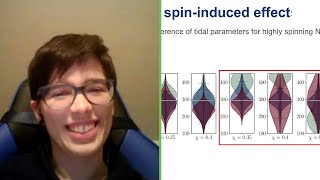
Waveform Systematics in the Gravitational-Wave Inference of Tidal Parameters
Exploración de sistemáticas en formas de onda para inferir parámetros de marea y ecuación de estado en señales de ondas gravitacionales de sistemas binarios de estrellas de neutrones.
Tides in Binary Star Systems - Lecture 1
Explore gravitational waves, tides in binary star systems, and multipole moments in this advanced lecture on theoretical astrophysics and gravitational-wave astronomy.
What Happens When Black Holes Collide - Expert Answers on Gravitational Waves
Explore the fascinating world of gravitational waves, black hole collisions, and the stretching of spacetime. Gain insights into cutting-edge physics research and its implications for our understanding of the universe.
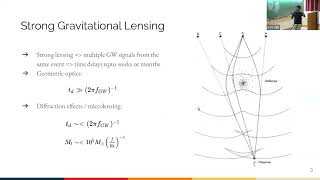
Micro-Lensing of Gravitational Wave Signals - Effect of the Galaxy Lens
Explore the intriguing effects of galaxy lensing on gravitational wave signals, delving into the phenomenon of micro-lensing and its implications for astrophysical observations.
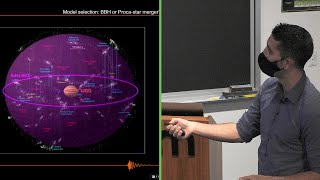
Challenge of Characterising High-Mass Compact Mergers - The Case of GW190521
Explores challenges in analyzing gravitational waves from massive binary mergers, focusing on GW190521. Discusses Bayesian inference, prior choices, and alternative interpretations like eccentric mergers or exotic objects.
Black Holes, Binary Systems, and Gravitational Waves - Extreme Mass-Ratio Inspirals - Lecture 2
Explore extreme mass-ratio inspirals in binary systems, focusing on black holes and gravitational waves. Learn about cutting-edge research in astrophysics and general relativity.
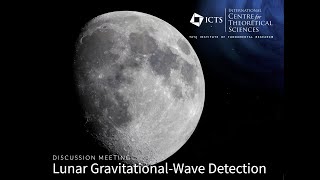
White Dwarf - Neutron Star Binaries and Their Gravitational Wave Signatures by Alexey Bobrick
Explore gravitational wave signatures of white dwarf-neutron star binaries, examining their unique characteristics and implications for astrophysics and gravitational wave detection.
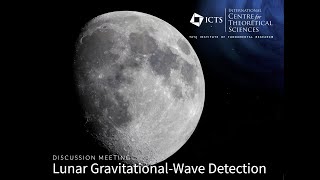
GW Signals from Tidal Disruption Events in the Decihertz Regime by Martina Toscani
Explore gravitational wave signals from tidal disruption events in the decihertz regime, focusing on lunar detection methods and their potential for breakthrough observations in astrophysics.
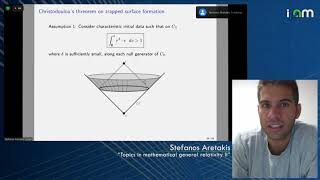
Topics in Mathematical General Relativity II - IPAM at UCLA
Explore black hole stability, linear wave equations, and Newman-Penrose constants in mathematical general relativity. Delve into extremal and subextremal cases, and examine key non-linear results in this field.
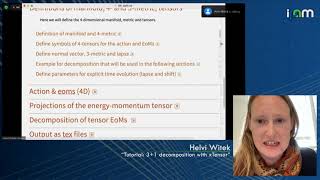
Tutorial: 3+1 Decomposition with xTensor - IPAM at UCLA
Learn to derive ADM-York equations for Einstein's equations using xTensor, an open-source tool for tensor algebra with Mathematica. Explore abstract tensor computations in gravitational wave astronomy.
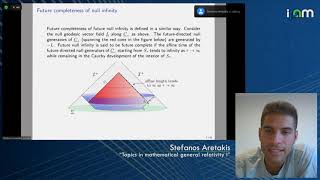
Topics in Mathematical General Relativity I
Explore key conjectures, problems, and methods in mathematical general relativity, including cosmic censorship, double null foliation, and short pulse method for studying trapped surfaces and Cauchy horizons.
Machine Learning for Gravitational Wave Astronomy - Concepts & Terminology
Explore machine learning concepts and terminology for gravitational wave data analysis, enhancing your understanding of this cutting-edge field in astronomy and physics.