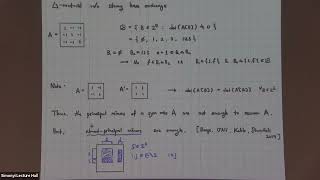
Baker-Bowler Theory for Lagrangian Grassmannians
Delve into advanced mathematical concepts exploring Baker-Bowler theory's extension to Lagrangian Grassmannians, covering matroid theory, symplectic vector spaces, and cryptomorphic definitions.
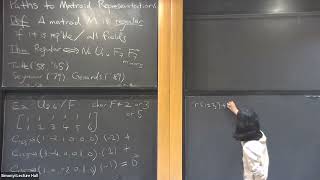
Paths to Matroid Representations
Delve into advanced matroid theory, exploring representation theorems, connectivity statements, and orthogonal matroids through historical developments and modern algebraic approaches.
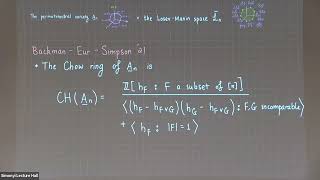
Multimatroids and Rational Curves with Cyclic Action
Explore the intersection of multimatroids and rational curves, discovering how these mathematical structures connect through combinatorial formulas and independence polytopal complexes in topological graph theory.
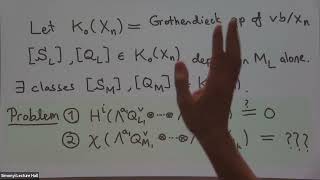
The External Activity Complex of a Pair of Matroids
Delve into advanced matroid theory, exploring external activity complexes and their relationship to Schubert varieties, with applications to tautological classes and Speyer's matroid invariant.
In-Context Learning Over Graphs for Large Language Models - PRODIGY Method
Explore PRODIGY, Stanford's innovative approach to graph machine learning that enables in-context learning for classification tasks on unseen graphs, advancing LLM reasoning capabilities.

Spectral Aspects of Symmetric Matrix Signings
Explore symmetric matrix signings, their spectral aspects, and applications in graph theory, polynomial identity testing, and algorithmic problems.
Sets, Logic and Graphs - Math Terminology - NJ Wildberger
Review of high school math language and notation for sets, logic, and basic graph theory. Covers key concepts like union, intersection, subsets, logical statements, and graph circuits, providing essential foundations for advanced mathematics.
Combinatorics - Math History - NJ Wildberger
Explore combinatorics through historical examples, counting problems, graph theory, and generating functions. Delve into partitions, Fibonacci numbers, Catalan sequence, and famous theorems in this engaging mathematical journey.
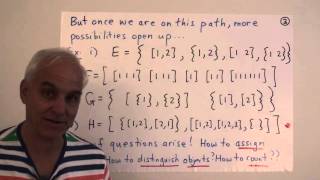
Higher Data Structures - Data Structures in Mathematics Math Foundations
Explore advanced mathematical data structures, including nested combinations of lists, ordered sets, multisets, and sets. Learn their applications in combinatorics, graph theory, and other mathematical fields.
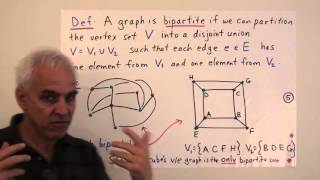
Canonical Structures Inside Platonic Solids II - Universal Hyperbolic Geometry
Explore symmetries and canonical structures within the cube, including 2-fold, 3-fold, and 4-fold symmetries. Gain insights into rigid motions and even/odd symmetries using graph theory concepts.
High-Dimensional Expanders - How I Learned to Stop Worrying and Love Group-Theoretic Constructions
Explore high-dimensional expanders, focusing on 2-dimensional cases, graphs of constant link, and group-theoretic constructions. Gain insights into advanced mathematical concepts and recent research developments.
Goemans-Williamson: Rounding the Max-Cut SDP - Lecture 20a of CS Theory Toolkit
Efficient algorithm for approximating maximum graph cuts using semidefinite programming and randomized rounding, with guaranteed performance ratio of 0.878.
Expander Graph Application 2: Derandomization - Lecture 16c of CS Theory Toolkit
Explore derandomization techniques using expander graphs to reduce error in randomized algorithms without significantly increasing random bits used.
Expander Graph Constructions - Lecture of CS Theory Toolkit
Explore explicit expander graph constructions, including Gabber-Galil, Ramanujan, and Zig-Zag product expanders. Learn about their properties, applications, and mathematical foundations in theoretical computer science.
Spectral Graph Theory - Eigenvalues at CMU - Lecture 15a of CS Theory Toolkit
Explore eigenvalues of the Laplacian and Markov operator in spectral graph theory, including associated formulas and their applications in theoretical computer science research.
Spectral Graph Theory - Minimizing/Maximizing the Quadratic Form
Explore spectral graph theory, focusing on minimizing and maximizing quadratic forms, with connections to graph components and bipartiteness in this graduate-level lecture.
Spectral Graph Theory - The Quadratic Form
Explores spectral graph theory, focusing on the quadratic form associated with undirected graphs. Covers basic setup and provides examples for graduate-level computer science research.
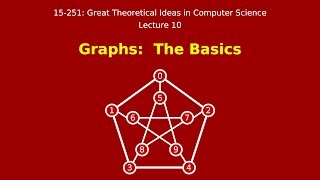
Great Ideas in Theoretical Computer Science - Graphs - The Basics
Explore fundamental concepts of graph theory, including definitions, basic questions, regular graphs, and perfect matching. Gain insights into connecting graphs and equivalence relations.
Finding Large Cliques in Random and Semi-Random Graphs
Explore algorithms for finding large cliques in graphs, including constructive arguments, polynomial-time proofs, and paradigms for tackling this NP-hard problem.
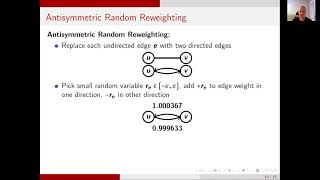
PODC 2021 - Restorable Shortest Path Tiebreaking for Edge-Faulty Graphs
Explore restorable shortest path tiebreaking in edge-faulty graphs, discussing lemmas, symmetry, consistency, and potential applications in network routing and fault tolerance.

Graph Theory and Fixed-Parameter Tractability
Explore fixed-parameter tractability in graph theory, focusing on counting patterns, galactic algorithms, and key concepts like minors and topological minors.