Introduction to Causal Graphical Models - Graphs, D-Separation, Do-Calculus
Explore causal graphical models, d-separation, and do-calculus. Learn about graphs, Bayesian networks, and instrumental variables for understanding causality in complex systems.
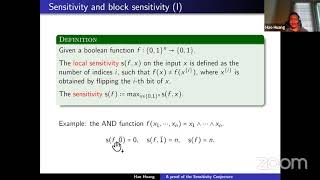
Sensitivity Conjecture and Its Applications
Explore sensitivity in Boolean functions, its relation to other complexity measures, and the recent proof of the long-standing Sensitivity Conjecture, with implications for theoretical computer science.
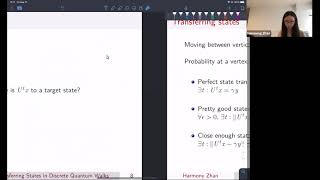
Transferring States in Discrete Quantum Walks
Explore discrete quantum walks, state transfer, and quantum walk search in graphs. Learn about coins, spectral correspondence, and applications in distance-regular graphs.
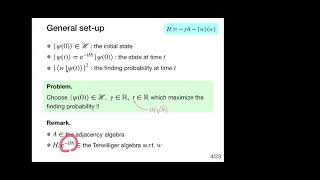
Spatial Search on Johnson Graphs by Continuous-Time Quantum Walk
Explore quantum walks on Johnson graphs for spatial search, covering setup, strategies, and analysis of search algorithms and success probabilities.
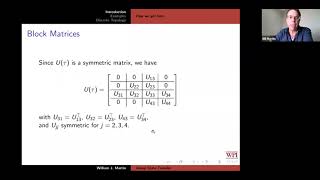
Quantum Walks on Graphs and Group State Transfer
Explore quantum walks, perfect state transfer, and group state transfer in graphs, focusing on algebraic structures and their applications in quantum information theory.
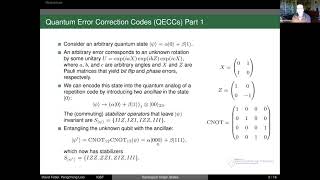
Topological Graph States
Explore topological graph states in quantum error correction, focusing on quantum graph states and their applications in error-correcting codes and topological systems.
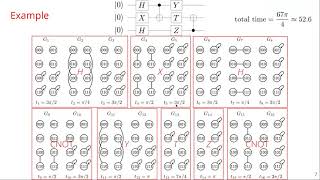
Simplifying Dynamic Quantum Walks for Quantum Gates
Explore simplification techniques for dynamic quantum walks in quantum gate implementation, focusing on Hadamard gates and cubic gates with practical examples and observations.
Finding Counterexamples to Conjectures via Reinforcement Learning - IPAM at UCLA
Explore reinforcement learning techniques to find counterexamples in graph theory and combinatorics, resolving open problems and improving existing solutions.
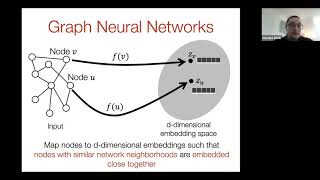
Graph Representation Learning and Its Applications to Biomedicine
Graph representation learning techniques for biomedical applications, focusing on SubGNN for disentangled subgraph embeddings and their use in predicting disease treatments and safe drug combinations.
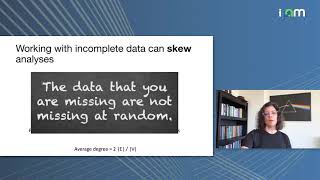
Task-Driven Network Discovery via Deep Reinforcement Learning on Embedded Spaces
Explore task-driven network discovery using deep reinforcement learning on embedded spaces. Learn about improving network observability and optimizing data collection for accurate analysis.
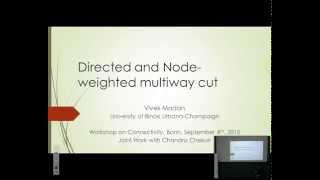
Simple and Fast Rounding Algorithms for Directed and Node Weighted Multiway Cut
Explore efficient algorithms for directed and node-weighted multiway cut problems, focusing on simple rounding techniques and integrality gap analysis in graph theory and combinatorial optimization.
Pseudorandomness
Explorations in pseudorandomness: SoS lower bounds, block rigidity, unbounded-width permutation branching programs, computational entropies, and random projections in circuit complexity.
Berkeley in the 80s - Richard Karp and the Theory of Computing
In-depth interview with Turing Laureate Richard Karp, exploring his groundbreaking research on computational theory at Berkeley in the 1980s and its lasting impact on computer science.
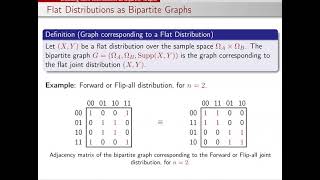
ITC Conference: P4-Free Partition and Cover Numbers & Applications
Explore P4-free partition and cover numbers in graph theory, their applications in cryptography, and connections to communication complexity and randomness extraction.
Theory Seminar - On Linear Data Structures and Matrix Rigidity, Sivaramakrishnan Ramamoorthy
Explores systematic linear data structures, rectangular rigidity, and their equivalence. Discusses rigidity lower bounds and Cayley graphs, presenting recent research findings and open problems.
Theory Seminar - Algorithms and Hardness for Linear Algebra on Geometric Graphs, Aaron Schild
Explore algorithms and hardness for linear algebra on geometric graphs, focusing on efficient spectral graph theory and its limitations in high-dimensional spaces.
Depth First Search Explained - Algorithm, Examples, and Code
Comprehensive exploration of Depth First Search algorithm, covering implementation methods, traversal types, and practical applications in graph theory.
Dinur's PCP- Degree-Reduction, Expanderizing, Mini-PCP - Lecture 27c of CS Theory Toolkit
Explore Dinur's PCP Theorem proof, covering degree-reduction, expanderizing, and alphabet-reduction in theoretical computer science. Gain insights into advanced concepts for research in computational complexity.
Dynamic Algorithms for Packing-Covering LPs via Multiplicative Weight Updates
Explore dynamic algorithms for packing-covering LPs using multiplicative weight updates, focusing on near-optimal approximation algorithms and complexity analysis in dynamic settings.
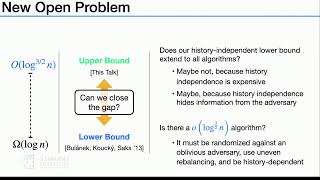
Online List Labeling - Breaking the Log^2 N Barrier
Explores a randomized data structure for online list labeling, improving the upper bound to O(log^{3/2} n) items moved per insertion/deletion, breaking the long-standing log^2 n barrier.
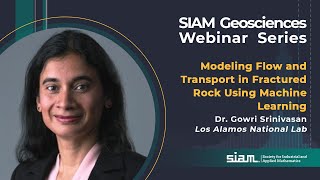
Modeling Flow and Transport in Fractured Rock Using Machine Learning
Integrating computational physics, machine learning, and graph theory to model flow and transport in fractured rock systems, offering a paradigm shift from high-fidelity models to efficient coarse-scale graphs.