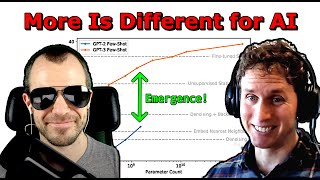
More Is Different for AI - Scaling Up, Emergence, and Paperclip Maximizers
Explore AI scaling, emergence, and safety with Jacob Steinhardt. Discuss qualitative changes in AI systems, implications for alignment, and thought experiments like the Paperclip Maximizer. Gain insights on future AI challenges and potential solutions.
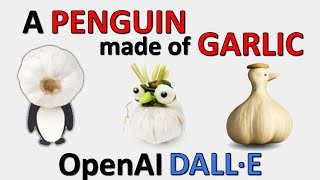
OpenAI DALL·E - Creating Images from Text - Blog Post Explained
Explore OpenAI's DALL·E model, its architecture, capabilities, and limitations in generating high-quality images from text descriptions. Learn about its potential impact on AI applications combining text and visuals.
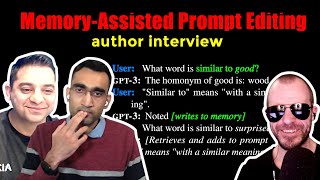
Author Interview - Memory-Assisted Prompt Editing to Improve GPT-3 After Deployment
Explore a method to improve GPT-3's performance post-deployment by maintaining interaction memory and dynamically adapting prompts, enhancing accuracy without retraining the model.
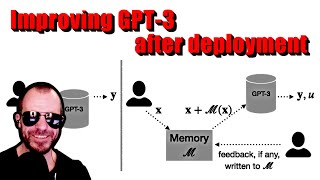
Memory-Assisted Prompt Editing to Improve GPT-3 After Deployment - Machine Learning Paper Explained
Explore adaptive methods to enhance GPT-3's performance post-deployment using memory-based prompts, improving accuracy without retraining the model. Learn about applications in fine-tuning and personalization.
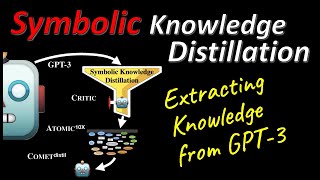
Symbolic Knowledge Distillation- From General Language Models to Commonsense Models Explained
Explore how to distill commonsense knowledge from large language models to create high-quality knowledge graphs and train smaller, specialized models for improved performance in commonsense reasoning tasks.
Fine-Tuning OpenAI's GPT-3
Explore GPT-3's applications, fine-tuning benefits, and API development with OpenAI's VP and a W&B engineer. Learn about commercial uses and the new OpenAI-W&B collaboration for logging fine-tuning projects.

Train GPT-3 on Any Corpus of Data with ChatGPT and Knowledge Graphs - SCOTUS Opinions Part 1
Learn to create knowledge graphs from Supreme Court decisions, enhancing GPT-3's understanding of legal concepts for improved AI applications in law and research.
Play Twenty Questions with GPT-3 - Full Game Coding Walkthrough
Step-by-step walkthrough of coding a Twenty Questions game using GPT-3, covering random word generation, prompt building, and bot creation for question answering and gameplay logic.
Write an Entire Blog Post With GPT-3 Fully Automatically
Learn to leverage GPT-3 for efficient blog post creation, from brainstorming and outlining to writing engaging content, with practical examples and recursive programming techniques.

AutoMuse- Synopsis GAN for Self-Improving Synopsis Generators
Explore AI-powered synopsis generation using GANs and GPT-3, delving into creative writing applications, story idea generation, and the challenges of crafting compelling narratives and characters.
AutoMuse- Synopsis and Plot Generator Walkthrough
Explore AI-powered creative writing tools for generating synopses, plots, and novel outlines. Learn about AutoMuse's capabilities and limitations in crafting full-length stories using GPT-3 technology.
AutoMuse- Writing a Novel with GPT-3 as a Plotter - Decompose the Problem into Steps
Explore novel writing with GPT-3 as a plotter. Learn to decompose tasks, brainstorm ideas, and develop characters for engaging fiction. Discover techniques for crafting compelling storylines and expanding themes.
Alignment Research- GPT-3 vs GPT-NeoX - Which One Understands AGI Alignment Better?
Explore the potential risks and unintended consequences of various AI objective functions, including minimizing suffering, maximizing freedom, and pursuing economic growth, in the context of AGI development.
AutoMuse: Working on Character and Scene Simulations - GPT-3 Finetuning Project
Explore character simulation and scene generation techniques using GPT-3 fine-tuning. Learn to create synthetic data, develop realistic characters, and generate novel scenes for AI-powered storytelling.

Fine-Tune a Perfect Email Generator in GPT-3 - Take Any Input and Generate a Great Email
Learn to fine-tune GPT-3 for generating perfect emails. Explore techniques for synthesizing content, automating creativity, and creating training datasets to improve email writing across various scenarios and intents.
Summarize Product Reviews with GPT-3 - Get Product Insights and Improvements Fast
Learn to leverage GPT-3 for efficient product review analysis, gaining valuable insights and improvement suggestions. Automate the process of summarizing customer feedback and generating actionable recommendations.
Fixing "Goldfish Memory" With GPT-3 and External Sources of Information in a Chatbot
Explore advanced chatbot development techniques, including external information integration, cognitive architecture, and debugging. Learn about particle physics concepts through AI-powered conversations.
Fixing "Goldfish Memory" with GPT-3 and External Sources of Information in a Chatbot
Explore techniques to enhance chatbot memory using GPT-3 and external information sources, improving long-term conversations and information retrieval for more intelligent and context-aware AI interactions.
Answer Complex Questions From an Arbitrarily Large Set of Documents With Vector Search and GPT-3
Learn to build a system that answers complex questions from large document sets using vector search and GPT-3, enhancing information retrieval and analysis capabilities.

Metaprompting with GPT-3 to Dynamically Generate Arguments
Explore advanced techniques for generating complex arguments and essays using GPT-3, including prompt chaining, metaprompting, and automated writing strategies.
Finetune GPT-3 to Write a Coherent Novel - Success! With Minor Bugs
Explore the process of using AI to write a novel, from generating summaries to creating full chapters, with insights on recursive neural networks and GPT-3 implementation.