Managing Open Source at Scale in an Era of Heightened Security Concerns - Panel Discussion
Industry leaders discuss open source security challenges, policy implications, and strategies for managing and securing open source software at scale in enterprise environments.

The AI Economist - Improving Equality and Productivity with AI-Driven Tax Policies
Explore AI-driven tax policies that balance equality and productivity through reinforcement learning, revealing emergent strategies and outperforming traditional economic models in simulations and human experiments.
Neural Opinion Dynamics Model for the Prediction of User-Level Stance Dynamics - Yulan He, Warwick
Explore neural opinion dynamics for predicting user stance shifts in digital democracy platforms, enhancing citizen engagement and policy-making through machine learning techniques.
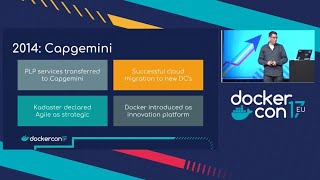
Putting Docker EE on the Map: Business Results and Technical Benefits of Becoming an Agile Organization
Discover how the Dutch Land Registry transformed into an efficient Agile/DevOps organization using Docker, achieving rapid deployments and innovative private cloud infrastructure for public services.
Deploying and Hosting EBSI Nodes Based on Hyperledger BESU
Explore EBSI's blockchain infrastructure for cross-border public services, including network setup, hosting, and management insights. Learn about European use cases and future technical developments.

AI and Democracy - Impacts on Governance and Citizen Participation
Explore AI's impact on democracy: campaigning, voting, legislation, policy enforcement, and courts. Discuss potential for increased citizen involvement and societal justice through secure AI systems.

The Collingridge Dilemma in AI Development - Challenges and Policy Implications
Explore the Collingridge dilemma in AI development, examining challenges in controlling technology's impact and fostering collaborative solutions between policymakers and developers.

Turing Lecture - Sir Mark Walport, Artificial Intelligence and Public Services
Explore AI's potential to transform public services, discussing efficiency gains, personalization, and ethical considerations in government applications of machine learning.

Applying AI to Analyze Public Voices for Advancing Sustainable Development Goals
Explore AI applications for analyzing public voices to advance Sustainable Development Goals, focusing on innovative approaches and potential impacts.

Our Immigration Conversation Is Broken - Here's How to Have a Better One
Historian Paul A. Kramer explores the divisive US immigration debate, challenging the "insider vs. outsider" framing and proposing new questions to reshape the conversation around rights, equality, and shared responsibility.

Captives Among Us - How U.S. Immigration Laws Encourage Domestic Violence
Exploring how U.S. immigration policies inadvertently foster domestic abuse among undocumented immigrants, challenging viewers to reconsider current laws and protect vulnerable populations.
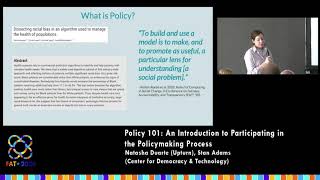
Policy 101 - An Introduction to Participating in the Policymaking Process
Learn to engage effectively in policymaking processes, focusing on technology policy. Gain insights into advocacy strategies and understanding legislative procedures for impactful participation.
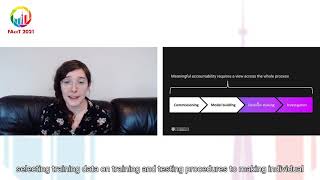
Reviewable Automated Decision-Making - A Framework for Accountable Algorithmic Systems
Explore a framework for accountable algorithmic systems, focusing on reviewable automated decision-making to enhance transparency and fairness in AI-driven processes.

Translation Tutorial - A Shared Lexicon for Research in Human-Centered Software Systems
Explore key terms in fairness, accountability, and transparency in algorithmic systems. Learn how different disciplines interpret these concepts to improve cross-disciplinary communication and research in human-centered software.
21 Definitions of Fairness and Their Politics
Explore 21 mathematical definitions of fairness in machine learning, their embedded values, and implications for ethics and policy. Gain insights into the complexities of algorithmic fairness and its connection to theories of justice.
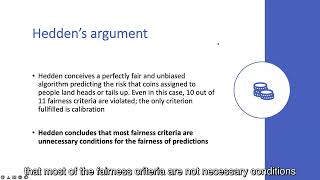
People Are Not Coins - Morally Distinct Types of Predictions Necessitate Different Fairness Constraints
Explore ethical implications of AI predictions and fairness constraints in different contexts, examining moral distinctions and their impact on algorithmic decision-making.

Law, Metaphor and the Encrypted Machine
Explore legal metaphors for encryption technology and their implications on civil liberties, commercial interests, and policy decisions in the digital age.

Securing Critical National Infrastructure
Panel discussion on securing critical national infrastructure featuring experts from energy, technology, and policy sectors. Explores challenges and strategies for protecting vital systems against cyber threats.

Locked Up Science
Exploring strategies to break down paywalls in scholarly communication and promote open access to scientific knowledge, including recent developments and collaborative efforts.

Beyond Encryption - Why We Can't Come Together on Security and Privacy
Expert panel explores the complex relationship between privacy and security, discussing challenges beyond encryption and proposing solutions to break the current stalemate in digital policy debates.

The Global Conversation on Encryption
Explores global government proposals affecting encryption, their potential impacts on security and rights, and how various stakeholders are responding. Discusses ways to support strong encryption policies.