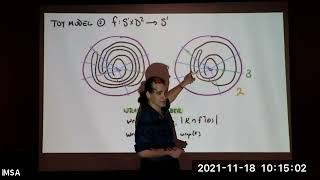
Bounds on Morse-Novikov Numbers of 3-Manifolds
Explore bounds on Morse-Novikov numbers of 3-manifolds, examining circle-valued Morse functions and their critical points, with applications to knot theory and topology.
Pencils on Algebraic Surfaces with Prescribed Classes of Irreducible Components
Exploring bounds on reducible fibers in curve pencils on projective surfaces, with focus on irreducible components' classes in Neron-Severi group. Generalizes results on fundamental groups of line arrangement complements.
Braids and Configuration Spaces
Explore topology, homotopy, and braid groups in this talk on configuration spaces. Discover connections between fundamental groups, loop spaces, and unordered configurations in mathematics.
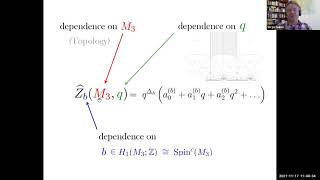
From Turaev to Rokhlin via VOA Characters and Curve Counting
Explore q-series invariants of 3-manifolds, their properties, and connections to topology, vertex algebras, and enumerative problems. Gain insights into recent developments in this mathematical field.
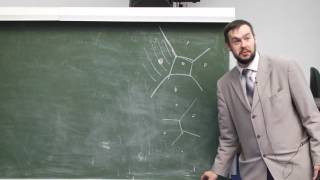
On Knot Theoretical Counterpart of the Groups G^k_n
Explore knot theory's connection to groups G^k_n, covering tetrahedron relations, permutations, and invariants. Gain insights into geometry, topology, and group theory applications.
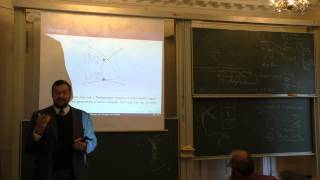
Picture Valued Invariants, Groups, and Applications of Virtual Knot Theory
Explore picture valued invariants, groups, and applications of virtual knot theory with Professor Vassily Manturov in this advanced mathematics lecture.
Skein Exact Triangles in Equivariant Singular Instanton Theory
Explore knot signatures and singular instanton homology, focusing on skein exact triangles in equivariant theory. Uncover new insights into link invariants and their categorifications.
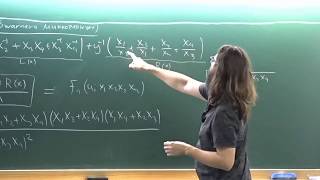
Mirror Symmetry for Character Varieties and Field Theory by Sergey Galkin
Explore mirror symmetry for character varieties, using threespace mirrors to construct SU(2) character variety mirrors on Riemann surfaces, with applications in topological field theory and random walks.
Representations of Fuchsian Groups, Parahoric Group Schemes by Vikraman Balaji
Explore advanced mathematical concepts including Fuchsian groups, parahoric schemes, and root systems. Delve into complex algebraic structures and their representations in this in-depth lecture on geometric group theory.
The Man Who Invented Calculus: The Life and Work of Madhava - Lecture 2
Explore Madhava's groundbreaking calculus work, including curve length definitions, tangent lines, and integral concepts. Gain insights into his mathematical innovations and their historical significance.
Phases to Phases - An Invitation to Topological Phases of Many Particles by Vijay Shenoy
Explore topological phases in many-particle systems, covering quantum condensed matter physics, electronic phases, and the tenfold way. Gain insights into topological insulators and their potential technological applications.
Geometry and Topology in Quantum Mechanics - Mathematical Properties
Explore geometric phases in quantum mechanics, from foundational concepts to advanced topics like Berry phases and null phase curves, with applications in optics and condensed matter physics.
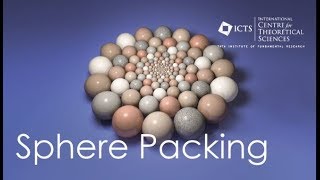
Modular Forms by Mahesh Kakde
Comprehensive exploration of modular forms, covering definitions, properties, and applications. Delves into Eisenstein series, theta functions, and related mathematical concepts for advanced learners in number theory.
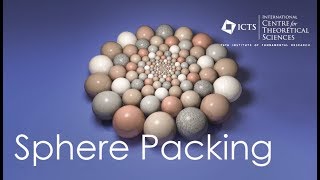
Quadratic Forms and Hermite Constant, Reduction Theory by Radhika Ganapathy
Explores techniques for computing densest lattice packings, including quadratic forms, Hermite constants, and reduction theory. Covers perfect forms, eutactic lattices, and Voronoi's algorithm for listing perfect forms.
From Local to Global Holomorphic Peak Functions - Lecture 1
Explore holomorphic peak functions in complex analysis, from local to global perspectives. Gain insights into Cauchy-Riemann equations, L2-theory, and applications in higher-dimensional complex manifolds.
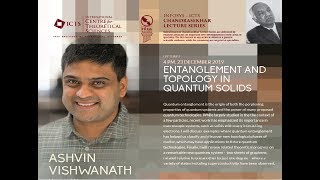
Topology, Correlations and Superconductivity in Magic Angle Graphene - Lecture 2
Explore topology, correlations, and superconductivity in magic angle graphene. Dive into band structures, symmetries, and experimental findings. Gain insights on flat bands, Landau levels, and correlated electron paradigms.
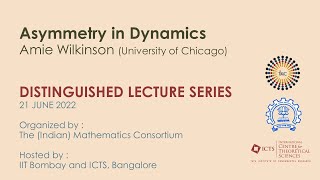
Asymmetry in Dynamics
Explore symmetries in dynamical systems and progress on Smale's conjecture about generic smooth systems having only trivial symmetries. Delve into complex analytic, Hamiltonian, and smooth dynamics.
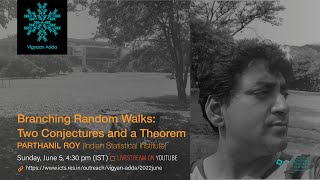
Branching Random Walks - Two Conjectures and a Theorem by Parthanil Roy
Explore branching random walks, their applications, and long-term behavior. Delve into conjectures and theorems with mathematician Parthanil Roy in this engaging lecture on probability theory.
Knot Polynomials from Chern-Simons Field Theory and Their String Theoretic Implications by P. Ramadevi
Explore knot polynomials, Chern-Simons theory, and string theory connections. Learn about knot classification, invariants, homology, and gauge-string duality in topological strings. Discover M-theory descriptions and brane constructions.
The Geometric Langlands Conjecture and Non-Abelian Hodge Theory - Lecture 1
Explore the Geometric Langlands conjecture and non-abelian Hodge theory, examining connections between quantum fields, geometry, and representation theory in modern mathematics and theoretical physics.
Hyperbolic Geometry, Fuchsian Groups and Moduli Spaces - Lecture 1
Introducción a la geometría hiperbólica: modelos, propiedades y trigonometría. Exploración de los modelos del semiplano superior, disco y hiperboloide, con énfasis en geodésicas, ángulos y curvatura constante.