The Creation, Collections, and Curators of the Rutgers University Geology Museum
Explore the rich history, diverse collections, and dedicated curators of the Rutgers University Geology Museum, uncovering its significance in geological education and research.
Planetary Geology: Mars Exploration - Presentation Only
Explore Mars through a graduate student's presentation, delving into the Red Planet's geological wonders and scientific mysteries.
Mineral Identification - Ask a Geologist Series
Learn mineral identification techniques from a geology expert, exploring physical properties and tools used to classify rocks and minerals found in nature.
Reconstructing the Early Solar System
Explore early solar system formation through meteoritic analysis, isotopic anomalies, and integrated data to uncover the origins of our cosmic neighborhood.

Improving Education and Career Pathways for Underrepresented Minority Students in the Geosciences
Explore strategies to enhance diversity and inclusion in geoscience education, focusing on underrepresented minority students' pathways to success.
How Squishy is the Middle Crust? - Exploring Crustal Rheology
Explore the deformation of Earth's middle crust and its implications for geological processes with Dr. Steven Kidder's insightful analysis.
What Shark Teeth Can Tell Us About Ancient Oceans
Explore ancient oceans through shark teeth fossils, uncovering climate history and marine ecosystem evolution with Princeton researcher Alliya A. Akhtar.
The Serpent Rises from the Waves - Origin of Mosasaurus, Lizard King of the Cretaceous
Explore the fascinating evolution of Mosasaurus, the dominant marine predator of the Cretaceous period, through expert insights and paleontological discoveries.
Earth and Planetary Sciences - Lightning Talks
Explore diverse Earth & Planetary Sciences topics through rapid-fire faculty presentations, covering geology, climate change, oceanography, and more in concise 3-minute talks.
Linking Petrological and Geophysical Monitoring of Volcanic Eruptions - La Palma Example
Explore the connection between petrology and geophysics in volcanic eruption monitoring, focusing on La Palma's case study with Dr. Marc-Antoine Longpré.
Building a Reliable Record of Animals' First Homes
Explore ancient sedimentary rocks to uncover the puzzling late emergence of complex life on Earth and its implications for the search for extraterrestrial life.
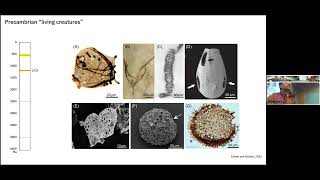
Insights into Ancient Sedimentary Environments via Three-Dimensional Reconstructions
Explore ancient sedimentary environments through 3D reconstructions, uncovering Earth's history and early life evolution via innovative analysis of rock records and fossils.
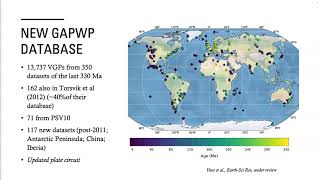
Apparent Polar Wander Paths for the Last 320 Million Years from Site-Level Data - 3/1/23
Explore global plate motion through paleomagnetic data analysis. Learn to calculate Apparent Polar Wander Paths using site-level data for improved accuracy in paleogeographic reconstructions.
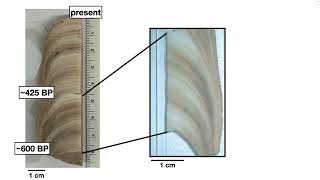
High-resolution Paleomagnetic Records from Speleothems using SQUID Microscopy
Explore high-resolution paleomagnetic records from speleothems using SQUID microscopy. Learn about advanced techniques for measuring paleomagnetism and compare with traditional methods.
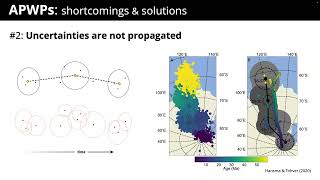
Constructing APWPs from VGPs - Going Virtual
Explore innovative methods for constructing Apparent Polar Wander Paths (APWPs) using Virtual Geomagnetic Poles (VGPs) to enhance understanding of Earth's paleogeography and polar wandering.
Signal Preservation: Global Perspective on Magnetite Dissolution and Local Insights into Greigite Formation
Explore magnetite dissolution and greigite formation in sediments. Gain insights into factors affecting magnetic mineral preservation and formation in modern environments, with implications for paleomagnetism.
Exploring Mercury's Petrologic Evolution Through Experimental and Modeling Approaches
Uncover Mercury's volcanic history through experimental and modeling techniques, exploring mantle structure and magma ocean dynamics to explain surface diversity.
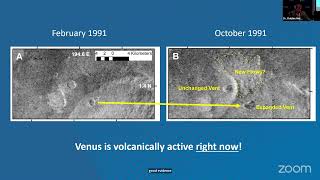
First Direct Observation of Present Day Volcanic Activity on Venus
Explore groundbreaking evidence of active volcanism on Venus through radar imagery analysis, revealing recent changes in Maat Mons volcano's vent.
Mammatus Clouds and Sedimentation Instabilities - Kirk Lecture
Explore the formation of mammatus and asperitas clouds through droplet sedimentation, thermodynamics, and wind shear. Analyze stability and patterns in cloud formations using mathematical models.
The Hawaiian Plume: What Surface Observables Tell Us - Rothschild Lecture
Explore the Hawaiian plume's impact on surface observables through fluid mechanical models, revealing insights into mantle dynamics and intraplate volcanism.
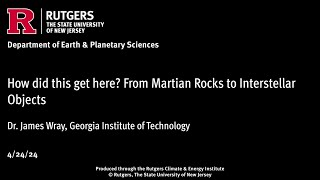
How Did This Get Here? From Martian Rocks to Interstellar Objects
Explore the journey of extraterrestrial materials, from Martian rocks to interstellar objects, with insights from Dr. James Wray's research in planetary science.