New Frontiers for AI-assisted Design and Discovery in Molecular Generation
Explore AI-assisted design and discovery for generating molecules with desirable properties. Learn about overcoming challenges in combinatorial space, modeling interactions, and segregating representations for improved drug and material development.
Hierarchical Imitation Learning with Vector Quantized Models
Learn hierarchical imitation learning techniques using vector quantized models for complex decision-making tasks, exploring subgoal identification and planning strategies to outperform expert demonstrations.
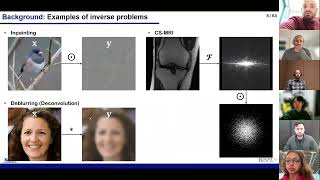
Diffusion Models for Inverse Problems
Explore advanced techniques for solving inverse problems using diffusion models, focusing on posterior sampling and manifold constraints.
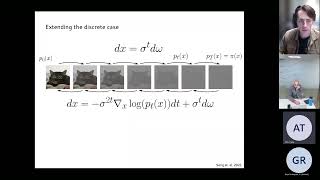
Hierarchically Branched Diffusion Models for Efficient and Interpretable Multi-Class Conditional Generation
Explore efficient and interpretable multi-class conditional generation using hierarchically branched diffusion models. Gain insights into advanced generative techniques.
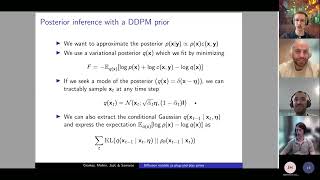
Diffusion Models as Plug-and-Play Priors
Explore diffusion models as versatile priors for various tasks, enhancing image processing and generation capabilities.
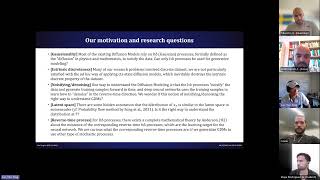
Blackout Diffusion: Generative Diffusion Models in Discrete-State Spaces
Explore generative diffusion models in discrete-state spaces through the innovative Blackout Diffusion approach, presented by researcher Yen Ting Lin.
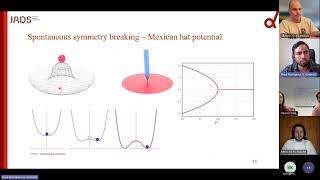
Spontaneous Symmetry Breaking in Generative Diffusion Models
Explore symmetry breaking in generative diffusion models, uncovering insights into their behavior and potential applications in AI and machine learning.
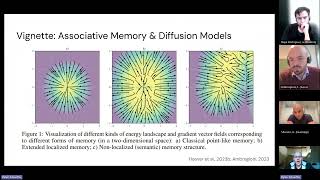
Bridging Associative Memory and Probabilistic Modeling
Explore the connection between associative memory and probabilistic modeling in this insightful presentation by Rylan Schaeffer.
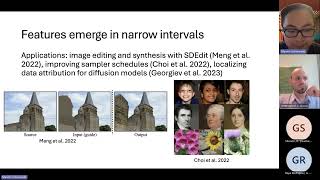
Critical Windows: Non-Asymptotic Theory for Feature Emergence in Diffusion Models
Explore non-asymptotic theory for feature emergence in diffusion models, focusing on critical windows and their implications for generative AI and machine learning.

Boltzmann Machines - The Grandfather of Generative Models
Explore Boltzmann Machines, early generative models learning data probability distributions using stochastic rules and latent representations. Understand their goals, distribution, update rules, and evolution to Restricted Boltzmann Machines.
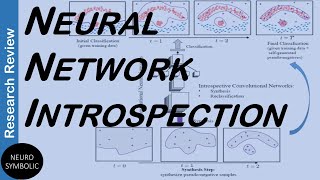
Neural Network Introspection - Approaches from Machine Learning and Knowledge Representation
Explore AI introspection approaches from ML and KR perspectives, covering ICNs, generative vs. discriminative models, and concept induction for enhanced machine learning understanding.

Building Deep Retrieval Models in Practical Applications
Explore deep retrieval models for efficient web-scale data search, balancing accuracy and computational cost. Learn techniques for training robust models with limited labeled data.
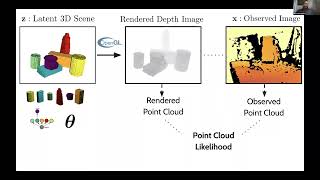
Probabilistic Programming Tutorial - Part 2
Explore advanced concepts in probabilistic programming, focusing on practical applications and techniques for scientific computing and data analysis.
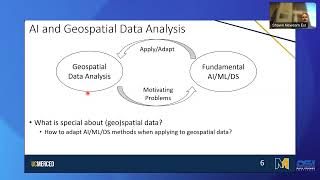
GeoAI: Past, Present, and Future
Explore GeoAI's evolution, applications, and future prospects in geographic data analysis. Gain insights into spatial context integration, multi-modal foundation models, and potential challenges with generative AI.
Koopman Operator Theory Based Machine Learning of Dynamical Systems
Explore Koopman Operator Theory for machine learning of dynamical systems, covering applications in fluid dynamics, power grids, network security, and more.
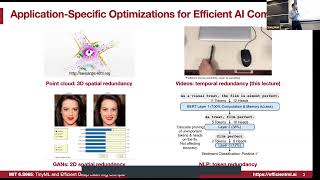
Efficient Video Understanding and Generative Models - Lecture 19
Explore efficient video understanding and generative models, focusing on techniques for deploying neural networks on resource-constrained devices and optimizing deep learning applications.
Efficient Video Understanding and Generative Models - Lecture 19
Explore efficient video understanding and generative models, focusing on techniques for deploying neural networks on resource-constrained devices and optimizing deep learning applications.
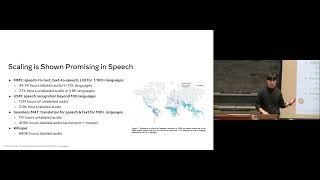
Large Scale Universal Speech Generative Models
Explore cutting-edge speech generative models, including Voicebox, and their applications in multilingual TTS, style conversion, and content editing. Learn about scalable approaches for audio AI.
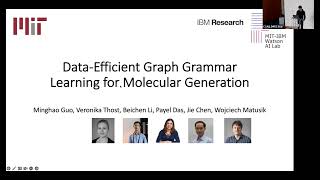
Data-Efficient Graph Grammar Learning for Molecular Generation
Explore data-efficient neurosymbolic generative models for molecular generation using learnable graph grammars, optimized for small datasets and physically synthesizable molecules.
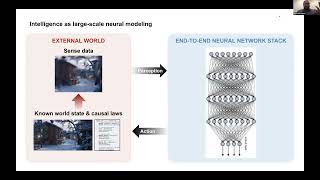
Probabilistic Programming Tutorial - Part 1
Explore probabilistic programming fundamentals and applications with MIT expert Vikash Mansinghka in this comprehensive tutorial.
Managing Small Knowledge Graphs for Multi-agent Systems - MLOps Podcast #236
Explore knowledge graph management for multi-agent systems, focusing on structural grounding, selective improvement, and end-to-end reliability. Learn strategies to enhance RAG accuracy and repeatability in AI pipelines.