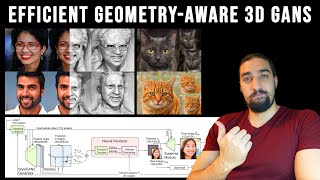
Efficient Geometry-Aware 3D Generative Adversarial Networks - GAN Paper Explained
Explore cutting-edge 3D generative models with a deep dive into efficient geometry-aware GANs, NeRF technology, and novel scene representation techniques for advanced computer vision applications.

Generative Adversarial Networks and Stable Diffusion
Explore Stable Diffusion for text-to-image generation using Keras. Learn to create custom images with Python, understand GANs, and dive into neural networks and convolutional computations.

Generative Adversarial Networks and TF-GAN - ML Tech Talks
Explore Generative Adversarial Networks (GANs) and TF-GAN library. Learn GAN applications, metrics, self-attention GAN, and practical implementation tips from a TensorFlow Research Engineer.
Generative Adversarial Networks - Computerphile
Explore Generative Adversarial Networks (GANs) with Rob Miles, learning how neural networks compete to create new, realistic data like images and faces.
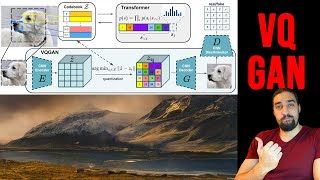
VQ-GAN - Taming Transformers for High-Resolution Image Synthesis - Paper Explained
Explore VQ-GAN's innovative approach to high-resolution image synthesis, combining modified VQ-VAEs with GPT-2 for impressive results. Learn about perceptual loss, adversarial techniques, and comparisons with other models.
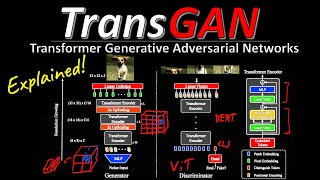
TransGAN - Two Transformers Can Make One Strong GAN - Machine Learning Research Paper Explained
Explore TransGAN, a novel approach using transformers for image generation. Learn about its architecture, key techniques, and competitive performance in various datasets.

Generative Adversarial Networks - Paper Explained
Explore the groundbreaking Generative Adversarial Networks paper, covering its innovative approach, theoretical foundations, and practical implications for AI-driven image generation and deep learning advancements.
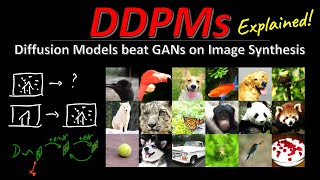
Diffusion Models Beat GANs on Image Synthesis - Machine Learning Research Paper Explained
Explore how Diffusion Models outperform GANs in image synthesis, with improved architecture, classifier guidance, and better sample quality while maintaining distribution coverage.
Build a Generative Adversarial Neural Network with Tensorflow and Python - Deep Learning Projects
Learn to build a Generative Adversarial Network from scratch using Python and TensorFlow. Master data visualization, neural network construction, custom training loops, and image generation in this hands-on deep learning project.

AutoMuse- Synopsis GAN for Self-Improving Synopsis Generators
Explore AI-powered synopsis generation using GANs and GPT-3, delving into creative writing applications, story idea generation, and the challenges of crafting compelling narratives and characters.

Building a GAN From Scratch With PyTorch - Theory + Implementation
Learn to build a Generative Adversarial Network from scratch using PyTorch and PyTorch Lightning, covering theory, implementation, and testing in this comprehensive tutorial.
Stable Diffusion and Friends - High-Resolution Image Synthesis via Two-Stage Generative Models
Explore the evolution of generative image models with Stable Diffusion co-creator Robin Rombach, covering GANs, Transformers, and latent Diffusion models for high-resolution image synthesis and creative applications.
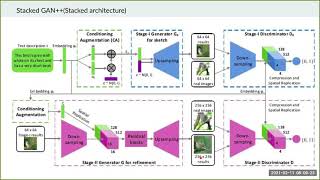
DF-GAN: Deep Fusion Generative Adversarial Networks for Text-to-Image Synthesis
Learn about DF-GAN, a deep fusion architecture for text-to-image synthesis. Explore its simplified backbone, gradient penalty, and deep fusion block, with quantitative and qualitative results.

BigGAN and Other Generative Models
Explore BigGAN and BigBiGAN generative models, their functionality in RunwayML, and learn about image reconstruction techniques in this informative video on advanced AI-powered image generation.

AE, DAE, and VAE with PyTorch - Generative Adversarial Networks and Code
Explore autoencoders, VAEs, and GANs with PyTorch. Learn implementation, visualization, and comparison of generative models through hands-on coding and insightful analogies.
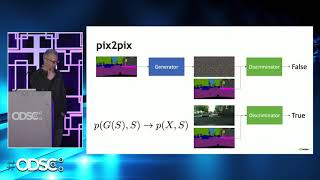
Generative Adversarial Networks for Image Synthesis and Translation - Dr. Jan Kautz
Explore recent GAN advancements for image synthesis and translation, including conditional GANs, supervised vs unsupervised methods, and multimodal approaches. Learn to design, modify, and understand GAN architectures.
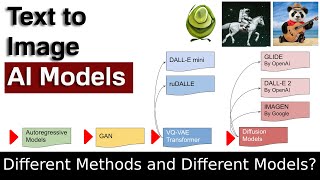
Text to Image AI Models - Different Methodologies and How It Works
Explore various AI methodologies for text-to-image generation, including Autoregressive models, GANs, VQ-VAE Transformers, and Diffusion models. Learn their inner workings and compare advanced systems like DALL-E 2 and Google Imagen.

What Are CycleGANs? - A Novel Deep Learning Tool in Pathology
Explore CycleGANs for unpaired image conversion, including applications in pathology and microscopy. Learn model architecture, training, and inference through code demos and real-world examples.
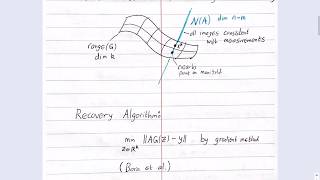
Theory of GANs for Compressed Sensing
Explore the theory of GAN priors in compressed sensing, covering key concepts, proofs, and optimization problems. Gain insights into visual representation and set restricted eigen value conditions.
VQ-GAN - PyTorch Implementation
Implement Vector Quantized Generative Adversarial Networks (VQGAN) using PyTorch, covering encoder, decoder, codebook, discriminator, and transformer stages for high-resolution image synthesis.
Train StyleGAN with Your Own Images
Learn to train StyleGAN with your own images using Colab, covering image preparation, training setup, and resuming training for both StyleGAN2 and StyleGAN3 models.