
The History of Black Holes - From Theory to Discovery
Explore the profound mysteries of black holes with Marcus Chown, uncovering their crucial role in understanding physics, the universe's origins, and humanity's existence in space and time.
Topological Evolution of Time in Unimodular Gravity
Explore the concept of topological evolution of time within the framework of Unimodular Gravity, as presented by Sayyed Rassouli from the University of Nottingham.
Directions in General Relativity
Explore cutting-edge research in general relativity, mathematical physics, and differential geometry with insights on black holes, gravitational instantons, and cosmological models.
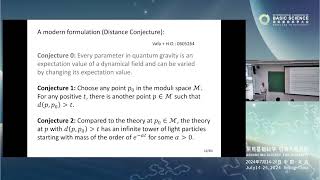
Constraints on Quantum Gravity
Explore constraints on quantum gravity theories, focusing on AdS/CFT correspondence and recent progress in holographic approaches. Examine symmetry constraints and the Distance Conjecture proof.
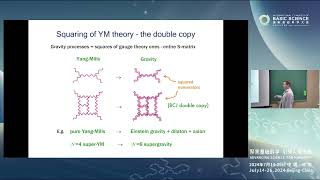
Gravity as a Double Copy of Gauge Theory
Explore the gravitational double copy framework, connecting gravity to Yang-Mills theory and enabling advanced quantum computations and classical general relativity studies.
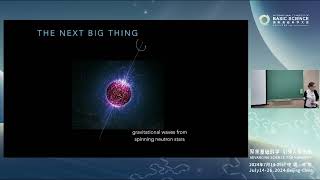
The Next Big Gravitational Wave Discovery - Continuous Sources
Explore the future of gravitational wave astronomy, focusing on continuous sources and their potential for groundbreaking discoveries in the field.
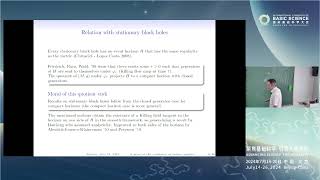
Constancy of Surface Gravity for Non-Degenerate Compact Horizons
Explore non-degenerate compact horizons, surface gravity constancy, and connections to cosmic censorship in general relativity.
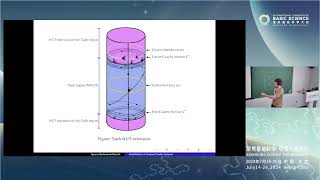
A Classification Theorem for Compact Cauchy Horizons in Vacuum Spacetimes
Explore a complete classification theorem for compact, non-degenerate Cauchy horizons in vacuum spacetimes, examining topology, generator behavior, and manifold implications.
Non-linearities and Gravitational Signals from Black Hole Spacetimes
Explore non-linear behavior of perturbed black holes and its implications for gravitational wave detection and new physics in mergers.
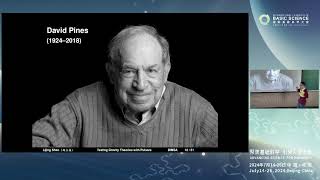
Testing Gravity Theories with Radio Pulsar Timing
Explore radio pulsar timing techniques and their application in testing alternative gravity theories using binary pulsars.
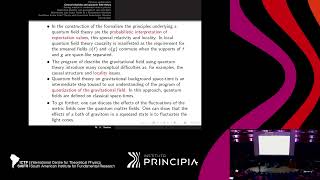
Analog Model for Euclidean Wormholes Effects
Explore an analog model for Euclidean wormholes effects, delving into quantum aspects of gravity and their potential laboratory observations.
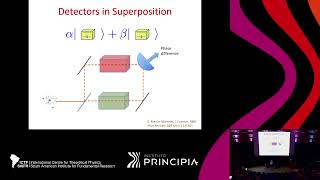
Spacetime in Superposition - Witnessing Quantum Aspects of Gravity in a Lab
Explore quantum aspects of gravity and spacetime superposition with Robert Mann's insightful lecture on cutting-edge research in theoretical physics.
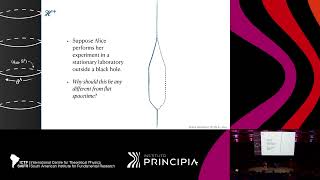
Black Holes and Cosmological Horizons Decohere Quantum Superstitions
Explore how black holes and cosmological horizons impact quantum superpositions, delving into the intersection of gravity and quantum mechanics.
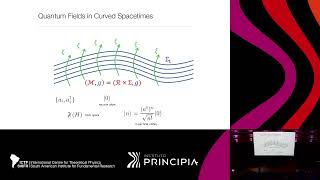
Quantum Communication in Curved Spacetimes
Explore quantum communication in curved spacetimes, examining its implications for gravity and potential lab applications.
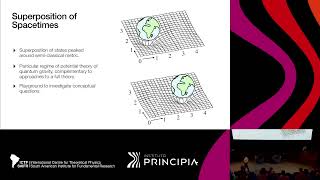
Identification is Pointless: Quantum Reference Frames, Localization of Events, and the Quantum Hole Argument
Explore quantum reference frames, event localization, and the quantum hole argument in relation to witnessing quantum aspects of gravity in laboratory settings.
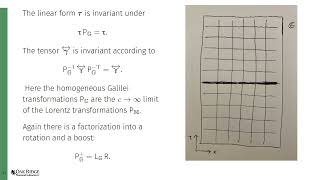
Towards Full Galilei General Relativity: Bargmann-Minkowski and Bargmann-Galilei Spacetimes
Explore Galilei general relativity, examining Bargmann-Minkowski and Bargmann-Galilei spacetimes for a deeper understanding of relativistic physics concepts.
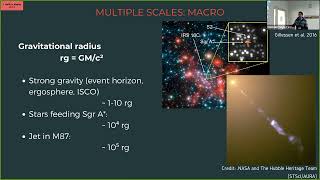
Simulating the Multi-Scale Environment of Supermassive Black Holes
Explore simulation techniques for modeling supermassive black holes, focusing on incorporating large-scale environmental data into event horizon simulations to enhance EHT observations.
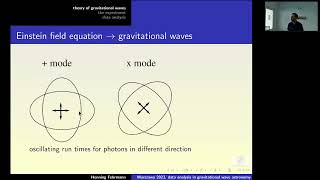
Data Analysis in Gravitational Wave Research
Explore data analysis methods for detecting gravitational waves from various cosmic sources, including mergers and continuous waves, with insights into the Atlas data analysis facility.
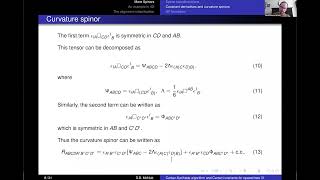
Cartan-Karlhede Algorithm and Cartan Invariants for Spacetimes - Part 3
Explore the Cartan-Karlhede algorithm for classifying spacetime solutions in General Relativity, including mathematical foundations and applications in geometry and gravity theories.
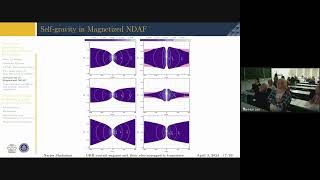
GRB Central Engines and Electromagnetic Transients
Explore gamma-ray burst central engines, focusing on hyper-accretion disks around black holes. Examine self-gravity, magnetic fields, and instabilities in neutrino-dominated accretion flows and their role in X-ray flares and prompt emissions.
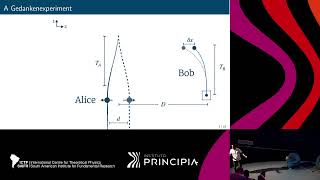
Gravitationally Mediated Entanglement: Newtonian Fields, Gravitons and Black Holes
Explore gravitationally mediated entanglement, from Newtonian fields to gravitons and black holes, in this advanced physics lecture on quantum aspects of gravity.