
Aspects of Black Hole Perturbation Theory - Lecture 3
Explore advanced concepts in black hole perturbation theory, focusing on mathematical techniques and physical implications for gravitational wave analysis and astrophysical phenomena.

Aspects of Black Holes Perturbation Theory - Lecture 2
Explore advanced concepts in black hole perturbation theory, focusing on mathematical techniques and physical implications for gravitational wave analysis and astrophysical phenomena.

Aspects of Black Holes Perturbation Theory - Lecture 1
Explore black hole perturbation theory, delving into advanced concepts and mathematical frameworks for understanding gravitational phenomena and spacetime dynamics.
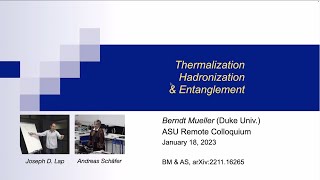
Thermalization, Hadronization, and Entanglement in Heavy Ion Collisions - Theoretical Physics Colloquium
Explore thermalization, hadronization, and entanglement in relativistic heavy ion collisions through holographic descriptions and ER=EPR duality. Gain insights into quantum mechanics, chaos, and black hole evaporation.
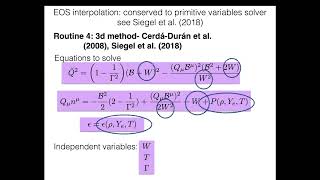
HARM3D and NUC: Numerical Simulations in Relativistic Astrophysics
Explore HARM3D and NUC in relativistic astrophysics, focusing on computational techniques for modeling extreme cosmic events and gravitational phenomena.
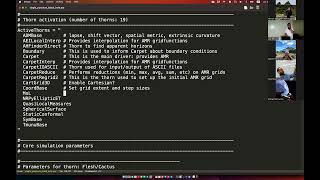
Tutorial on Simulation Analysis
Explore advanced techniques for analyzing gravitational wave simulations, focusing on data interpretation and visualization in computational relativity research.
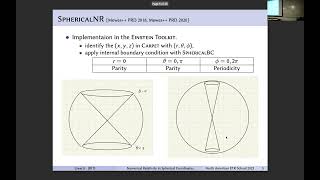
Numerical Relativity in Spherical Coordinates with SphericalN
Explore numerical relativity in spherical coordinates using SphericalN, covering advanced computational techniques for gravitational physics simulations.
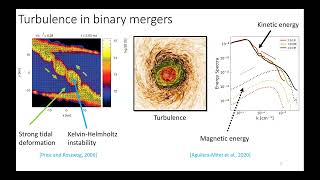
Modeling the Kelvin-Helmholtz Instability in BNS Mergers
Explore advanced modeling techniques for Kelvin-Helmholtz instability in binary neutron star mergers, enhancing understanding of gravitational wave sources and astrophysical phenomena.
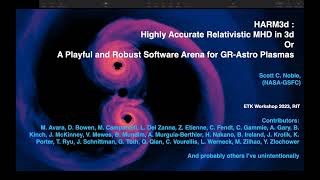
Harm3D: Highly Accurate Relativistic MHD in 3D
Explore highly accurate relativistic magnetohydrodynamics in 3D with Harm3D, a cutting-edge computational tool for astrophysical simulations.
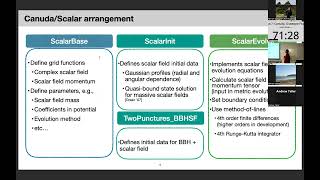
Canuda Tutorial
Explore gravitational wave analysis using the Canuda toolkit in this comprehensive tutorial from the 2023 North American Einstein Toolkit School and Workshop.
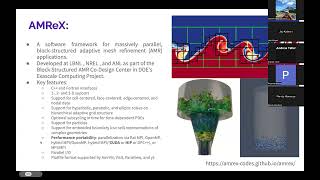
AsterX and GPU Simulations in Computational Relativity - Tutorial
Explore AsterX and GPU simulations for computational relativity and gravitation, enhancing understanding of advanced numerical techniques in astrophysics.
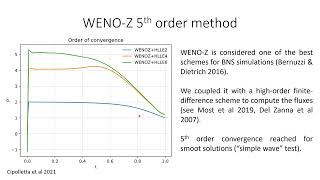
The Spritz Code for Computational Relativity and Gravitation
Explore the Spritz code for computational relativity and gravitation with expert Bruno Giacomazzo. Gain insights into advanced numerical techniques for simulating astrophysical phenomena.

Dendro-GR: An Introduction to Adaptive Mesh Refinement in Numerical Relativity
Explore Dendro-GR, a cutting-edge tool for computational relativity and gravitation, presented by David Neilsen at the 2023 North American Einstein Toolkit School and Workshop.
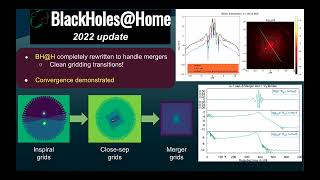
BlackHoles@Home - Citizen Science in Computational Relativity
Explore cutting-edge research on black holes through citizen science, contributing to gravitational wave detection and understanding cosmic phenomena.
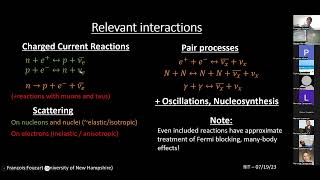
Neutrinos in Neutron Star Simulations
Explore neutrino physics in neutron star simulations, focusing on computational methods and their impact on astrophysical modeling.
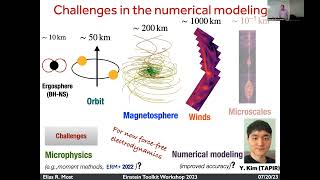
Simulating Extreme Plasmas in Neutron Star Mergers
Explore cutting-edge simulations of extreme plasma behavior during neutron star mergers, uncovering insights into astrophysical phenomena and gravitational waves.
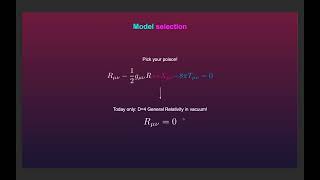
Introduction to Numerical Relativity
Explore advanced concepts in numerical relativity, focusing on computational techniques for modeling gravitational phenomena and spacetime dynamics.
Initial Data for the Numerical Evolutions of Compact Binaries
Explore numerical evolutions of compact binaries, focusing on initial data preparation for simulating gravitational wave sources in computational relativity.
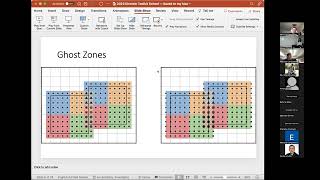
CarpetX and the Future of the Einstein Toolkit
Explore CarpetX and its impact on the Einstein Toolkit's future in computational relativity and gravitation research with Erik Schnetter.
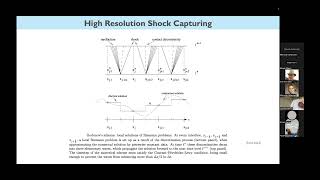
Introduction to General Relativistic Magnetohydrodynamics (GRMHD)
Explore General Relativistic Magnetohydrodynamics (GRMHD) fundamentals and applications in astrophysical simulations, focusing on compact objects and their environments.
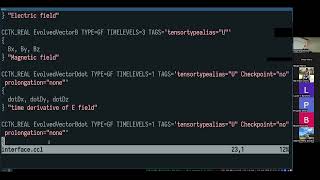
Tutorial on Writing a Physics Thorn - Einstein Toolkit
Learn to create a physics thorn in the Einstein Toolkit, exploring computational techniques for relativistic astrophysics and gravitational wave research.