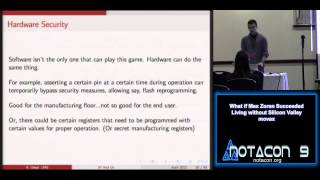
What If Max Zoran Succeeded Living Without Silicon Valley - Notacon 9
Explore living without Silicon Valley tech, examining open-source hardware, reverse engineering, and alternative approaches to technology development. Challenges intellectual property norms and discusses creating fresh hardware solutions.
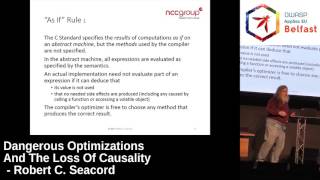
Dangerous Optimizations and the Loss of Causality in C and C++ Programming
Explore compiler optimizations in C/C++ that can lead to software vulnerabilities. Learn about mitigation strategies and the importance of maintaining causality in code.

GCC and Clang Optimizations for Embedded Linux Development
Explore GCC/Clang optimizations for embedded Linux, covering size, performance, and architecture-specific tuning. Learn compiler-friendly coding and command-line options for power, performance, and size trade-offs.

Optimizing C for Microcontrollers - Best Practices
Explore best practices for optimizing C code on microcontrollers, focusing on size and performance improvements using Zephyr RTOS and GCC compiler techniques.

Toolchains in the New Era and How to Update Safely
Explore modern toolchains, safe updating strategies, and advanced techniques for optimizing code performance and security in embedded systems development.

Security Features Status Update for Linux Kernel Toolchains
Comprehensive update on Linux kernel security features across GCC and Clang, discussing toolchain parity, open problems, and new features like CFI, LTO, and overflow protection.

Anatomy of Cross-Compilation Toolchains for Embedded Linux Development
Comprehensive exploration of cross-compilation toolchains for embedded Linux, covering components, build process, configurations, and practical implications for developers.

Feedback Driven Optimization: Improving Program Performance Through Compilation
Explore Feedback Driven Optimization (FDO) techniques for code performance enhancement, including AutoFDO, its benefits, challenges, and real-world applications in embedded Linux systems.
Cutting Edge Toolchain - Latest Features in GCC and GLIBC
Explore latest features in GCC 8/9 and Glibc 2.29, including performance optimizations, security enhancements, and CPU architecture advancements for Linux developers.
Toolchains for People in a Hurry - Latest Features of GCC and GLIBC
Explore the latest features of GCC and GLIBC toolchains, focusing on recent developments and their impact on software development and performance optimization.
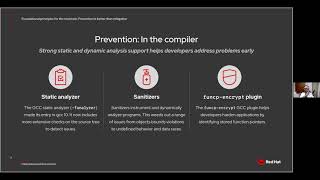
Securing GCC and GLIBC
Explore strategies for enhancing security in GCC and GLIBC, crucial components of Linux systems, with insights from a Red Hat expert.
A Few Effective GCC - Clang Optimizations for Embedded Systems
Explore effective gcc/clang optimizations for embedded systems, focusing on code size reduction, performance enhancement, and compiler-friendly coding practices for Linux-based platforms.

Embedded Linux Size Reduction Techniques
Techniques for minimizing Linux kernel and filesystem size in embedded systems, covering compiler optimizations, configuration options, and user space tools for faster boot times and resource efficiency.
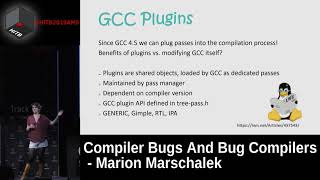
Compiler Bugs and Bug Compilers
Explore compiler vulnerabilities and malicious modifications in GCC, from accidental bugs to intentional exploits. Learn about compiler stages, potential attack vectors, and strategies for detecting malicious alterations.

Modified Condition - Decision Coverage in Gcc - An Introduction, Motivation, Intuition and Tooling
Explore Modified Condition/Decision Coverage: its importance in safety-critical software, benefits, and implementation using GCC, with insights for automotive and aviation industries.
Picolibc - A C Library for Small 32-Bit Systems
Exploring picolibc: a C library for 32-bit embedded systems, blending newlib and avr-libc functionalities to reduce development costs and enhance capabilities for ARM and RISC-V projects.
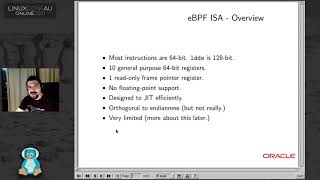
Supporting BPF in the GNU Toolchain
Explore the integration of BPF support in GNU Toolchain, including GCC, binutils, GDB, and GNU simulator. Learn about current developments and practical applications in BPF programming.
Toolchain MC
Explore recent developments, roadmaps, and challenges in GNU Toolchain and Clang/LLVM, focusing on their critical role in Linux Kernel, Open Source Software, and hardware innovation.
Eliminating Implicit Function Declarations
Explore strategies for eliminating implicit function declarations in C programming, addressing challenges and potential solutions for improved code quality and security.
Using the GCC Regression Test Suite for LLVM
Learn how to leverage GCC's regression test suite to enhance LLVM's testing capabilities, improving compiler reliability and performance.

Rapid: Region-Based Pointer Disambiguation for Efficient Memory Optimization
Explore Rapid, a tool for efficient pointer disambiguation using region-based allocation. Learn about its performance benefits, low-overhead allocator, and improved dynamic checks for compiler optimizations.