Functional Geometry - Producing Pure Spaces
Explore geometric synthesis using category theory and functional programming. Learn to model complex spatial configurations with C++14, combining Geometric Algebra and FP paradigms for dimensional fluency.

Monoids, Monads, and Applicative Functors - Repeated Software Patterns
Explore abstract mathematical structures in software development, focusing on monoids, monads, and applicative functors. Learn to recognize these patterns and apply them to improve code design and problem-solving skills.
Design Patterns in the 21st Century
Explore modern C++ design patterns, functional programming concepts, and improvements to classic Gang of Four patterns. Learn how lambda expressions enable monads and enhance software design.
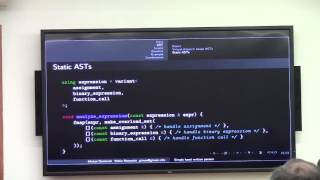
Simple Hand Written Parsers
Explore techniques for implementing recursive descent parsers, focusing on LL(1) grammars with insights on LL(k) and LL(*). Covers AST design, parser combinators, and tokenization for improved debuggability and error handling.
Goodbye Metaprogramming, and Hello Functional
Explore modern C++ features and functional constructs that simplify metaprogramming, moving beyond traditional template techniques to more elegant and efficient solutions.

Haskell Taketh Away - Limiting Side Effects for Parallel Programming
Exploring how limiting side effects in programming languages enhances parallel programming, with insights from Haskell and C++ on determinism, purity, and embedded domain-specific languages.
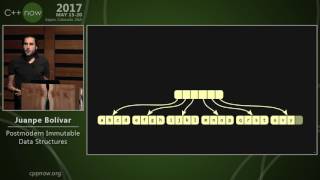
Postmodern Immutable Data Structures
Explore modern immutable data structures in C++, their benefits for concurrent systems, and efficient implementation techniques using Relaxed Radix Balanced Trees and the Immer library.
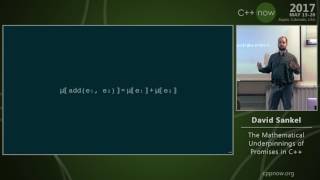
The Mathematical Underpinnings of Promises in C++
Explore the mathematical foundations of promises in C++ and their practical implementation, covering functional design principles, algebraic concepts, and real-world applications in library development.
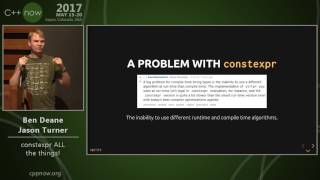
Constexpr ALL the Things!
Explore the power of constexpr in C++17, examining techniques for compile-time computation, data structures, and algorithms. Learn to effectively combine compile-time and runtime computations for optimal performance.
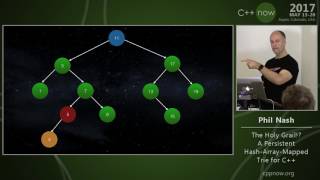
The Holy Grail - A Persistent Hash-Array-Mapped Trie for C++
Exploring Hash-Array-Mapped Tries: A persistent, efficient data structure for C++ that combines tree and hash table characteristics, offering superior memory efficiency and immutability benefits.
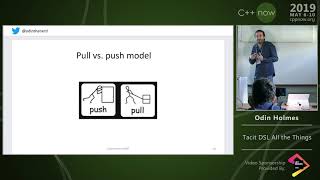
Tacit DSL All the Things
Explore functional programming concepts in C++ through an extended ranges DSL, unifying various paradigms and libraries for more declarative and composable code.
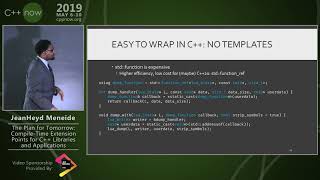
The Plan for Tomorrow - Extension Points in C++ Applications
Explore advanced C++ extension techniques beyond callbacks and virtual classes, examining libraries' non-dynamic extension points for compile-time customization and improved application flexibility.
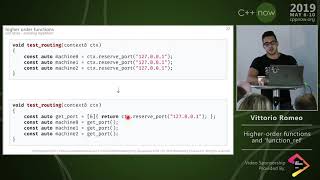
Higher-Order Functions and Function Ref
Explore higher-order functions in C++, their practical applications, and the proposed `function_ref` abstraction for C++20, enhancing code flexibility and performance.
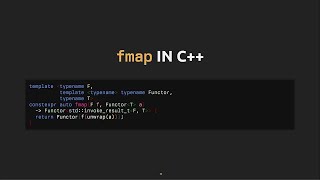
Applicative - The Forgotten Functional Pattern in C++
Explore the powerful applicative pattern in C++, its practical applications, and how it enhances code simplicity and composability across various programming scenarios.
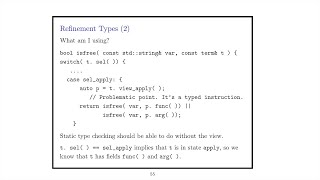
Trees for Logic and Parsing in C++
Explore efficient implementation of recursive tree-types in C++ for logic and parsing, with insights on construction, inspection, and replacement of subtrees.
Magical NumPy with JAX
Explore JAX's NumPy-compatible API for performant numerical modeling and gradient-based optimization. Learn functional programming, deterministic random number generation, and neural network integration.
Writing Functional Code in Python
Explore functional programming concepts and their application in Python, enhancing code quality and efficiency through practical examples and key principles.
A Perfect Match - The History, Design, Implementation, and Future of Python's Structural Pattern Matching
Explore Python 3.10's structural pattern matching: its history, design, implementation, and future. Learn powerful object-oriented approaches and practical applications for this functional programming feature.
PyScript and the Magic of Python in the Browser
Explore how PyScript brings Python's power to web browsers, enabling interactive and dynamic web applications without leaving the Python ecosystem.
Rethinking Objects
Explore the evolution of Object-Oriented programming, comparing traditional concepts with functional approaches and examining the enduring value of objects in library design.
Pythonic Functional - Itertools for Your Data Challenges
Explore Python's functional programming capabilities for data challenges, focusing on itertools, functools, and map-reduce patterns through interactive Advent of Code puzzles.