Quantum Mechanics and Quantum Field Theory from Algebraic and Geometric Perspectives - Part 1
Explore alternative viewpoints on quantum mechanics, including algebraic and geometric approaches. Gain insights into particle concepts, scattering, and L-functionals for solving infrared problems in quantum electrodynamics.
What Perturbative Field Theory Teaches Us About Statistical Analysis
Explore perturbative field theory's applications in particle physics, statistical mechanics, and functional analysis, focusing on divergence regularization and optimal transportation.
Fock Spaces Associated with Coxeter Groups of Type B
Explore Fock spaces related to infinite hyperoctahedral groups, examining two-parameter functions and their positive definiteness in extreme characters. Apply findings to cyclic Fock spaces of type B.
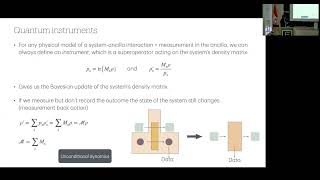
Quantum Jump Patterns in Hilbert Space and Stochastic Operation of Quantum Thermal Machines
Explore quantum jump patterns in Hilbert space and their impact on stochastic quantum thermal machines, advancing understanding of quantum information and control.
The Non-perturbative Hilbert Space of JT Gravity
Explore non-perturbative aspects of JT gravity's Hilbert space in this advanced theoretical physics lecture, delving into quantum information and gravity connections.
Inhomogeneous Helmholtz Equations in Wave Guides - Existence and Uniqueness Results with Energy Methods
Analyse mathématique des équations de Helmholtz inhomogènes dans les guides d'ondes, démontrant l'existence et l'unicité des solutions par des méthodes énergétiques pour des coefficients périodiques.

Rough Paths for Physicists - Lecture 1
Explore rough paths theory in physics, covering iterated integrals, control differential equations, and applications to one-dimensional objects.
Mathematics of Quantum Entanglement - Part 1
Explore quantum entanglement's mathematical foundations, including its role in communication, Bell inequalities, and quantum capacities.
Rough Paths for Physicists - Motivations, Sewing Lemma, and Young Integrals - Lecture 1
Explore rough paths in physics, focusing on motivations, the sewing lemma, and Young integrals. Gain insights into advanced mathematical concepts for physical applications.
Potential Theoretic Methods for Deterministic Schrödinger Operators
Explorez les méthodes de théorie du potentiel pour les opérateurs de Schrödinger déterministes, présentées par Wilhelm Schlag de l'Université Yale.
The Feynman Propagator and Self-Adjointness
Explore analytic techniques in dynamics and geometry, focusing on the Feynman propagator and self-adjointness with Stanford's A. Vasy.
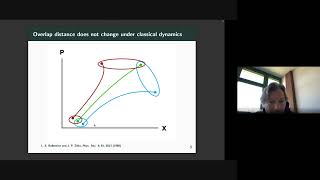
Detection of Quantum Chaos with Quantum Hamming Distance
Explore quantum chaos detection using Quantum Hamming Distance, uncovering state sensitivity in quantum theory and challenging traditional beliefs about quantum evolution.
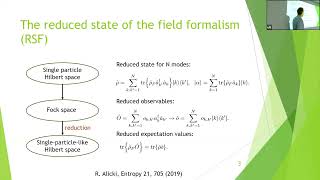
Mesoscopic Description of Entanglement of Bosonic Fields and Its Open Evolution
Explore mesoscopic descriptions of entanglement in bosonic fields, focusing on simplified models that capture non-classical phenomena for photonic quantum computing and communication.
Hyper-contractivity in Analysis and Theoretical Computer Science - Introduction 3
Explore hyper-contractivity in analysis and theoretical computer science, examining its applications and implications for advanced mathematical concepts.
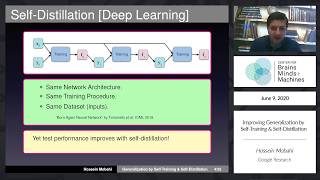
Improving Generalization by Self-Training & Self Distillation
Explore self-training and self-distillation techniques to improve model generalization, with insights on regularization effects and applications in deep learning.
The Mother of All Representer Theorems for Inverse Problems and Machine Learning - Michael Unser
Explore the mathematical foundations of inverse problems and machine learning, focusing on representer theorems, Banach spaces, and kernel methods for advanced data science applications.
Reinforcement Learning in Feature Space: Complexity and Regret
Explore reinforcement learning in feature space, focusing on complexity, regret analysis, and innovative approaches like MatrixRL. Learn about state feature mapping and its applications in real-world scenarios.
Stabilizer Formalism & Quantum Error Correction Through the Lens of Tensors - Part 1
Explore stabilizer formalism and quantum error correction using tensor methods. Learn about many-body systems, error correction challenges, and connections to finite symplectic geometries.
Solvable Entanglement Dynamics in Quantum Circuits with Generalized Dual Unitarity
Explores solvable entanglement dynamics in quantum circuits using generalized dual unitarity, advancing understanding of quantum matter stability and non-equilibrium physics.
Quantum Information Phases in Space-time: Measurement-induced Entanglement and Dynamics
Explore quantum information phases in space-time, focusing on measurement-induced entanglement and related phenomena. Gain insights into cutting-edge research in quantum many-body systems and their stability.
Nonisomorphic Simple AH-Algebras with the Same Elliott Invariant and Radius of Comparison
Explore nonisomorphic simple AH-algebras, examining their Elliott invariants and radius of comparison in this advanced operator algebra seminar by N. Christopher Phillips.