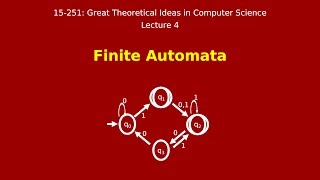
Great Ideas in Theoretical Computer Science: Finite Automata
Explore finite automata and regular languages in theoretical computer science, covering DFAs, computation concepts, and language analysis techniques.
A Quantum Query Complexity Trichotomy for Regular Languages
Explore quantum query complexity for regular languages, uncovering a trichotomy that advances understanding in computational theory and quantum algorithms.
Chomsky Normal Form and Conversion of CFG to CNF in Automata Theory
Learn to convert Context-Free Grammars to Chomsky Normal Form, a standardized format for simplifying and analyzing grammars in automata theory. Understand the steps and rules for this important transformation.
Conversion of NFA with Epsilon to NFA Without Epsilon in Automata Theory
Learn to convert NFA with epsilon transitions to NFA without epsilon, a crucial skill in automata theory. Understand the step-by-step process and its importance in simplifying finite automata representations.
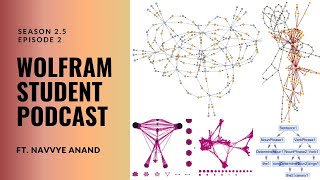
Exploring Formal-Language Syntax with Multiway Systems
Explore computational dynamics of formal-language syntax using multiway systems, focusing on substitution rules and visualization of various grammar types.
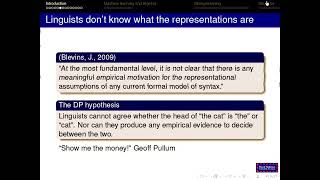
Weak and Strong Learning of Context-Free Grammars - 2012
Explore recent advancements in unsupervised learning of context-free grammars and the transition from weak to strong learning algorithms for accurate syntactic structure prediction.
Eliminating Input-Based Attacks by Deriving Automated Encoders and Decoders from Context-Free Grammars
Learn to derive automated encoders and decoders from context-free grammars to eliminate input-based attacks, enhancing security in complex language communication systems.
Compile-time Reparsing - C++Now 2012
Explore compile-time parsing techniques in C++ for creating embedded domain-specific languages, including runtime expressions, compile-time strings, and angle-bracket expressions.
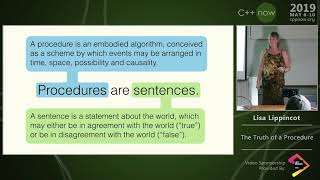
The Truth of a Procedure in Programming
Explore the mathematical logic behind programming procedures, treating them as statements about event arrangements and bridging programming with formal languages and truth concepts.
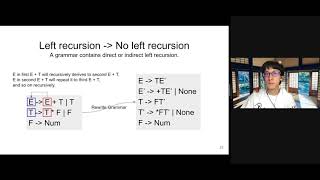
Learn from LL-1 to PEG Parser the Hard Way
Explore parser evolution from LL(1) to PEG, covering compiler fundamentals, traditional techniques, and CPython's implementation. Gain insights into parsing concepts and their practical applications.
Automated Ambiguity Detection in Layout-Sensitive Grammars
Explore automated ambiguity detection in layout-sensitive grammars using SMT solving. Learn about local ambiguity, reachability conditions, and their application to language design.
Significance of Regular Languages and Regular Operations - Lecture 5
Explore regular languages, non-regular examples, and key operations like union, concatenation, and Kleene star to deepen understanding of formal language theory.
Elimination of Left Recursion in Compiler Design - Examples and Explanation
Explore left recursion in compiler design, its impact on parsing, and techniques for elimination. Learn to identify and resolve left-recursive grammars for efficient parsing.
Left Factoring in Compiler Design - Elimination of Left Factored Grammar
Explore left factoring in compiler design, including left factored grammar and elimination techniques. Learn to optimize grammar for efficient parsing and reduce ambiguity in language processing.
Specification of Tokens in Compiler Design - Regular Expressions, Languages, and Alphabets
Explore token specification in compiler design, covering regular expressions, languages, strings, and alphabets. Learn key concepts for effective lexical analysis and token recognition.
Deep CPCFG for Information Extraction
Explore deep learning techniques for information extraction using Conditional Probabilistic Context-Free Grammars. Learn about document parsing, schema representation, and handling noisy data in this advanced lecture.
Building Grammar Libraries for Mathematics and Avoiding Manual Work
Explore techniques for constructing efficient grammar libraries in mathematics, focusing on automation to minimize manual effort and enhance productivity in formal language development.
Mathematical Structures in Generative Linguistics
Explore mathematical structures in generative linguistics, from formal languages to Hopf algebras and geometric spaces for modeling semantics and syntactic variation across languages.

Programming Language as Language
Explore programming languages as human languages, examining their structural elements, cognitive impacts, and role in shaping developer communities and mental models.
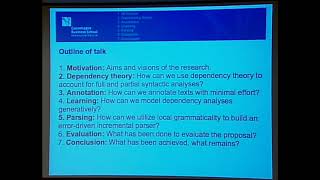
Modelling Human Syntax by Means of Probabilistic Dependency Grammars - 2007
Explore probabilistic dependency grammars for modeling human syntax, addressing linguistic phenomena beyond context-free grammars and discussing generative models and parsing algorithms.
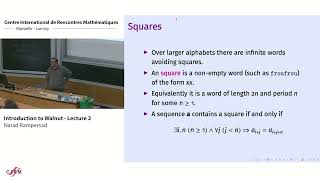
An Introduction to Walnut - Lecture 2
Explore Walnut, a tool for automata-based proofs in number theory and combinatorics. Delve into advanced techniques and applications in this comprehensive mathematical lecture.