Conservation of Mass in Fluid Dynamics - Governing Equations Review
Explore conservation of mass principles in fluid dynamics, covering compressible and incompressible flows, mass flow rate, and governing equations for heat transfer.
Laminar and Turbulent Flows - Part 1 - Lecture 32
Explore laminar and turbulent flows, understanding velocity, Reynolds experiment, and typical flow regimes. Gain insights into fluid dynamics concepts.
Code Walkthrough for PINNs in Burgers Equation
Explore Physics-Informed Neural Networks (PINNs) applied to the Burgers equation through a detailed code walkthrough.
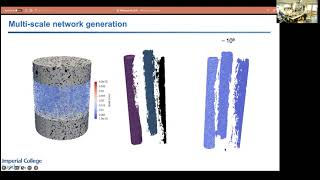
Multi-scale Flow and Transport Dynamics in Porous Media
Explore multi-scale flow and transport dynamics in porous media, covering computational and experimental approaches to enhance predictive capabilities for various subsurface processes.
Invasion Percolation - Part II
Explore advanced concepts of invasion percolation, building on fundamental principles to deepen understanding of fluid flow in porous media.

Invasion Percolation - Part I
Explore invasion percolation concepts and applications in porous media flow modeling, focusing on fundamental principles and computational techniques.
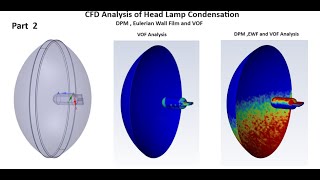
CFD Analysis of Head Lamp Condensation - DPM, EWF, and VOF Condensation Models
Model condensation in headlamps using DPM, EWF, and VOF approaches. Learn particle absorption, film thickness, and transitions between models for accurate simulation.
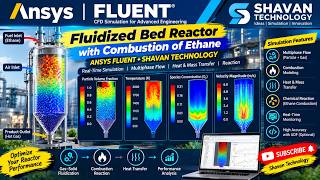
Fluidized Bed Reactor Modeling with DDPM, DEM Collision, and Combustion in Ansys Fluent
Model fluidized bed reactors using DEM collision, DDPM, and combustion in Ansys Fluent. Learn to incorporate particle interactions for accurate simulations.
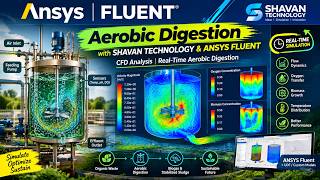
Aerobic Digestion in Bio-Reactor - Monod Reaction, Biomass Growth, and Heterogeneous Reaction
Explore aerobic digestion in bioreactors using Ansys Fluent, covering Monod reaction, biomass growth, and heterogeneous reactions.
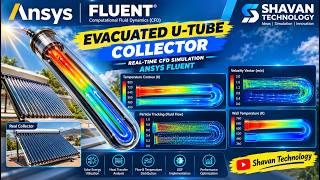
Evacuated U-Tube Solar Collector - Design and Analysis
Explore evacuated U-tube solar collectors using DO model ANSYS Fluent simulation for efficient solar energy collection and analysis.
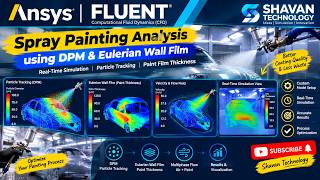
CFD Analysis of Spray Painting - DPM and Eulerian Wall Film in Ansys Fluent
Explore spray painting simulation using DPM and Eulerian wall film in Ansys Fluent, featuring DEFINE_DPM_INJECTION_INIT macro implementation.
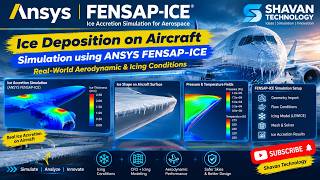
Ice Deposition on Aerodynamic Surfaces Using Ansys Icing - Subcooled Water and Freezing
Explore ice formation on aerodynamic surfaces at high altitudes using Ansys Icing, focusing on flow, water deposition, and freezing processes with subcooled water droplets.
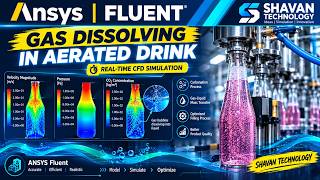
Aerated Drink Analysis Using Ansys Fluent - Henry's Law and Solubility of Gas in Liquid
Explore gas dissolution in liquids under high pressure using Ansys Fluent, applying Henry's Law to analyze aerated drink behavior and gas solubility.

Modulating Lipid Packing and Solute Permeability of Model Protocells
Explore lipid packing and solute permeability in model protocells, gaining insights into early cell membrane formation and potential implications for astrobiology research.
Detecting the Unruh Effect in Thermal Analogue Systems
Explore the Unruh effect in thermal analogue systems, focusing on BECs and superfluid helium. Discover recent proposals and theoretical developments for detecting this quantum phenomenon.
Expansion Thresholds for the Stability of Cosmological Fluids
Explore stability thresholds for cosmological fluids in expanding universes. Examine recent progress on homogeneous fluid states and their dependence on expansion rates.
Causality Constraints on Effective Field Theories
Explore causality's role in constraining higher derivative corrections to Einstein Maxwell theory through photon scattering off charged shock waves, examining gravitational effects and IR divergences.
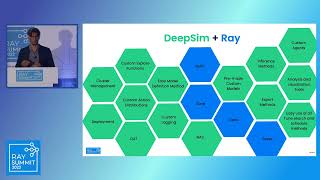
Wind Farm Optimization Using Reinforcement Learning and Large-Scale Simulation
Optimize wind farm energy production using deep reinforcement learning and large-scale simulations. Boost annual output by 1-2% through advanced yaw control strategies.
High Resolution Flux Estimation with TurbulenceFlux.jl
Explore advanced flux estimation techniques using wavelet analysis in TurbulenceFlux.jl, offering improved accuracy for non-stationary environments and turbulent transport identification in ecosystem studies.
Oceananigans - An Ocean-Flavoured Fluid Dynamics Library
Explore Oceananigans, a Julia-based fluid dynamics library for oceanic modeling, featuring flexibility, GPU performance, and easy integration of custom components like sea-ice and biogeochemistry.

Neural Implicit Flow - Physics Informed Machine Learning
Explore physics-informed machine learning with Neural Implicit Flow, covering turbulent data compression, sparse sensor placement, and mesh-agnostic approaches for advanced fluid dynamics applications.