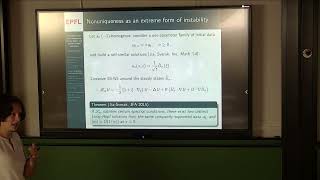
Instability and Non-Uniqueness for the Euler and Navier-Stokes Equations
Explore instability and non-uniqueness in Euler and Navier-Stokes equations, focusing on effective theories in classical and quantum particle systems.
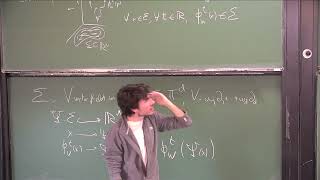
Quasiperiodicity and Chaos in the Incompressible Euler Equation
Explore quasiperiodicity and chaos in incompressible Euler equations through analytic techniques in dynamics and geometry.
Wind-Forced Seasonal Exchange Between Marginal Seas and the Open Ocean
Explore wind-driven circulation in marginal seas and ocean exchange using numerical models. Analyze interior and shelf dynamics, coastal wave impacts, and deep water exchange through straits.
Mechanisms of Offshore Solid and Liquid Freshwater Flux from the East Greenland Current
Explore mechanisms controlling freshwater export from East Greenland Current using numerical models and scaling theory. Analyze offshore ice flux, liquid freshwater flux, and key parameters influencing these processes.
Hydrodynamics: From Relativistic to Carroll - Lecture
Explore hydrodynamics as an effective field theory, focusing on symmetries and their role in constructing Euclidean thermal partition functions for exotic field theories.
Modeling Planetary-Scale Fluid Flows in the Laboratory
Explore planetary-scale fluid dynamics through laboratory experiments, from Rossby waves to exoplanet atmospheres. Gain insights into climate transitions and extreme weather patterns.
Stratospheric Planetary Flows from the Perspective of the Euler Equation on a Rotating Sphere
Explore stratospheric planetary flows through the lens of the Euler Equation on a rotating sphere, delving into the dynamics of large-scale fluid movements.
Dynamics Near a Shear Flow with Coriolis Force
Explore the impact of Coriolis force on large-scale fluid dynamics, focusing on shear flows under beta-plane approximation and their unique spectral properties.
Waves on the β-Planes in the Presence of a Mean Zonal Flow - Beyond the Doppler Shift
Explore waves on β-planes with mean zonal flow, analyzing eigenvalue equations, dispersion curves, and instabilities in rotating shallow water systems.
The Matsuno-Gill Model on the Sphere - Extended Analysis and Applications
Explore the extended Matsuno-Gill model on a sphere, analyzing its parameters and solutions across different damping and rotation rates. Gain insights into planetary-scale fluid dynamics.
Vortices over Bathymetry - Dynamics of Planetary-scale Fluid Flows
Explore long-lived anticyclones over topographic basins in oceans, examining their coexistence with cyclonic circulation and analyzing variational solutions in two-layer models.
Modeling Density-Driven Flows in the Presence of Chaotic Advection
Explore a hybrid kinematic-dynamic model for density-driven flows, combining traditional Stommel Box and chaotic advection approaches to study oceanic feedback processes.
Dipolar Geophysical Vortices: Coastal Eddies and Mesoscale Ocean Dipoles
Explore coastal eddy modeling and mesoscale dipoles in ocean dynamics. Analyze vortex-wave interactions, energy fluxes, and quasi-geostrophic equations for planetary-scale fluid flows.
The Limits of Beta Plane Turbulence
Explore jet separation scales in quasigeostrophic shallow-water systems, examining flow structure simplification and transitions in jet structure across varying deformation radii.
Wind-Driven Transport at the Ocean Surface: Beyond the f-Plane
Explore wind-driven ocean transport beyond the f-plane, examining Ekman's theory extensions to β-plane and sphere, and analyzing water column trajectories using advanced mathematical techniques.
The Dynamics of Oceanic Vortices
Explore mesoscale vortices in Earth's oceans, their connections to regional currents and submesoscale structures, using observations and models. Compare with other planetary atmospheres.
Balance, Jets and Coherent Structures in Geophysical Fluid Dynamics - Lecture 4
Explore planetary-scale fluid dynamics, focusing on balance, jets, and coherent structures in geophysical systems.
Balance, Jets and Coherent Structures in Geophysical Fluid Dynamics - Lecture 3
Explore planetary-scale fluid dynamics, focusing on balance, jets, and coherent structures in geophysical systems.
Mathematical Fluid Dynamics of Atmospheric and Oceanic Flows
Explore mathematical fluid dynamics for atmospheric and oceanic flows, focusing on thin-shell approximation in rotating spherical coordinates and perturbation theory for atmospheric modeling.
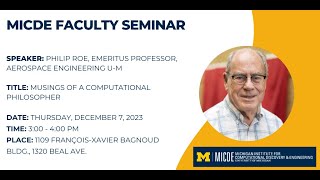
Musings of a Computational Philosopher - Exploring Accuracy in Compressible Flow Algorithms
Explore computational fluid dynamics through philosophical lens. Delve into accuracy, information flow, and innovative algorithms for compressible flow problems. Gain insights from an emeritus professor's decade-long research.
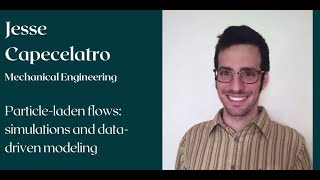
Particle-Laden Flows: Simulations and Data-Driven Modeling
Explore particle-laden flows through simulations and data-driven modeling techniques, gaining insights into complex fluid dynamics and engineering applications.