
Stretch, Recoil, Break - The Turbulent Voyage of a Polymer by Jason Picardo
Explore the dynamic behavior of polymers in turbulent environments, examining stretching, recoiling, and breaking mechanisms. Gain insights into complex fluid dynamics and soft matter physics.

Elastocapillary Phenomena - Lecture 2
Explore elastocapillary phenomena in soft matter physics, examining interactions between elastic and capillary forces in materials and their applications across various scientific disciplines.

Elastocapillary Phenomena - Lecture 1
Explore elastocapillary phenomena: interactions between elastic and capillary forces in soft materials. Learn fundamental concepts and applications in physics, engineering, and biology.

The Odyssey of Liquid Crystals - From Carrot to Flat Screen by Michel Mitov
Explore the fascinating journey of liquid crystals from their discovery in carrots to their application in flat screens, revealing their impact on technology and daily life.
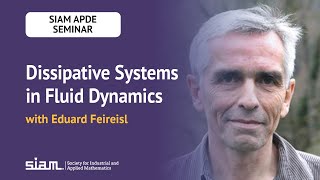
Dissipative Systems in Fluid Dynamics with Eduard Feireisl
Explore dissipative systems in fluid dynamics, focusing on evolutionary partial differential equations, boundary conditions, and challenges in modeling thermodynamically open systems that exchange energy with the environment.

Polymer Material Design for Gas Separations - Lecture 2
Explore polymer material design for gas separations, focusing on advanced techniques and applications in membrane technology for efficient molecular separation processes.

Elastocapillary Phenomena - Lecture 3
Explore elastocapillary phenomena in soft matter physics, examining interactions between elastic and capillary forces in materials and their applications across various scientific disciplines.
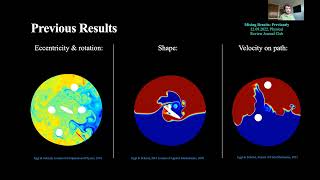
Mixing Enhancement for Binary Fluids Using PDE-Constrained Optimization
Optimization approach for enhancing binary fluid mixing efficiency through innovative stirring protocols and stirrer shapes, utilizing unsteady hydrodynamics and vortex-shedding to improve homogeneity within energy constraints.
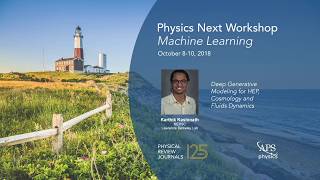
Deep Generative Modeling for HEP, Cosmology and Fluid Dynamics
Explore deep generative modeling applications in high-energy physics, cosmology, and fluid dynamics with insights from NERSC expert Karthik Kashinath.
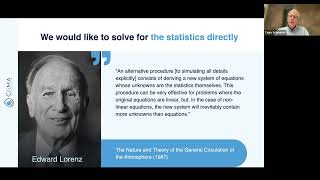
Turbulence: The Great Unsolved Problem of Classical and Climate Physics
Explore turbulence as a critical unsolved problem in classical and climate physics with Professor Tapio Schneider, delving into its impact on our understanding of climate variability.
Prediction and Manipulation of Hydrodynamic Rogue Waves
Explore hydrodynamic rogue waves, focusing on the Peregrine soliton's emergence from various initial conditions and its controlled occurrence in water tank experiments using nonlinear spectral engineering.

Deep Spontaneous Penetration of Water into Hot Granular Materials - Physical Review Journal Club
Exploring the unexpected deep penetration of water droplets into hot granular materials, challenging traditional Leidenfrost effect assumptions and revealing unique fluid-like behaviors of granular substances.

Discussing Turbulence - Novel Scaling and Symmetry Approaches
Explore novel turbulence scaling in fluid mechanics through symmetry theory and high-resolution simulations. Gain insights from Martin Oberlack's research on wall-bounded shear flows and channel flow dynamics.

Growth of Respiratory Droplets in Cold and Humid Air
Explores how respiratory droplets grow in cold, humid air, challenging previous assumptions and discussing implications for airborne disease transmission.
Physics Matters - Fluid Dynamics of Wildfires
Explore the fluid dynamics of wildfires, their environmental impact, and how Computational Fluid Dynamics can model and potentially prevent these destructive natural phenomena.

Aspect Ratio Affects Iceberg Melting - Physical Review Journal Club
Explore how iceberg shape influences melting rates in this insightful discussion with researchers, featuring presentation of results and audience Q&A.

The Influence of Multiple Scales in Fractured Media on Flow and Transport Properties
Explore how fracture geometry and network structure in low-permeability media affect fluid flow and solute transport using discrete fracture network models and high-fidelity simulations.
Pore to Darcy to Field Scale: Challenges in Upscaling Porous Media Models
Explore multiscale modeling in porous media, from nanometers to kilometers. Discuss upscaling challenges, theoretical advances, and practical applications in geosciences, with insights on physics and data integration.
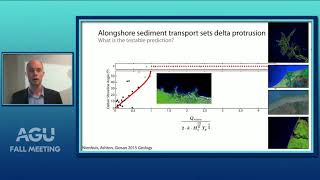
Testing Morphodynamic Theories by Comparing and Contrasting River Deltas
Explore coastal dynamics and river delta morphology, examining the impact of waves, tides, and fluvial forces on delta formation and future changes due to human activities and sea-level rise.
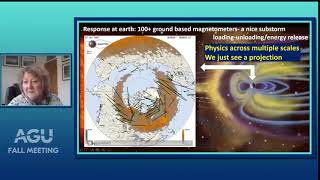
Multiscale Nonlinear Space Physics: From Fundamental Physics to Quantifying Risk - Ed Lorenz Lecture
Introduction to nonlinearity, complexity, and scaling in earth science processes, focusing on solar system plasmas. Explores challenges and progress in applying nonlinear physics concepts to space weather and magnetospheric dynamics.
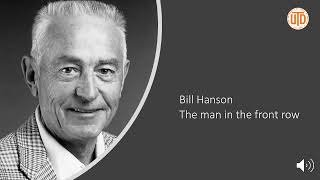
William B. Hanson and SPA Award Lectures 2020
Innovative space science lectures covering ionospheric dynamics, plasma turbulence, and shock waves. Highlights research contributions from early-career scientists and public outreach efforts in space physics.