Нелинейная волновая механика и технологии - Аннотация курса
Изучите основы нелинейной волновой механики и связанных технологий. Сформируйте базовые знания в этой области геологии и нефтегазовой отрасли.
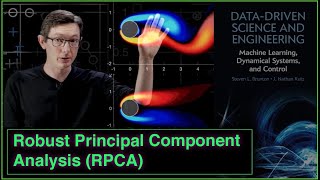
Robust Principal Component Analysis
Explore robust PCA for handling corrupted data in fields like fluid mechanics and image processing. Learn its applications and importance in data-driven science and engineering.
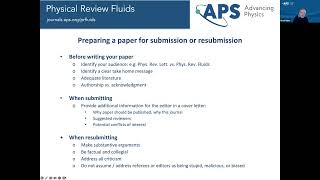
Physical Review Fluids Tutorial for Authors and Referees
Tutorial on manuscript submission and review processes for Physical Review Fluids, offering tips for efficient writing and refereeing. Presented by journal editors to help authors and reviewers navigate the publication process.
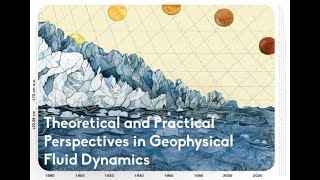
Visualization with Python Tutorial
Learn Python visualization techniques for geophysical fluid dynamics, covering data representation and analysis tools essential for atmospheric and oceanic research.

Theoretical and Practical Perspectives in Geophysical Fluid Dynamics - Afternoon Session
Explore geophysical fluid dynamics through lectures, talks, and tutorials on eddies, waves, turbulence, and climate modeling. Gain insights from theory, models, and observations in this interdisciplinary meeting.
Adaptive Regularization and Linearization for Nonsmooth and Degenerate Problems
Explore advanced mathematical techniques for solving nonsmooth and degenerate problems in flow and transport, focusing on adaptive regularization methods and Newton-based linearization approaches.

The Million Dollar Equations - With Tom Crawford
Explore four of the seven unsolved million-dollar math problems, including the Riemann hypothesis and P vs NP, with Oxford mathematician Tom Crawford in this engaging lecture on complex mathematical concepts.
Infinity in Greek Mathematics - Math History - NJ Wildberger
Explore ancient Greek mathematics, focusing on Eudoxus and Archimedes' groundbreaking work in calculus, geometry, and mechanics. Discover their ingenious formulas and principles that laid the foundation for modern mathematics.

The Divergence of a Vector Field: Sources and Sinks
Explore the divergence operator in vector calculus, understanding its role in quantifying local expansion or contraction of vector fields, with examples and applications in fluid dynamics.
Vectorized Integration and the Lorenz Equation
Explore vectorized integration and the Lorenz equation, focusing on chaos, turbulence, and uncertainty in engineering mathematics, with practical MATLAB implementations.
Overview of Engineering Mathematics
Explore engineering mathematics through weather modeling, covering fluid dynamics, disease networks, and systems of equations using MATLAB.
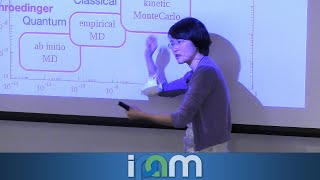
Multiscale Inverse Problem, from Schroedinger to Newton to Boltzmann - IPAM at UCLA
Explore multiscale inverse problems across quantum, classical, and statistical physics, connecting Schroedinger, Newton, and Boltzmann equations to reveal universal mathematical principles in diverse scientific domains.
Why Study Fluid Mechanics?
Explore the importance and applications of fluid mechanics in this engaging lecture by Rama Govindarajan, offering insights into this fundamental field of physics and engineering.
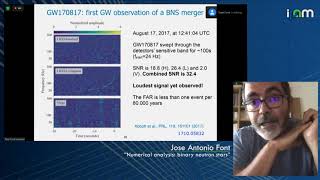
Numerical Analysis - Binary Neutron Stars - IPAM at UCLA
Explore numerical modeling of binary neutron star mergers, covering hydrodynamics, MHD equations, and simulation methods. Learn about gravitational waves, gamma-ray bursts, and r-process elements.
Promoting Global Stability in Models of Quadratic Nonlinear Dynamic
Explore innovative algorithm for identifying globally stable fluid and plasma flow models, featuring presentation and Q&A on recent research in nonlinear dynamics and vortex shedding.
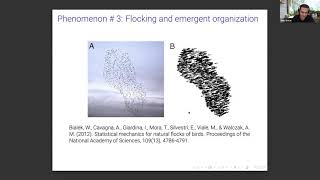
Comprehensive Fluids, Entropy Hierarchies, and Flocking - SIAM PDE Seminar
Exploring compressible fluid equations, entropy hierarchies, and flocking dynamics. Covers Navier-Stokes models, nonlocal collective dynamics, and mathematical proofs for fluid behavior and emergent organization.
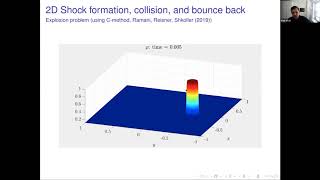
Shock Formation and Vorticity Creation for Compressible Euler
Exploration of shock formation and vorticity creation in compressible Euler equations, featuring constructive proofs, self-similar variables, and analysis of singularities in multiple dimensions.

Navier-Stokes Equations
Explore the fascinating Navier-Stokes equations with Oxford mathematician Tom Crawford, discussing their significance and the $1 million Millennium Prize challenge they present.

Deriving the Heat Equation in 2D and 3D and in N Dimensions with Control Volumes and Vector Calculus
Explore the derivation of the heat equation in multiple dimensions using Gauss's theorem, control volumes, and vector calculus techniques for a comprehensive understanding of heat transfer.

Partial Differential Equations Overview
Explore the mathematical language of physical phenomena with an overview of partial differential equations, covering canonical PDEs, linear superposition, and nonlinear PDEs like Burgers Equation.
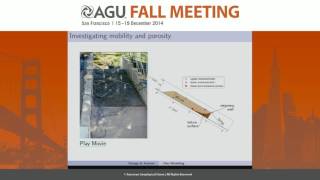
Numerical Modeling of the 2014 Oso, Washington, Landslide
Explore numerical simulations of the 2014 Oso landslide, examining factors behind its devastating runout. Learn how initial sediment conditions can dramatically influence landslide behavior and consequences.