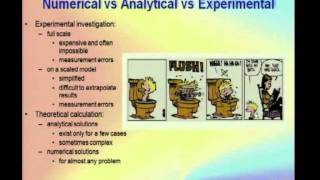
Computational Fluid Dynamics
This course provides an introduction to Computational Fluid Dynamics (CFD) with an emphasis on the fundamental principles that govern the implementation of CFD in practical applications.

Computational Fluid Dynamics
Comprehensive exploration of computational fluid dynamics, covering mathematical foundations, discretization methods, and numerical techniques for solving fluid flow problems.
Computational Fluid Dynamics
This course looks at all the aspects theoretical, numerical, and application aspects of computational fluid dynamics. Computational fluid dynamics (CFD) has become an essential tool in the analysis and design of thermal and fluid flow systems in a wide r…
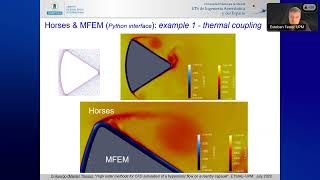
New Avenues in Computational Fluid Dynamics
Explore cutting-edge developments in high-order spectral element solvers for computational fluid dynamics, including multiphysics simulations and machine learning integration.
Finite Element Modeling of Magnetic Fields in Julia
Explore finite element modeling of magnetic fields using Julia in this TU Delft master course. Implement mathematical models and collaborate on real-world projects with industry partners.

Machine Learning to Enhance Numerical PDE Simulations
Explore machine learning techniques to enhance numerical PDE simulations, focusing on acceleration, surrogate modeling, and improved physical representation for complex physics and engineering systems.
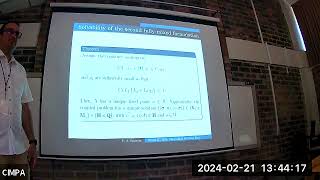
New Banach Spaces-Based Fully-Mixed Finite Element Methods for Pseudostress-Assisted Diffusion
Explora nuevos métodos de elementos finitos mixtos para difusión asistida por pseudoestrés, basados en espacios de Banach.
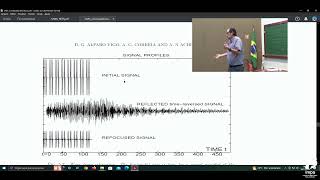
Numerical Methods for PDEs - Class 22
Aprofunde-se em métodos numéricos avançados para equações diferenciais parciais, explorando técnicas e aplicações em nível de doutorado.
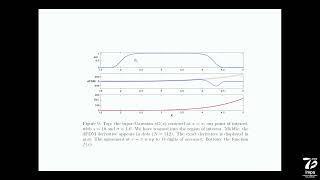
Numerical Methods for PDEs - Class 21
Explore advanced numerical methods for solving partial differential equations in this doctoral-level lecture, focusing on cutting-edge techniques and applications in mathematical modeling.
Convergence in Hölder and Sobolev Norms for Galerkin Approximations of Generalized Whittle-Matern Fields
Optimal convergence rates for Galerkin approximations of generalized Whittle-Matern fields in Hölder and Sobolev norms, covering spectral and finite element methods for Gaussian random fields.
Two-Scale FEMs for Non-Variational Elliptic PDEs
Explore advanced finite element methods for non-variational elliptic PDEs, focusing on two-scale approaches, monotonicity enforcement, and novel error estimation techniques for complex mathematical problems.
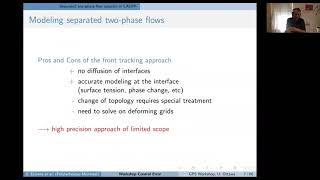
Combined Arbitrary Lagrangian-Eulerian Approach and Adaptive Remeshing Technique for the Finite
Explore advanced numerical methods combining ALE approach and adaptive remeshing for finite element simulations, enhancing accuracy and efficiency in complex engineering problems.
The Multiscale Hybrid Mixed Finite Element Method for Polygonal Meshes
Explores Multiscale Hybrid Mixed method for polygonal meshes, discussing upscaling, flux reconstruction, and a new variant with elliptic problems. Covers applications and collaborations in computational mathematics.
Multiscale Approximations for the Stationary Ginzburg-Landau Equation
Explores discrete minimizers of Ginzburg-Landau energy in finite element spaces, focusing on parameter κ's influence on vortex lattices and mesh resolution conditions for accurate numerical simulations.
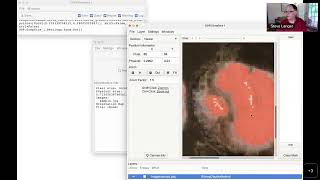
Microstructure Modeling with OOF2 and OOF3D - Interactive Finite Element Analysis for Materials Science
Explore microstructure modeling using OOF2 and OOF3D. Learn to assign material properties, construct finite-element meshes, and perform virtual experiments to investigate structure-property relationships.
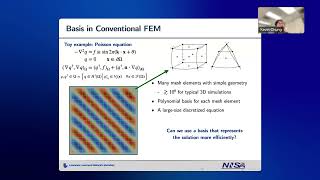
Data-Driven Discontinuous Galerkin FEM via Reduced Order Modeling and Domain Decomposition
Explore scalable component reduced order modeling for efficient large-scale simulations, combining Discontinuous Galerkin Domain Decomposition and proper orthogonal decomposition to accelerate scientific technology transition.
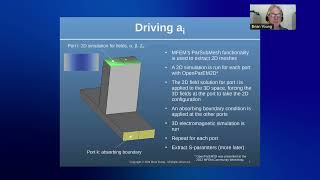
A Full-Wave Electromagnetic Simulator for Frequency-Domain S-Parameter Calculations
Explore an open-source electromagnetic simulator for S-parameter calculations, featuring adaptive mesh refinement, arbitrary order finite elements, and parallel processing using MFEM.
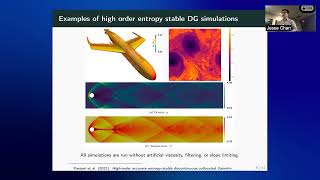
High Order Positivity-Preserving Entropy Stable Discontinuous Galerkin Discretizations
Explore high order discontinuous Galerkin methods for nonlinear conservation laws, focusing on entropy stability and positivity preservation in numerical solutions.
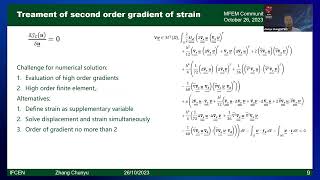
Homogenized Energy Theory for Solution of Elasticity Problems - MFEM Workshop 2023
Explore homogenized energy theory for solving elasticity problems, addressing limitations in classical continuum mechanics and offering insights into size effects and stress singularities.
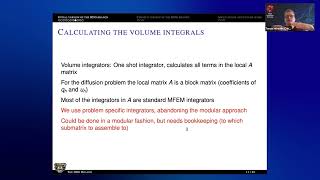
Implementation of Hybridizable Discontinuous Galerkin Methods - MFEM Workshop 2023
Explore advancements in hybridizable discontinuous Galerkin methods for high-order finite element calculations, featuring flexible implementations for diverse PDEs and applications.
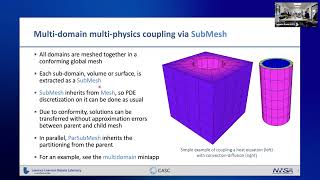
MFEM Workshop 2023 - Recent Developments in Modular Finite Element Methods
Explore recent advancements in MFEM, including GPU optimizations, new mini-apps, and integrations with scientific software libraries for high-order finite element calculations.