
Technology and Invention in Finance - Financial Markets
Explore financial technology's societal impact, from limited liability corporations to inflation indexation and swap contracts, emphasizing the evolution and importance of financial inventions in managing risks.

Introduction to Financial Markets - Lecture 1
Explore finance as a pillar of civilized society, managing resources and risks. Learn from industry experts about investment, regulation, and using wealth for philanthropy.

Risk and Financial Crises - Probability Theory in Financial Markets
Explore probability theory in financial crises context, covering expected value, variance, covariance, and regression analysis. Learn about risk decomposition and the limitations of normal distribution assumptions in finance.

Investment Banking: Principles, Regulation, and Career Paths - Lecture 19
Explore investment banking principles, regulations, and career paths with insights from industry experts. Gain understanding of shadow banking, repo markets, and Wall Street's role in the financial crisis.

Exchanges, Brokers, Dealers, and Clearinghouses in Financial Markets
Explore the evolution of financial markets, from ancient exchanges to modern electronic trading, examining broker-dealer dynamics, order types, and the impact of high-frequency trading on market stability.

Introduction to Financial Theory - Why Study Finance?
Explore financial theory's history, efficient markets hypothesis, leverage cycle, and real-world applications through lectures and experiments. Gain insights into the field's relevance and limitations.

Options Markets - Introduction to Pricing, Exchanges, and Applications
Explore options markets, including pricing models, exchanges, and applications in portfolio management. Learn about the Black-Scholes formula and how options can be used for risk management in various asset classes.

Debt Markets: Term Structure and Interest Rate Theories
Explore debt markets, term structure, and bond pricing. Learn about Treasury auctions, corporate debt issuance, interest rate theories, and the impact of inflation on bond markets.

Forwards and Futures Markets - History, Development, and Applications - Lecture 21
Explore the history and mechanics of futures markets, from their origins in 17th century Japan to modern financial applications, including hedging strategies and risk management tools.

Portfolio Diversification and Supporting Financial Institutions - CAPM Model
Explore portfolio diversification, efficient frontiers, and the Capital Asset Pricing Model to maximize returns and manage risk in financial markets.

Real Estate Finance and Its Vulnerability to Crisis
Explore real estate finance, its vulnerability to crises, and its impact on the economy. Learn about commercial assets, mortgages, regulatory measures, and housing booms in this comprehensive lecture.

Making It Work for Real People - The Democratization of Finance
Explore financial risk management tools, social insurance programs, and ethical considerations in finance, with insights on inequality, government policies, and career guidance for young professionals.

Market Inefficiency and Risk Management in Financial Markets
Hedge fund manager Andrew Redleaf explores market inefficiency, psychological barriers in finance, risk management, and current economic issues, offering insights for aspiring investors and financial professionals.

Efficient Markets vs. Excess Volatility - Financial Markets
Explore theories of stock price analysis, including efficient markets and random walk, and their implications for predicting market behavior and beating the market.
Human Foibles, Fraud, Manipulation, and Regulation in Financial Markets - Lecture 8
Explore psychological factors influencing financial decisions and the role of regulatory bodies in protecting investors while maintaining market trust and participation.
Understanding Stocks and Corporate Finance - Lecture 11
Explore the stock market's role in corporate finance, including ownership, dividends, leverage, and key theories. Gain insights into how companies manage capital and shareholder relations.
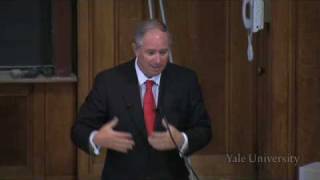
Financial Markets - Insights from Private Equity and Global Finance
Stephen Schwarzman shares insights on global finance, the subprime crisis, and his experiences in private equity. He offers career advice and discusses the future of investing and financial institutions.

Investment Banking and Secondary Markets - Financial Markets
Explore investment banking's role in financial markets, including underwriting, SEC requirements, and market stabilization, with insights on recent reforms and the importance of reputation.
Professional Money Managers and Their Influence in Financial Markets - Lecture 18
Explore the role of professional money managers, financial institutions, and regulatory bodies in personal finance and investment strategies for individuals and households.

Banking: Successes and Failures - From Goldsmiths to Modern Regulation
Explore the evolution, functions, and challenges of banking institutions, from their origins to modern regulatory frameworks and the subprime crisis, highlighting their crucial role in economic systems.
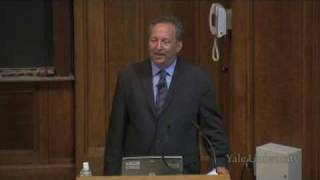
Learning from and Responding to Financial Crisis - Lecture 1
Explore financial crises, monetary policy, and economic cycles with insights from Lawrence Summers. Gain understanding of modern financial markets, behavioral finance, and government interventions in economic fluctuations.