
Lessons From Evaluating and Debugging Healthcare AI in Deployment
Explore challenges in translating AI to healthcare: data curation, model testing, and human-AI interactions. Learn insights from real-time AI trials and FDA-approved medical AI systems analysis.

Data, Algorithms, Justice and Fairness - Lecture 2
Exploring algorithmic fairness in justice systems: accuracy, data sources, and potential biases. Discusses AI decision-making, explainability, and societal implications of algorithms in criminal justice.

Fairness in Machine Learning: Tasks, Experiences, and Performance Measures
Explore fairness in machine learning, focusing on risk assessment tasks, data representation challenges, and performance measures. Learn about new findings and alternative approaches to promote equitable AI systems.

Privacy-Preserving, Fair, and Robust Machine Learning Models in Online Dating
Explore privacy-preserving, fair, and robust machine learning models in online dating apps. Learn about data privacy challenges and innovative solutions for protecting personal information while ensuring effective matchmaking.

Keynote - Consumer Protection in the Age of AI
Explore insights from Stephanie Nguyen of the U.S. Federal Trade Commission on critical issues at the intersection of technology, fairness, accountability, and transparency in this keynote address.
Unbiased Learning-to-Rank Needs Unconfounded Propensity Estimation
Explore advanced techniques in unbiased learning-to-rank systems, focusing on propensity estimation methods and their impact on fair ranking algorithms and search result optimization.

What is Your Data Worth? Equitable Data Valuation in Machine Learning
Explore equitable data valuation in machine learning, focusing on Data Shapley Value and its applications in healthcare, face recognition, and NLP.

Privacy and Fairness in Collaborative AI
Explore information-theoretic approaches to enhance privacy and fairness in collaborative AI systems, focusing on trustworthy machine learning techniques.

Algorithmic Decision Making and the Cost of Fairness
Explore algorithmic decision-making in pre-trial settings, examining bias identification, fairness concerns, and the trade-offs between accuracy and equity in automated systems.
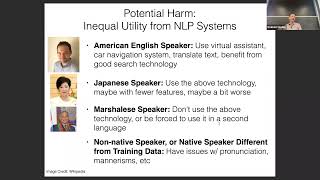
CMU Advanced NLP: Bias and Fairness
Explore types of bias in NLP models, detection techniques, and mitigation strategies for fairer language processing systems.
AI Explainability 360 - First Half of the Tutorial
Explore AI Explainability 360 toolkit: understand machine learning models, enhance transparency, and gain insights into AI decision-making processes for more responsible and ethical AI applications.
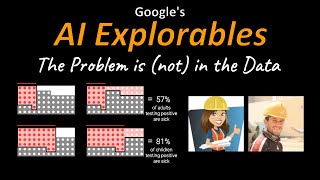
Is the Problem in the Data? Examples on Fairness, Diversity, and Bias
Exploring AI bias through interactive examples on fairness, diversity, and hidden biases. Examines whether bias issues stem from data or other factors in machine learning models.
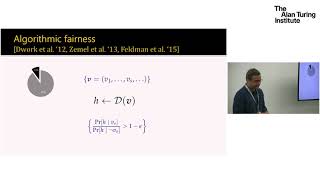
Fairness and Robustness in Machine Learning – A Formal Methods Perspective - Aditya Nori, Microsoft
Explore fairness in machine learning through formal methods. Learn techniques for verifying probabilistic properties and certifying fairness in decision-making programs using FairSquare.

Human-Compatible Artificial Intelligence - Stuart Russell, University of California
Stuart Russell explores the potential and risks of AI surpassing human capabilities, proposing a fundamental shift in AI development to ensure beneficial outcomes and addressing key ethical and philosophical questions.
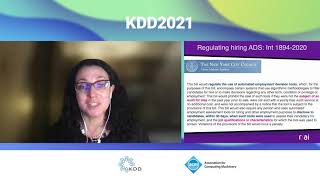
KDD TransFAT - Translating Fairness, Accountability, and Transparency - Julia Stoyanovich
Explore ethical AI challenges in automated decision systems, focusing on fairness, accountability, and transparency in hiring processes and beyond.

Interpretable Machine Learning - Data Brew Season 2 Episode 7
Explore interpretable machine learning with Ameet Talwalkar, discussing its relation to data privacy, fairness, and practical applications in this insightful interview on cutting-edge ML research.

Mitigating Bias in Models with SHAP and Fairlearn
Learn techniques to identify and mitigate bias in machine learning models using SHAP and Fairlearn, enhancing fairness and transparency in AI systems.

Flagging and Fixing Bias in Machine Learning
Explore techniques to identify and mitigate bias in machine learning models, enhancing fairness and accuracy in AI applications.
The Search for Transparency and Accountability in the Age of AI - RAI and XAI as Essential Tools
Explore responsible AI and explainable AI as essential tools for building ethical, transparent, and trustworthy systems. Uncover techniques to interpret complex models and foster accountability in AI development.

Algorithmic Fairness, Loss Minimization and Outcome Indistinguishability
Explore algorithmic fairness, loss minimization, and outcome indistinguishability in machine learning. Discover how these concepts address fairness issues and enable flexible predictor optimization across various constraints.

Evaluating Fairness of Machine Learning Models Under Uncertain and Incomplete Information
Explore methods for assessing ML model fairness with limited data, addressing challenges in uncertain and incomplete information scenarios.