
The Smallest Distributed System
Explore lessons learned from building Travis CI's distributed system, focusing on simplicity, resilience, and handling failures. Gain insights on evolving from a monolithic to a distributed architecture.

Reactive Systems - 21st Architecture for 21st Century Systems
Explore reactive systems architecture for modern software design. Learn about asynchronous messaging, isolation, back-pressure, and microservices to build scalable, resilient applications suited for 21st-century challenges.

Riak & Dynamo, Five Years Later
Reflection on Riak and distributed databases, discussing successes, challenges, and future prospects. Insights into NoSQL evolution since Amazon's Dynamo paper, with focus on Riak's journey and innovations.

Don't Give Up on Serializability Just Yet
Explore serializability in distributed databases, its benefits, and challenges. Learn about consistency models, transaction execution, and the balance between consistency and performance in modern systems.

I Made Everything Loosely Coupled - Does My App Fall Apart?
Explore nuances of integrated systems, including loose coupling, messages vs. events, and cloud automation's impact on integration. Learn to tackle challenges in modern, interconnected cloud applications.

Crafting the Core - Why and How We Built the Core Banking System
Explore the journey of building a core banking system, focusing on API-driven architecture, domain-driven design, and event storming. Learn about challenges, solutions, and best practices in modern fintech development.

The Future of Real-time - Offline - Data
Exploring the future of real-time and offline data management in web development, focusing on GraphQL and local-first approaches for simplified, efficient application architecture.

Managing Consistency, State and Identity in Distributed Microservices
Explore techniques for handling consistency, state, and identity in distributed microservices. Learn about idempotency, eventual consistency, CAP theorem, and distributed domain design for robust system architecture.

Using CRDTs to Build a Highly Available Decentralized Service
Explore CRDTs for building decentralized services in Go, covering implementation, advantages, and practical applications in distributed systems.

Patterns for Scalability and Availability in Trading Systems
Explore architectural patterns for high-availability, high-throughput trading systems. Learn approaches to balance performance, scalability, and reliability in millisecond-critical environments.
Easy Eventual Consistency with Actor Models + Amazon Web Services
Discover how to achieve strong eventual consistency in distributed systems using actor models and AWS, sidestepping the CAP theorem with simple rules and proven mathematical principles.
Effective Eventual Consistency with Actor Models + Amazon Web Services
Discover how to achieve strong eventual consistency in distributed systems using actor models and AWS. Learn practical techniques to sidestep the CAP theorem and ensure data integrity.
Embracing Messaging and Eventual Consistency in Your Microservices Solutions
Explore microservices architecture, messaging strategies, and CQRS patterns for scalable, manageable solutions. Learn design principles and implementation using ASP.NET Core and Azure services.
Hypermnesia: Auto Reconciliation in Mnesia - Code BEAM Europe 2023
Explore automatic conflict resolution in Mnesia using Hypermnesia, an extension featuring async_ec for streamlined replica reconciliation after network partitions.

The Road to Exceptional Data Correctness - Strategies from Stripe
Discover strategies for achieving exceptional data correctness in financial technology, including infrastructure design, quality checks, and observability platforms.

Mria - An Eventually Consistent Mnesia
Explore Mria, an extension of Mnesia database offering eventual consistency for improved horizontal scalability. Learn advanced Erlang techniques and testing methods used in EMQX message broker development.

Event Sourcing - What Could Possibly Go Wrong?
Explore challenges and solutions in Event Sourcing implementation, covering storage, schema evolution, scalability, and consistency. Learn from real-world experiences to optimize your ES architecture.

Conflict Resolution for Eventual Consistency
Explore eventual consistency in distributed systems, focusing on conflict resolution techniques for collaborative editors, mobile apps, and multi-datacenter databases. Learn strategies for offline functionality and data synchronization.

Providing Flexible Database Consistency Levels with Manhattan at Twitter
Explore Twitter's Manhattan distributed key-value store, its architecture, consistency levels, and adaptations. Learn about eventual consistency benefits and alternative models for database management.
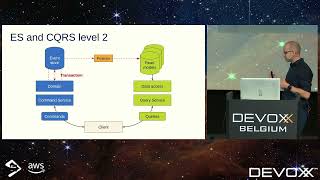
Event Sourcing - What Could Possibly Go Wrong?
Explore challenges and solutions in implementing Event Sourcing, including storage, schema evolution, scalability, and consistency, based on real-world commercial experience.
Dealing with Eventual Consistency
Explore patterns and strategies for handling eventual consistency in software systems, balancing user expectations for immediate feedback with backend performance and decomposability.