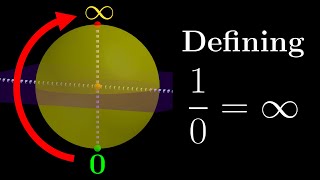
What if We Define 1-0 = Infinity - Möbius Transformations Visualized
Explore Möbius transformations and their connection to defining 1/0 = ∞, with insights on circular inversion, Riemann sphere, and applications in geometry and complex analysis.
How Geometry Created Modern Physics
Explore the evolution of geometry from Euclid to Einstein, uncovering how post-Euclidean concepts revolutionized our understanding of spacetime and laid the foundation for modern physics.
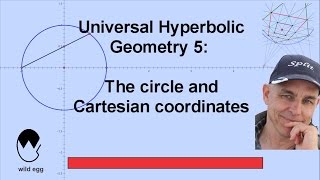
The Circle and Cartesian Coordinates in Universal Hyperbolic Geometry - Lecture 5
Explore Cartesian coordinates and the unit circle, covering key theorems on lines, points, and circles. Learn about determinants, parametrization, and the intersection of lines and circles in geometry.
Inconvenient Truths About the Square Root of 2 - Real Numbers and Limits
Explores the concept of sqrt(2), its historical significance, and modern approaches, challenging traditional views on irrational numbers and highlighting logical issues in mathematical analysis.
The Geometry of Surfaces - Algebraic Topology Lecture 20
Explore the connection between 2D surfaces and classical geometries, focusing on isometries and introducing hyperbolic geometry through circle inversions in the Beltrami Poincare disk model.
Reflections in Hyperbolic Geometry - Universal Hyperbolic Geometry Lecture 14
Explore reflections in hyperbolic geometry, comparing with Euclidean counterparts. Discover unique properties and surprising connections to circle geometry in this advanced mathematical exploration.
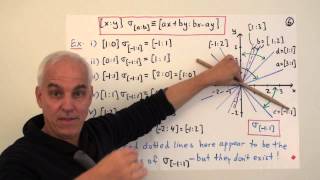
Isometry Groups of the Projective Line - Rational Geometry Math Foundations 138
Explore isometry groups of the projective line, focusing on rotations and reflections. Learn about symmetry, group theory, and their algebraic relationships in a concrete, accessible way.
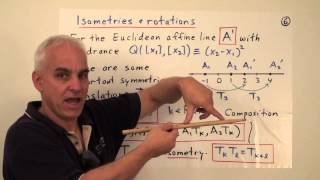
Algebraic Structure on the Euclidean Projective Line - Rational Geometry Math Foundations 137
Explores algebraic structure on the Euclidean projective line, covering projective formulas, isometries, rotations, and their compositions. Connects to chaos theory and complex number multiplication.
The Chromatic Algebra of 2x2 Matrices - Part 2
Explores chromatic algebra of 2x2 matrices, focusing on subalgebras, complexions, dot products, and the four-dimensional Dihedrons algebra. Compares to quaternions and highlights unique properties.
The Chromatic Algebra of 2x2 Matrices - Wild Linear Algebra B41
Explore chromatic algebra in 2x2 matrices, covering subalgebras, complexions, trace, determinant, and characteristic polynomials. Introduces unique dot products on 2x2 matrices.
Circles and Spheres via Dot Products - Part 1
Explore circles using dot products in linear algebra. Learn two approaches: quadratic and bilinear equations. Discover applications to tangents, pole/polar duality, and classical theorems in projective geometry.
Applications of the Dot Product to Planar Geometry - Part 1
Explore how the dot product shapes planar Euclidean geometry, introducing linear functionals, normal vectors for lines, and geometric projections in linear algebra.
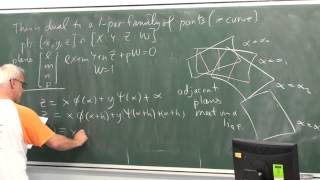
Meusnier, Monge and Dupin - Differential Geometry - Lecture 32
Explore Monge's contributions to differential geometry, including descriptive geometry, theorems, and studies on curves, surfaces, and lines of curvature in this advanced mathematics lecture.
The Rational Number Line and Irrationalities - Famous Math Problems 19b
Geometric approach to modeling the continuum using the rational number line. Explores properties, projective view, and introduces irrationalities through Euclidean geometry and polynomial equations.
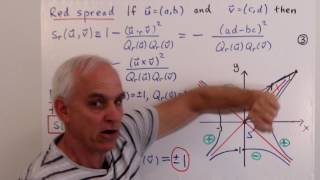
Colored Spreads and Generalizations in Rational Trigonometry - Lecture 2
Explore colored spreads in planar geometries, visualizing red and green spreads using cross products and determinants. Learn about generalized dot products and Pythagoras' theorem in different geometries.
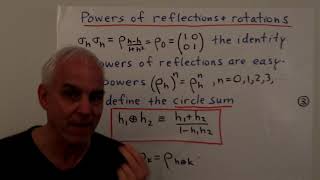
Half-Slope and the Full Group of Euclidean Isometries - WildTrig: Intro to Rational Trigonometry
Explore half-slopes in planar reflections and rotations, circle sums, and translations to understand Euclidean isometries. Gain insights into rational trigonometry and algebraic approaches to geometry.
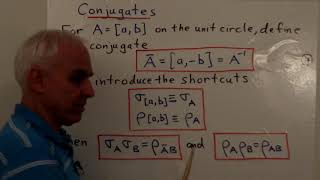
The Geometry of Euclidean Reflections and Rotations - Grounded Case
Explore Euclidean reflections and rotations using rational geometry. Learn about complex number multiplication, group structures, and a visual notation for describing transformations.

Geometry in Everyday Life - Past, Present, and Future
Explore the past, present, and future of geometry with Yang-Hui He and Madeleine Hall. Discover how geometric principles shape our world, from ancient postulates to modern applications in nature and science.
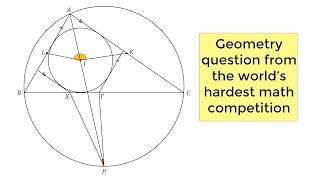
Geometry Problem from the 2024 International Mathematical Olympiad - Explained
Explore a challenging geometry problem from the 2024 International Mathematical Olympiad, with step-by-step analysis and proof techniques for advanced mathematical reasoning.
Affine and Euclidean Geometry - The Modern Approach
Explore modern approaches to affine and Euclidean geometry, with applications to electrodynamics and relativity theory in this advanced physics lecture.
The Conundrum of the Fourth Postulate - Euclid's Geometry Revisited
Explore the historical and philosophical aspects of Euclid's fourth postulate, examining its provability within a constructive setting and offering a novel perspective on this classical mathematical problem.