
Auditing Black-box Models
Learn techniques to audit and interpret complex machine learning models, focusing on detecting unintended dependencies and biases using a specialized software library through hands-on examples.

Will Self-Taught, A.I. Powered Robots Be the End of Us?
Experts explore AI's potential impact on humanity, discussing machine learning, creativity, consciousness, and ethics, while considering the future of artificial general intelligence.

Fairness Through Robustness - Investigating Robustness Disparity in Deep Learning
Explore robustness disparity in deep learning, its impact on fairness, and potential mitigation strategies for more equitable AI systems.
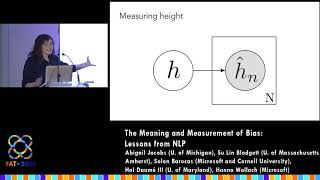
The Meaning and Measurement of Bias - Lessons from NLP
Explore the complexities of bias in NLP, covering measurement processes, construct validity, and fairness evaluation. Gain insights into representational harms and practical examples in word embeddings.

Learning Algorithms
Exploration of fairness in machine learning algorithms, focusing on disparity assessment, classification with fairness constraints, and comparative studies of fairness-enhancing interventions.
Provably Beneficial Artificial Intelligence
Stuart Russell explores the concept of provably beneficial AI, addressing potential risks and proposing solutions for developing AI systems that are demonstrably advantageous to humanity.
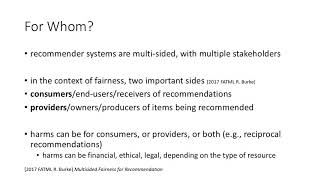
Building User Trust in Recommendations via Fairness and Explanations
Explore techniques to enhance user trust in recommender systems through fairness and explanations, addressing ethical concerns and promoting transparency in AI-driven decision-making.

Besser natürlich dumm als künstlich inteligent - Warum KI nicht die Lösung unserer Probleme sein kann
Kritische Betrachtung der KI: Grenzen, Unterschiede zur menschlichen Intelligenz und Auswirkungen auf Entscheidungsfindung und Wissenserzeugung in verschiedenen Lebensbereichen.
Addressing Algorithmic Bias
Explore strategies to address, avoid, and mitigate AI algorithmic bias in critical decision-making processes. Learn about fair algorithms, trade-offs in bias protection, and techniques for auditing and combating bias in AI systems.
Fight AI Bias With Bias
Explore techniques to de-bias datasets and build fair, equitable AI systems. Learn how to address biases, increase trust, and promote responsible AI practices for improved adoption and safety.

Self Replicating Genies - How to Democratize and Ensure Ethics in AI
Explore ethical AI systems and user data ownership in the age of automation. Learn strategies for democratizing AI while ensuring responsible development and implementation.
Implementing Ethics - Developing Trustworthy AI
Discover a UX framework for developing ethical AI systems that are accountable, de-risked, respectful, secure, honest, and usable. Learn practical steps to implement ethics in AI development.
Assessing and Mitigating Unfairness in AI Systems
Learn to assess and mitigate fairness issues in AI systems, focusing on healthcare disparities. Hands-on practice with Fairlearn library to evaluate and improve ML model performance across racial groups.
Approaches to Fairness and Bias Mitigation in Natural Language Processing
Exploring fairness and bias mitigation in NLP models, discussing detection methods, mitigation strategies, and tools to ensure equitable results in language understanding and generation applications.
Life is Not Fair, but Your ML Pipeline Can Be
Explore techniques to evaluate and enhance fairness in multi-cloud Kubeflow workflows, covering responsible AI, fairness aspects, and open-source tools for fair model learning and hyperparameter tuning.

Building an AI Arsenal
Palmer Luckey discusses developing cutting-edge AI for defense, addressing ethical concerns and geopolitical challenges in adapting advanced technologies.

An AI with an Agenda - How Our Cognitive Biases Leak Into Machine Learning
Explores how human cognitive biases can infiltrate AI and machine learning models, offering strategies to mitigate these issues and create more objective, ethical algorithms.
LinkedIn's Insights on AI Fairness in Hiring
Explore LinkedIn's approach to AI fairness in hiring, focusing on mitigating bias in algorithmic and product design, and data processing for more equitable recruitment practices.
Responsible AI: Importance, Challenges, and Future Directions
Explore responsible AI with IBM's Dr. Stacy Hobson, discussing its importance, examples of irresponsible AI, and future developments in inclusive technology research.

Generative AI Tools - Understanding Risks and Limitations
Explore the critical challenges and ethical considerations of generative AI, from inherent biases and environmental impacts to responsible implementation strategies and human-centric approaches.
Resisting AI: Understanding Social and Political Dimensions of Artificial Intelligence
Explore the critical social and political implications of AI systems with Dr. McQuillan, examining how deep learning impacts society and discovering alternative approaches rooted in feminist and decolonial perspectives.