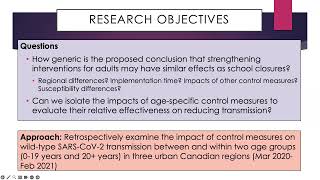
Retrospective Modelling Analysis on the Effects of Control Measures on COVID Transmission in Canada
Explore the impact of COVID-19 control measures in Canada through retrospective modeling analysis, examining transmission patterns and effectiveness of interventions.
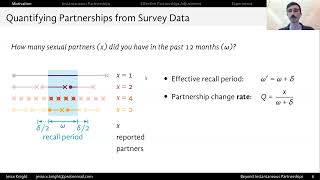
Re-examining the Force of Infection Equation in Compartmental HIV Transmission Models
Explore innovative approaches to HIV transmission modeling, focusing on the force of infection equation and its implications for public health strategies and interventions.
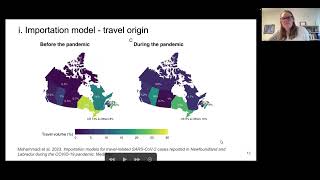
Modelling to Support Regions Implementing an Elimination Strategy
Explore mathematical modeling techniques for regional disease elimination strategies, focusing on public health applications and policy support.

Logarithms: Applications in Mobile Technology, Pandemic Modeling, and Social Networks
Explore logarithms' relevance in modern life, from pandemic modeling to information theory and social networks. Discover their history and applications in this insightful lecture by Professor Oliver Johnson.
Vectors and How Climate May Impact Them
Explore how climate change affects disease vectors, their ecology, and transmission dynamics. Gain insights into vector-borne diseases and their potential future impacts on ecosystems and public health.
Cause and Effect - Understanding Causation in Scientific Research
Exploring causal inference methods in epidemiology and their impact on scientific understanding, challenging traditional views on correlation vs. causation in data analysis.
Graphs in the Modern World: Analyzing Infectious Disease Dynamics
Explore graph-based models for analyzing infectious diseases, from deterministic compartmental models to agent-based simulations in modern epidemiology.
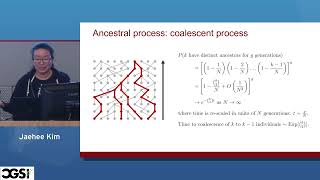
Bayesian Inference of Dependent Population Dynamics in Coalescent Models
Explore Bayesian inference techniques for analyzing dependent population dynamics in coalescent models, focusing on applications in genomics and evolutionary biology.

On the Spread of an Infection in a Host Population Distributed on Z - Lecture
Explore mathematical models of infection spread in host populations distributed on Z, focusing on stochastic processes in evolutionary biology.
A Mathematical Toolkit for Pandemics
Explore mathematical tools for understanding and managing pandemics with Prof. Julia Gog. Gain insights into modeling, data analysis, and decision-making strategies for infectious disease outbreaks.
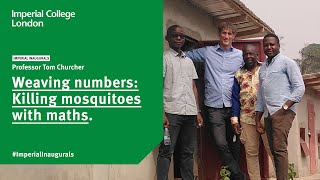
Weaving Numbers: Killing Mosquitoes with Mathematics
Explore how mathematical modeling aids in combating mosquito-borne diseases and informs effective intervention strategies for global health impact.
Statistics 101 for Bedside Nurses - 2023
Learn essential statistical concepts for bedside nursing, enhancing your ability to interpret and apply data in clinical practice.
Bayesian Markov Switching Space-Time Model for Zika in Colombia
Explorez un modèle bayésien spatio-temporel à changement de régime markovien pour l'épidémie de Zika en Colombie, examinant les facteurs d'émergence, de transmission et de persistance de la maladie.
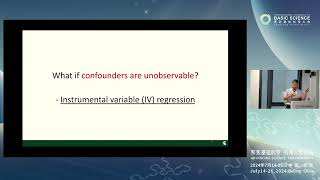
Causal Inference with Mendelian Randomization in Biomedical Studies
Explore Mendelian Randomization for causal inference in biomedical research. Learn innovative methods, overcome challenges, and gain insights into complex disease relationships through simulation and case studies.

Party Hard! The Maths of Connections - 2013
Explore unexpected applications of connection mathematics, from modeling flu epidemics to galaxy formation, through an intriguing party guest problem.

After Long COVID - A Musical Performance of Self-Discovery
Cellist Joshua Roman shares his long COVID journey through music, blending performance and storytelling to explore illness, self-discovery, and renewal. Followed by a discussion on long COVID research.
Using Mouse Models to Understand Disease Mechanism - Lessons From Cavernous Malformation and COVID-19
Explore groundbreaking research using mouse models to uncover disease mechanisms, focusing on cavernous malformation and COVID-19's impact on cardiovascular systems.
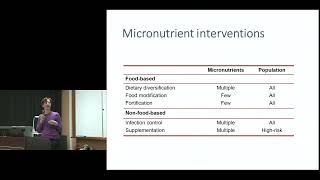
Micronutrients of Major Global Health Significance - Chapter 4
Explore the critical relationship between micronutrients and global health, focusing on key deficiencies, their impact on infections, and public health implications in different populations worldwide.
Vaccines - Presented by Professor Peter Openshaw
Explore COVID-19 vaccines with Prof. Openshaw: development, types, effectiveness, variants, and global strategies. Gain insights on immune responses and future prospects.

Type IV Hypersensitivity Reaction - Let's Make a Granuloma - Immunology
Explore Type IV Hypersensitivity Reactions and granuloma formation in this immunology lecture, covering clinical examples like poison ivy, tuberculosis, and sarcoidosis.

The Gram-Positive Bacteria - Microbiology and Infectious Diseases
Explore Gram-positive bacteria, focusing on Staphylococci and Streptococci. Learn key characteristics, clinical relevance, and diagnostic features of these important pathogens in microbiology and infectious diseases.