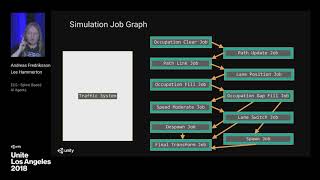
Spline Based AI Agents - Unite LA
Explore traffic simulation using ECS, examining compute kernels, Burst-produced code, and spline-based AI agents. Learn about system components, data structures, and optimization techniques.
Scaling CPU Experiences - An Introduction to the Entity Component System
Explore Unity's Entity Component System and C# Job System to optimize CPU performance in game development. Learn implementation techniques and benefits for modern, efficient game creation.

Introduction to Qt 3D
Explore Qt 3D for integrating real-time 3D rendering in C++ apps. Learn about Entity Component System architecture, custom geometries, materials, and user input handling.
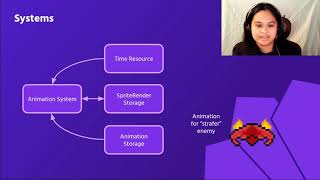
Project Necromancy - How to Revive a Dead Rust Project
Discover strategies for reviving abandoned Rust projects through effective planning, refactoring, and documentation. Learn from a real-world collaboration experience.
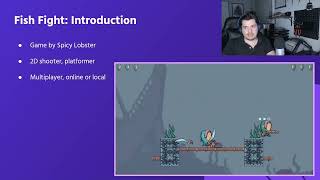
Making Rust More Accessible Through Game Development
Explore strategies to make Rust more accessible through game development, focusing on lowering barriers and attracting newcomers to the Rust community.
Building Your First Meta Spatial SDK App for Meta Quest
Dive into building immersive Meta Quest applications using Spatial SDK, from adding 3D objects to deploying your first interactive experience in just 11 minutes.
Game Programming: Collision Detection and AABB - Lecture 8
Explore collision detection in game programming, focusing on AABB techniques. Learn to implement and resolve collisions for realistic gameplay mechanics.

Game Programming: Building a Zelda-Style Game Engine with Entity Component Systems - Lecture 16
Dive into game programming fundamentals through a Zelda-style assignment, covering entity management, AI systems, asset handling, and physics implementation in C++ with SFML graphics.
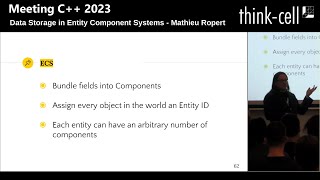
Data Storage in Entity Component Systems
Explore Entity Component System architecture, optimizing data arrangement for fast iteration and lookup in game development and beyond.
Game Programming: SFML Circles, Polygons, and Collisions - Lecture 7
Explore game programming concepts, including SFML graphics, entity-component systems, and game architecture. Learn to implement player controls, enemies, scoring, and special abilities.

Game Programming: Introduction to Entity Component System (ECS) - Lecture 5
Explore Entity Component System architecture for game development, enhancing performance and flexibility in C++ game programming.
Game Programming: Assignment 3 Overview and Implementation - Lecture 11
Explore game programming fundamentals, including vector math, rendering, AI, physics, and UI. Learn to build functional games using ECS architecture, C++, and SFML graphics library.
Game Programming Course Project Information - Lecture 14
Develop a game project with required features, scenes, and mechanics. Create a level editor, assets, and trailer. Submit proposal, demo, and report video. Work effectively in groups.

Game Programming: Saving Progress, Game Tools, and Drag & Drop - Lecture 16
Explore game programming essentials: saving progress, game tools, and drag & drop functionality. Learn practical techniques for enhancing player experience and streamlining development.
COMP4300 - Game Programming - SFML and ImGui Tutorial - Lecture 4a
Explore SFML and ImGui for game development, covering rendering, animation, and user interfaces in C++. Learn to create functional games using ECS architecture.
Game Programming: Introduction to Entity Component System - Lecture 5
Explore Entity Component System architecture for game development, learning its principles and implementation in C++ with SFML graphics library.
Game Programming: Sprites, Textures, and Animations - Lecture 9
Explore sprite rendering, texture management, and animation techniques for game development using C++ and SFML graphics library.
Game Programming: Assignment 3 Specification and Implementation - Lecture 11
Develop a 2D game with player movement, bullet spawning, collisions, and animations using C++ and SFML. Implement level loading, physics, and entity-component systems for a complete gaming experience.
Pathfinding and Steering in Game Programming - Lecture 15
Explore pathfinding and steering techniques in game development, enhancing AI movement and navigation for more realistic and engaging gameplay.
Introduction to Entity Component System (ECS) in Game Programming - Lecture 5
Explore Entity Component System (ECS) architecture for game programming, covering design principles, implementation details, and practical coding examples using C++ and SFML.
Game Programming: Optimizations, Cache Memory, and Memory Pooling - Lecture 17
Master game optimization techniques through cache memory management, memory pooling, and data structure efficiency for enhanced performance in C++ game development.