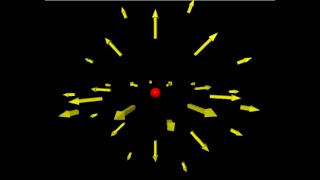
Creating a 3D Visualization of Electric Field Due to a Point Charge with Python
Create a 3D visualization of an electric field from a point charge using Web VPython, with step-by-step guidance and provided code.
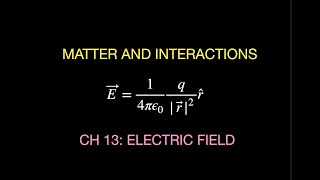
Matter and Interactions: Electric Fields - Chapter 13 Summary
Explore electric fields, charges, and forces in physics, covering Coulomb's law, superposition, spheres, and dipoles.
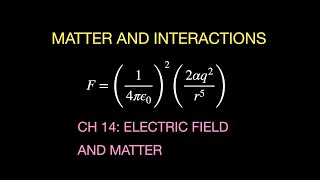
Electric Fields and Matter - Summary
Explore electric fields, charge conservation, insulators vs. conductors, induced dipoles, and drift velocity in this concise physics overview.
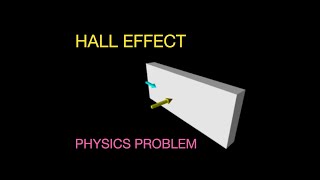
Physics Problem: Lorentz Force and the Hall Effect Sensor
Explore the Lorentz Force and Hall Effect through a practical problem, calculating electric fields, drift velocity, and potential difference in a metal bar.
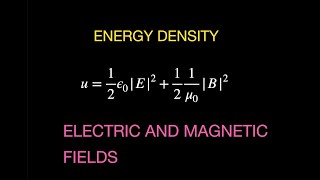
Finding the Energy Density for Electric and Magnetic Fields
Derive electric and magnetic field energy densities through step-by-step calculations and explanations.
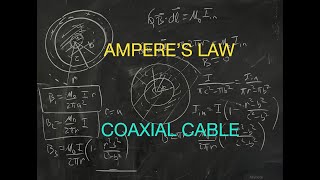
Ampere's Law: Magnetic Field due to a Coaxial Cable
Explore magnetic fields in coaxial cables using Ampere's Law, understanding key principles and applications in electromagnetic theory.
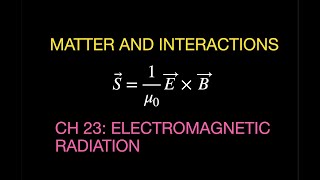
Matter and Interactions: Electromagnetic Radiation - Chapter 23 Summary
Explore electromagnetic radiation, Maxwell's equations, and the Poynting vector in this concise chapter summary on fixing Ampere's Law and wave pulses.
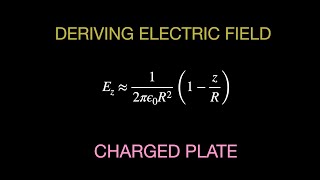
Finding the Electric Field Due to a Charged Plate and a Parallel Capacitor - All Steps
Derive the electric field for charged plates and parallel capacitors through step-by-step explanations and calculations.
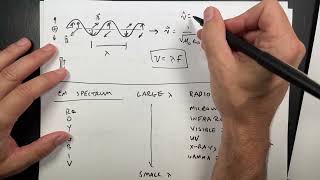
College Physics Chapter 22 Summary - Electromagnetic Waves
Explore electromagnetic waves, Maxwell's equations, wave properties, spectrum, refraction, energy, light intensity, polarization, and Doppler effect.
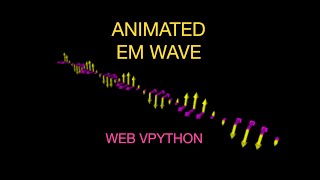
Animated Electromagnetic Wave in Web VPython
Create an animated electromagnetic wave visualization using Web VPython, enhancing understanding of EM field behavior through interactive coding.
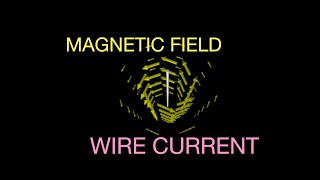
Magnetic Field due to a Wire - Python Calculation and Visualization
Explore magnetic fields created by wires through calculations and Python visualizations. Master theoretical concepts and practical applications in electromagnetism.
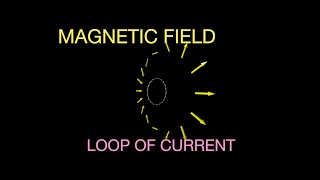
Magnetic Field due to a Loop of Current - Python Calculation Included
Derive the magnetic field from a current loop and perform numerical calculations using Python, enhancing understanding of electromagnetic principles.
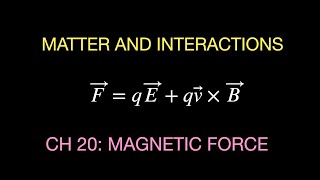
Matter and Interactions: Magnetic Force - Chapter 20 Summary
Explore magnetic force concepts, from charge interactions to practical applications like electric motors and the Hall Effect.
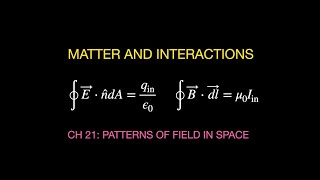
Matter and Interactions: Patterns of Fields in Space - Chapter 21 Summary
Explore fundamental concepts of electromagnetic fields, including flux, Gauss's Law, and Maxwell's equations, with practical applications and in-depth explanations.
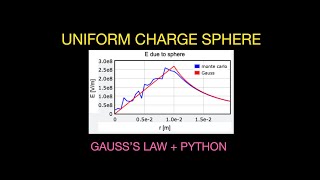
Electric Field due to Uniform Sphere - Gauss's Law and Python Simulation
Explore electric fields of uniformly charged spheres using Gauss's law and Python simulation with 10,000 random points for precise calculations.
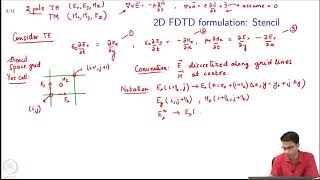
Finite Difference Time Domain Methods: 2D FDTD Formulation and Stencil
Explore 2D FDTD formulation and stencil techniques in finite difference time domain methods for electromagnetic wave simulation.
Spectral Approximation for Maxwell's Equations in Conductive Media
Explore spectral approximation for Maxwell's equations in conductive media, focusing on non-selfadjoint operators, spectral pollution, and domain truncation methods.

Can AI Solve Physics Problems? ChatGPT Takes on Physics Challenges
Explore ChatGPT's ability to tackle physics problems, from projectile motion to quantum mechanics. Witness AI's potential and limitations in comprehending and solving complex scientific questions.

Patterns in Tri-Block Copolymers: Droplets, Double-Bubbles and Core-Shells - A New Partitioning Problem
Explore patterns in tri-block copolymers, including droplets, double-bubbles, and core-shells. Examine a novel partitioning problem in mathematical physics and materials science.
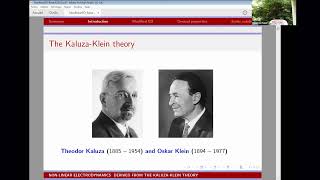
Non-linear Electrodynamics Derived from Kaluza-Klein 5-Dimensional Gravity
Explore non-linear electrodynamics derived from Kaluza-Klein theory, examining unique Maxwell equation generalizations and potential static solutions as electron models.

Topological Charges with Electromagnetic and Gravitomagnetic Interactions
Explore topological charges in liquid crystals and their resemblance to particle physics, examining EM-like Lagrangian, Gauss law, and particle-like topological defects in 4D field dynamics.