Multi-messenger Astrophysics - Part 1
Explore multi-messenger astrophysics through an in-depth lecture covering fundamental concepts, observational techniques, and recent discoveries in this cutting-edge field.
Introduction to Observational Astrophysics
Explore fundamental concepts and techniques of observational astrophysics, from celestial objects to data analysis methods.
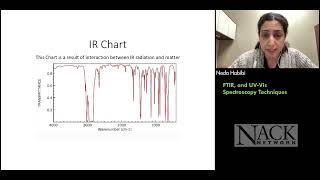
FTIR and UV-Vis Spectroscopy Techniques - Lecture 3
Explore FTIR and UV-Vis spectroscopy techniques, their principles, applications, and operational mechanisms. Gain insights into radiation interactions, vibration types, and spectrum analysis for nanoscale characterization.
Searching for Axion Dark Matter with a Dielectric Haloscope
Explore axion dark matter detection using dielectric haloscopes, covering working principles, simulations, technological challenges, and the MADMAX experiment's potential.
Axion Theory - Axion Electrodynamics - Lecture 1
Explore axion electrodynamics in this advanced physics lecture, delving into theoretical concepts and their implications for particle physics and cosmology.
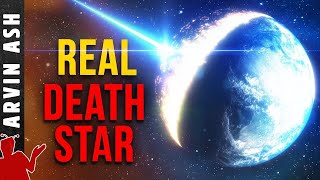
The Insane Power of a Hypernova - Second Only to the Big Bang
Explore the mind-blowing power of hypernovas, their formation, and potential cosmic threats. Discover how these stellar explosions create intense gamma-ray bursts that could impact Earth.
Physics 4B - Conceptual Questions on Sources of Magnetic Fields - Fall 2023
Explore sources of magnetic fields through conceptual questions, enhancing understanding of electromagnetic principles in physics.
Physics 4B - Sources of Magnetic Fields - Conceptual Questions
Explore sources of magnetic fields through conceptual questions, enhancing understanding of fundamental physics principles in this engaging lecture.
Physics 4C - Conceptual Questions with ChatGPT - Introduction to Photons
Explore fundamental concepts of photons and quantum physics through interactive discussions and AI-assisted learning, enhancing understanding of modern physics principles.
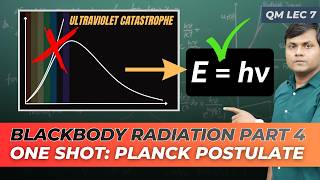
Understanding Ultraviolet Catastrophe and Planck Postulate - The Birth of Quantum Mechanics
Explore the origins of quantum mechanics through Planck's revolutionary solution to the ultraviolet catastrophe, challenging classical physics and introducing the concept of energy quanta.

Planck Theory of Blackbody Radiation - Resolving the Ultraviolet Catastrophe
Explore Max Planck's revolutionary theory explaining blackbody radiation, deriving the Planck Energy Distribution and resolving the ultraviolet catastrophe through energy quantization.
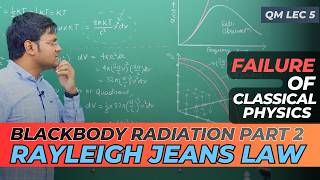
Rayleigh-Jeans Law and the Failure of Classical Physics
Explore the Rayleigh-Jeans Law, its foundations in classical physics, and how its failure led to the development of quantum mechanics, revolutionizing our understanding of radiation.

Blackbody Radiation - Experimental Observations, Stefan's Law, and Wien's Displacement Law - Part 1
Explore blackbody radiation, Stefan's law, and Wien's displacement law through experimental observations and theoretical explanations in this comprehensive physics lecture.
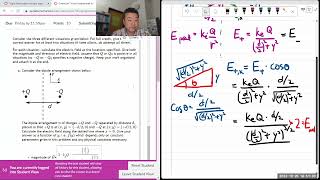
Physics 4B - Electrostatics Freeform Timed Assessment Demo - Extended Charge Field Calculation 1
Explore electrostatics through an extended charge field calculation, demonstrating practical problem-solving techniques in a timed assessment format.
Magnetic Fields in Current-Carrying Loops and Ideal Solenoids - General Physics
Explore magnetic fields in current-carrying loops and ideal solenoids. Learn formulas, right-hand rules, and solve practice problems to calculate field magnitudes at loop and solenoid centers.
Electromagnetic Waves in General Physics - Lecture 21.2
Explore electromagnetic waves, from Maxwell's equations to the EM spectrum. Learn about wave properties, light intensity, and the Doppler effect. Practice problem-solving to reinforce understanding.
Self Inductance and Mutual Inductance in General Physics - Lesson 20.3
Explore self inductance, mutual inductance, and transformers in AC circuits. Learn about Faraday's Law, Lenz's Law, and practical applications in electrical engineering.
Ultrarelativistic Nuclear Collisions as Seen Through Photons
Explore photon production in ultrarelativistic nuclear collisions, focusing on energy spectra, production mechanisms, and momentum anisotropy in proton-proton and heavy-ion collisions.
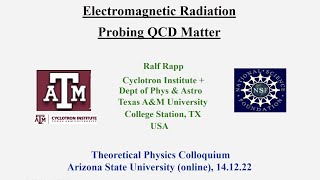
Electromagnetic Radiation Probing QCD Matter
Explore electromagnetic radiation's role in probing QCD matter, focusing on light vector mesons and their dilepton decays to understand in-medium spectral functions and QCD phase transitions.
Optical Waveguides - Theory and Design of 2D Confined Optical Waveguides
Explore the theory and design principles of optical waveguides with 2D confinement, enhancing your understanding of advanced photonics concepts.
Pale Blue Dot - Introduction to Energy and Climate on Earth
Explore Earth's energy balance, climate change, and the greenhouse effect with Cornell Professor Toby Ault in this engaging lecture at the Museum of the Earth.