Measurement Induced Transitions in Long-Range Spin Systems by Rosario Fazio
Explore measurement-induced transitions in long-range spin systems, examining their dynamics, properties, and implications for quantum physics and information theory.
Quantum Supremacy and Quantum Phase Transitions in Analog Quantum Many by Dimitris G. Angelakis
Explore quantum supremacy and phase transitions in analog quantum many-body systems. Gain insights into cutting-edge research on quantum simulation and its implications for complex quantum systems.
New Topological Phases with Quasi-periodic Driving
Explore new topological phases in quasi-periodically driven systems, examining localization-delocalization physics and their implications for quantum matter and complex systems.
How Wavefunction Geometry Helps Explain the Electromagnetic Responses of Solids
Explore wavefunction geometry's role in understanding electromagnetic responses of solids, bridging quantum mechanics and materials science for advanced insights into solid-state physics.
Probing Carrier Interactions in Quantum Matter Using Electron Hydrodynamics by Prineha Narang
Explore electron hydrodynamics to understand carrier interactions in quantum matter, focusing on novel techniques and insights in condensed matter physics and quantum materials research.
Dissipative Many-Body Quantum Systems & Hidden Time-Reversal by Aashish Clerk
Explore dissipative many-body quantum systems and hidden time-reversal symmetry. Gain insights into complex quantum phenomena and their implications for advanced physics research.
The Invisible Universe: From Supernovas to Black Holes
Explore the hidden cosmos beyond visible light, from ancient galaxies to black holes. Discover how astronomers use advanced technology to unveil the invisible universe and its fascinating phenomena.
A New Population of Mid-Infrared-Selected Tidal Disruption Events
Explore a newly discovered population of tidal disruption events selected through mid-infrared observations, offering insights into supermassive black holes and galactic nuclei properties.
Exploring the Remains of Stars Disrupted by Stellar Black Holes
Investigación sobre estrellas destruidas por agujeros negros estelares, analizando eventos de disrupción de marea y su impacto en la comprensión de núcleos galácticos y agujeros negros supermasivos.
The Search for Tidal Disruption Events
Explore the latest advancements in detecting tidal disruption events, their impact on understanding galactic nuclei, and the challenges in modeling these cosmic phenomena.
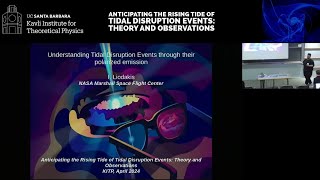
Understanding Tidal Disruption Events Through Their Polarized Emission
Explore polarized emission in tidal disruption events, offering unique insights into supermassive black holes and galactic nuclei. Part of a conference on advancing TDE research and observations.
Observations of TDEs and Other Nuclear Transients
Explore observations of tidal disruption events and nuclear transients, providing insights into galactic nuclei and supermassive black holes. Learn about recent advances and outstanding questions in the field.
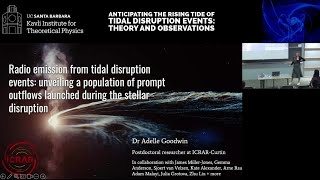
Radio Emission from Tidal Disruption Events - Unveiling Prompt Outflows During Stellar Disruption
Explore radio emissions from tidal disruption events, unveiling prompt outflows during stellar disruption by supermassive black holes. Gain insights into galactic nuclei and black hole properties.
Origins of Late-Time Radio Emission in Tidal Disruption Events
Explore the origins of late-time radio emissions in tidal disruption events, providing insights into galactic nuclei and supermassive black holes through luminous accretion flares.
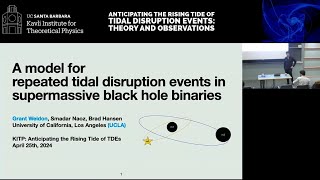
A Model for Repeated Tidal Disruption Events in Supermassive Black Hole Binaries
Explore a model for repeated tidal disruption events in supermassive black hole binaries, offering insights into galactic nuclei and black hole properties through luminous accretion flares.
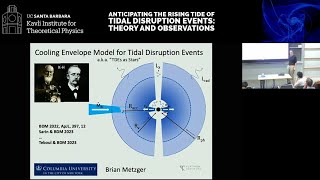
Cooling Envelope Model for Tidal Disruption Events
Explore the cooling envelope model for tidal disruption events with Brian Metzger, examining how stars are destroyed by supermassive black holes and the resulting luminous accretion flares.
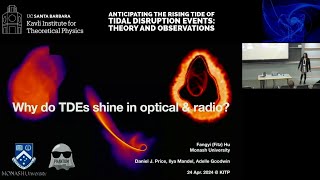
Why Do Tidal Disruption Events Shine in Optical and Radio More Than X-ray
Explore why tidal disruption events emit more optical and radio waves than X-rays, offering insights into supermassive black holes and galactic nuclei through luminous accretion flares.
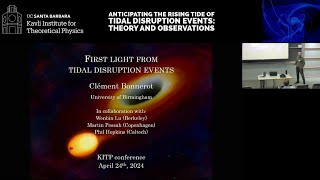
First Light from Tidal Disruption Events
Explore the initial electromagnetic emission from tidal disruption events, providing insights into supermassive black holes and galactic nuclei through stellar destruction observations.
Multi-messenger Astrophysics - Part 1
Explore multi-messenger astrophysics through an in-depth lecture covering fundamental concepts, observational techniques, and recent discoveries in this cutting-edge field.
Introduction to Observational Astrophysics
Explore fundamental concepts and techniques of observational astrophysics, from celestial objects to data analysis methods.
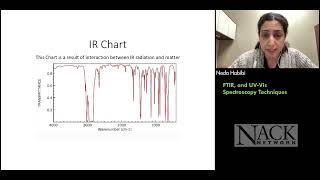
FTIR and UV-Vis Spectroscopy Techniques - Lecture 3
Explore FTIR and UV-Vis spectroscopy techniques, their principles, applications, and operational mechanisms. Gain insights into radiation interactions, vibration types, and spectrum analysis for nanoscale characterization.