tinyMLPerf: Benchmarking Ultra-low Power Machine Learning Systems
Explore benchmarking for ultra-low power ML systems, focusing on tinyMLPerf's methodology, tasks, and ecosystem impact. Learn about quantization and community-driven efforts in this emerging field.

Resource Efficient Machine Learning in a Few KBs of RAM - tinyML Summit 2020
Explore resource-efficient machine learning techniques for IoT devices with limited RAM, focusing on Microsoft's EdgeML library and algorithms like ProtoNN and FastRNN for edge computing.
Raspberry Pi Pico and Bluetooth
Learn to integrate Bluetooth with Raspberry Pi Pico using MicroPython. Covers UART, serial communications, and Bluetooth modules for enhanced project connectivity and control.
The "Top" Ten tinyML Commandments
Explore ten essential principles for tinyML success, covering data engineering, codesign, metrics, reproducibility, and industry collaboration, to drive innovation in embedded machine learning.
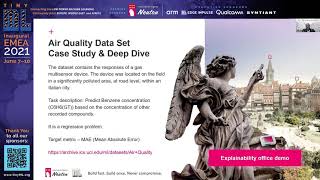
Avoiding Loss of Quality in Tiny Models - Neuton.ai Partner Session
Explore compact AI models without sacrificing quality. Learn to assess model quality, understand decision-making logic, evaluate training data, and interpret model outputs for tinyML applications.
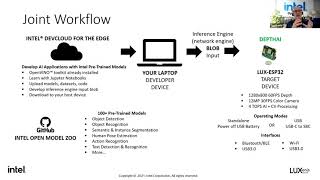
tinyML Vision Challenge - Intel-Luxonis DepthAI Platform Overview
Explore Intel and Luxonis' DepthAI platform for advanced vision solutions. Learn about AI inference, OpenVINO toolkit, and developing spatial edge applications using the LUX-ESP32 device.
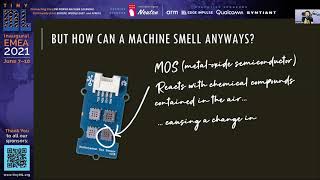
Lessons Learned from Building a TinyML-Powered Artificial Nose
Explore building a TinyML-powered artificial nose, from concept to implementation. Learn about hardware, sensors, models, and integrating TinyML applications into IoT ecosystems.
TinyML Talks - Building TinyML Applications Using Rune
Explore containerization for TinyML apps using Rune and Hammer. Learn to build efficient, portable solutions for healthcare, field ops, and telecom, with a focus on cough detection in public spaces.
hls4ml: An Open-Source Co-Design Workflow for Scientific Low-Power Machine Learning Devices
Explore hls4ml, an open-source workflow for implementing machine learning algorithms on FPGAs and ASICs, enabling real-time processing for scientific applications and accelerating discoveries.
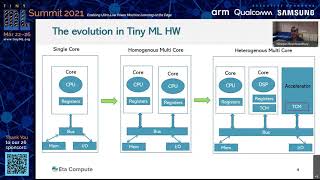
TinyML Summit 2021 Tiny Talks - TinyML Software Runtime for Hybrid Multicore Architecture
Explore software runtime for hybrid multicore architecture in TinyML, focusing on efficient resource allocation, minimized processing overhead, and optimized memory transfers for edge AI hardware.
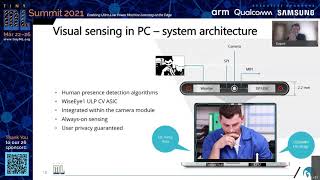
TinyML Journey: From Face Detection Demo to Real-Life Commercial Deployment
Exploring the journey from tinyML face detection demos to large-scale commercial deployment, addressing real-world challenges and bridging the gap between prototypes and practical applications.
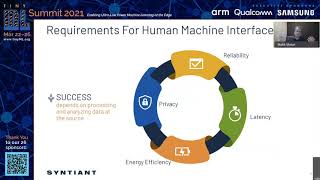
tinyML: Impact and Growth of Always-On Devices
Explore the growing impact of tinyML devices in everyday life, from always-on voice in phones to environmental sensing in machines, and learn about the market's rapid expansion and technological requirements.
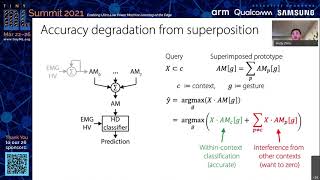
Memory-Efficient, Limb Position-Aware Hand Gesture Recognition Using Hyperdimensional Computing
Memory-efficient hand gesture recognition using hyperdimensional computing and sensor fusion. Improves accuracy by 17.79% while reducing memory footprint, addressing limb position changes for human-machine interfaces and prosthetics.
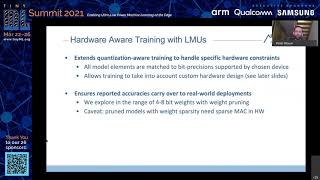
Hardware Aware Training for Efficient Keyword Spotting - tinyML Research Symposium 2021
Explore hardware-aware training for efficient keyword spotting, focusing on Legendre Memory Unit networks to achieve state-of-the-art accuracy and power efficiency on various hardware platforms.
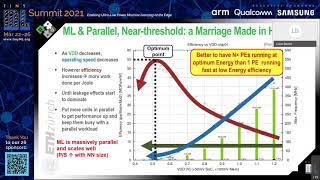
Many Shades of Acceleration - An Open TinyML Platform Perspective
Explore extreme edge AI, energy efficiency, and acceleration techniques for TinyML applications with insights from the PULP platform and RISC-V processors.
TinyML Vision Challenge - Summit 2021
Discover the tinyML Vision Challenge: Create innovative computer vision applications using tinyML, compete for $6k in prizes, and gain recognition from the tinyML Foundation.
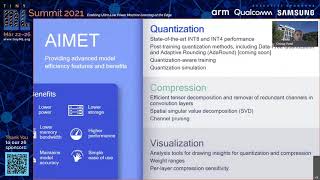
Advanced Network Quantization and Compression Using AIMET - tinyML Summit 2021
Explore advanced network quantization and compression techniques using AIMET to optimize AI models for efficient deployment on end devices, addressing memory, compute, and energy constraints.
Build Industrial-Grade TinyML Applications with Edge Impulse - Tutorial
Learn to build industrial-grade tinyML applications using Edge Impulse. Covers dataset collection, model design, training, optimization, and integration into embedded systems running on MCUs.
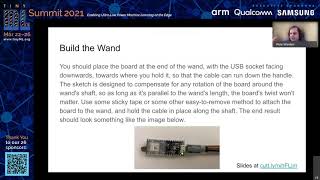
Building a Magic Wand with TensorFlow Lite Micro - Tutorial
Learn to build an IMU-based gesture recognition model for Arduino, covering data gathering, training, and deployment using TensorFlow Lite Micro and CMSIS-NN library.
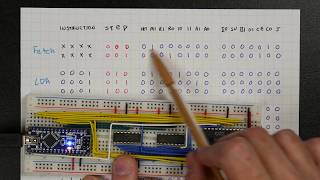
Reprogramming CPU Microcode With an Arduino
Explore microcode reprogramming using Arduino, covering EEPROM programming, constants definition, and NoOp instructions for enhanced CPU control and customization.
Best Practices for Cellular IoT Development
Explore key aspects of low-power cellular IoT development, including hardware architecture, LTE technology, network coverage, security protocols, and antenna design for successful product creation.