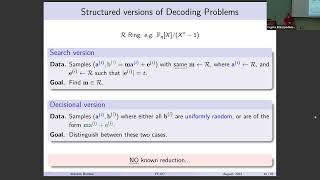
Coding Theory - Advances and Applications
Explore cutting-edge advancements in coding theory and cryptography at this Crypto 2022 session, featuring expert discussions on innovative algorithms and security protocols.
Gaussian B-Inequality: Stability and Equality Cases
Explore stability and equality cases in the Gaussian B-inequality, based on collaborative research with Livshyts, Rotem, and Volberg.
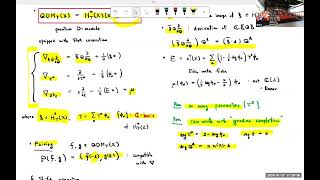
Fourier Analysis of Equivariant Quantum Cohomology II - 1-27-2024
Explore advanced concepts in Fourier analysis and equivariant quantum cohomology, building on previous research in homological mirror symmetry and mathematical physics.
Complexity of Sparse Linear Regression
Explore new methods for solving sparse linear regression, overcoming limitations of traditional approaches and exploiting structural properties of covariance matrices in machine learning and statistics.
Classification, Reduction and Stability of Toric Principal Bundles
Explore toric principal bundles' classification, reduction, and stability in this mathematical lecture, delving into advanced concepts in algebraic geometry and group theory.
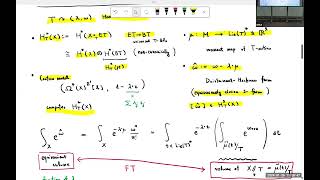
Fourier Analysis of Equivariant Quantum Cohomology - Part I
Explore Teleman's conjecture, equivariant quantum cohomology, and Fourier spectral analysis in symplectic geometry. Gain insights into D-module decomposition for projective bundles and blowups.
Spectrum of Sparse Inhomogeneous Random Graphs
Explore the spectrum of sparse inhomogeneous random graphs, examining structural properties and applications in network science, probability theory, and statistical physics.
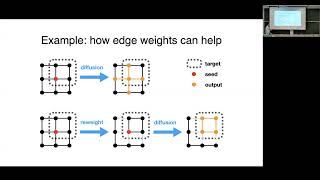
Local Graph Clustering with Noisy Labels
Explore techniques for local graph clustering with noisy labels, focusing on applications in complex networks and data analysis.
Towards a Formalized Proof of Carleson's Theorem
Explores formalizing Carleson's theorem on Fourier series convergence, discussing its significance, challenges, and recent generalizations in metric spaces using the Lean theorem prover.
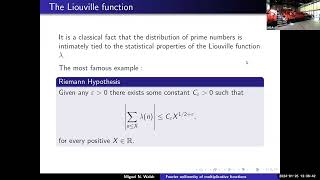
Fourier Uniformity of Multiplicative Functions
Explore Fourier uniformity of multiplicative functions, its connection to prime number distribution, and related conjectures like Chowla and Sarnak in this advanced mathematics lecture.

Fourier Integral - Cosine and Sine Integrals with Important Problems
Explore Fourier Integral concepts, including cosine and sine integrals, through clear explanations and problem-solving techniques for engineering applications.
Laplace Transform of Periodic Function - Engineering Mathematics Problem
Learn to apply Laplace transforms to periodic functions, focusing on square waves. Gain practical skills for solving engineering math problems involving periodic signals.
Quantum Diffusion Convolution Kernels on Graphs
Explore quantum diffusion convolution kernels for graph neural networks, improving predictive accuracy through quantum particle propagation and multiscale message passing techniques.
Signal Recovery, Restriction Theory, and Applications - Lecture 3
Explore signal recovery techniques using Fourier transforms and restriction theory. Delve into improved recovery conditions and multi-linear approaches for multiple transmissions.
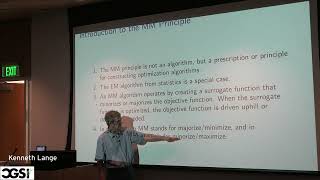
MM Principle of Optimization - CGSI 2023
Explore the MM Principle of Optimization in computational genomics, covering algorithms, applications in signal processing, and machine learning techniques.
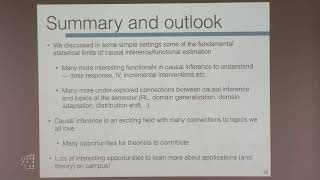
Statistical Limits of Causal Inference
Explore fundamental limits of causal effect estimation in observational data, examining personalized effects, non-smooth settings, and discrete scenarios without assuming prior causal inference knowledge.
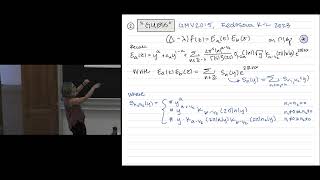
A Summary of Methods for Solving Differential Equations Involving Automorphic Forms
Explore advanced techniques for solving differential equations with automorphic forms, enhancing mathematical problem-solving skills in complex analysis and number theory.
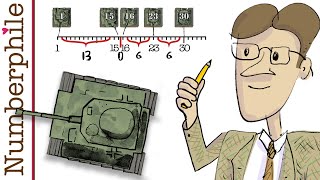
The Clever Way to Count Tanks - World War II Statistical Analysis
Discover how mathematics and probability solved the mystery of Nazi Germany's tank production during World War II, featuring insights from Dr James Grime on this fascinating historical application.
Signal Recovery, Restriction Theory, and Applications - Lecture 4
Explore signal recovery techniques using Fourier transforms and restriction theory. Delve into improved recovery conditions for multiple transmissions and continuous aspects of the problem.
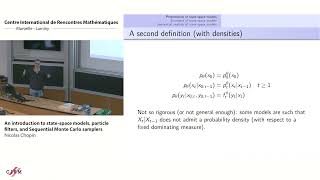
An Introduction to State-Space Models, Particle Filters, and Sequential Monte Carlo - Lecture 1
Explore state-space models, particle filters, and sequential methods in Bayesian statistics with Nicolas Chopin's comprehensive introduction to these advanced mathematical concepts.
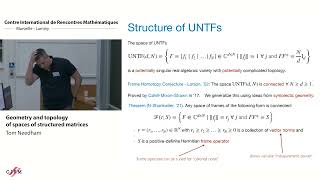
Geometry and Topology of Spaces of Structured Matrices
Explore geometric and topological aspects of structured matrices, including momentum maps, frame spaces, and applications in compressed sensing and graph theory.