Finite Dimensional Vector Spaces - An Overview
Comprehensive overview of finite dimensional vector spaces, exploring key concepts, properties, and applications in linear algebra and mathematical analysis.
Diagonalization of a Matrix - Numerical Examples in Linear Algebra
Learn to diagonalize matrices through clear examples, enhancing your understanding of linear algebra and its applications in various mathematical and scientific fields.
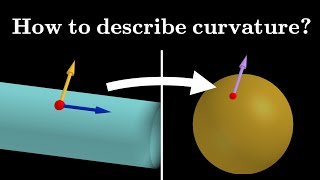
The Clever Way Curvature is Described in Math - Gaussian and Mean Curvatures
Explore Gaussian and mean curvatures in differential geometry, focusing on the shape operator to understand surface curvature and its applications in minimal surfaces.
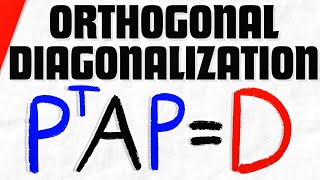
Orthogonal Diagonalization Explained - Linear Algebra
Explore orthogonal diagonalization in linear algebra, covering symmetric matrices, eigenvectors, and the Gram-Schmidt process. Includes step-by-step examples and proofs of key theorems.
Introduction to Non-Commutative Geometry - Lecture 1
Explore non-commutative geometry with John Barrett, covering algebraic concepts, reconstruction theorems, and differential operators. Gain insights into fuzzy spaces and Hermitian operators.
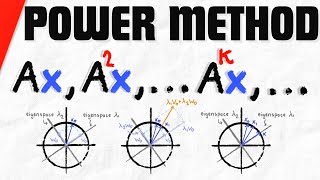
Power Method for Dominant Eigenvalues and Eigenvectors in Linear Algebra
Learn to approximate dominant eigenvalues and eigenvectors using the power method with maximum entry and Euclidean scaling. Explore power sequences, Rayleigh quotient, and geometric intuition in linear algebra.
Invariant Subspaces, Eigenvalues, and Eigenvectors
Explore invariant subspaces, eigenvalues, and eigenvectors to deepen your understanding of linear algebra concepts and their applications.
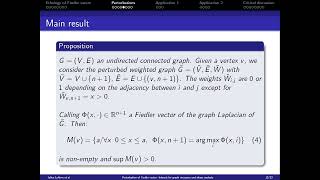
Perturbation of Fiedler Vector: Interest for Graph Measures and Shape Analysis
Explore Fiedler vector perturbation and its applications in graph measures and shape analysis, gaining insights into advanced mathematical concepts.
Stationary Distribution of a Markov Chain
Explore the concept of stationary distribution in Markov chains, understanding its properties and applications in probability theory and stochastic processes.

Properties of Eigenvalues
Explore key properties of eigenvalues in linear algebra, enhancing understanding of matrix transformations and their applications in various fields.
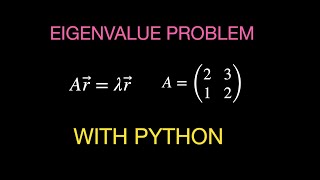
Solving the 2x2 Eigenvalue Problem - Also with Python
Explore eigenvalues and eigenvectors for a 2x2 matrix, with practical Python implementation for solving complex linear algebra problems.

Linear Algebra in NumPy and SciPy - ME3255
Learn essential linear algebra operations using NumPy and SciPy libraries in Python for efficient numerical computations and data analysis.
The Sensitivity Conjecture: A Proof from the Book and Connections to Physics
Explore the elegant proof of the Sensitivity Conjecture, its implications for theoretical computer science, and connections to physics concepts like Majorana fermions.
Perturbation Methods for Nonlinear PDEs - Lecture 3
Explore advanced perturbation techniques for nonlinear PDEs, focusing on multiple scales, asymptotic analysis, and the interplay between linear waves and nonlinearity in various scientific contexts.
Classical and Quantum Subjectivity in Uncertainty and Belief Systems
Explore uncertainty in subjective logic, from Markov networks to quantum quasiprobabilities, gaining insights on computational irreducibility and belief spaces.
Physics Python Warm Up Questions Using Numpy
Master Python for physics: import libraries, create arrays, plot data, manipulate matrices, calculate eigenvalues, and handle complex data structures.
All the Planes of Rotation for IncrL - Quantum Computer Programming - Lesson 91
Explore all 2-D rotation planes for the Increment-mod-L operator in quantum computing, advancing understanding of quantum operations and transformations.
Técnicas Espectrais para Detecção de Comunidades
Explore técnicas espectrais para detecção de comunidades em redes complexas, abordando decomposição de autovalores, otimização de modularidade e agrupamento espectral para análise eficiente de padrões.
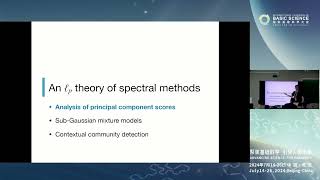
An ℓp Theory of PCA and Spectral Clustering
Explore an advanced $\ell_p$ theory of PCA, improving upon vanilla PCA for heteroscedastic noises and yielding optimal bounds for spectral clustering and community detection.
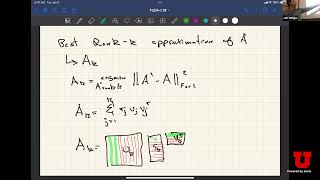
Singular Value Decomposition and Rank-K Approximation - Lecture 19
Dive into Singular Value Decomposition (SVD) concepts, exploring vector path tracing and rank-k approximation techniques for advanced matrix analysis and dimensionality reduction.
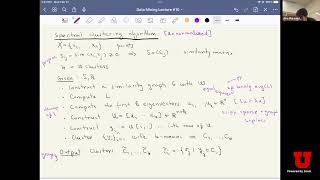
Spectral Clustering and Graph Partitioning - Data Mining Spring 2023
Master spectral clustering concepts through graph theory, Laplacians, eigenvalues, and practical algorithms for data partitioning and similarity analysis.