
Walter B. Langbein Lecture on Hydrology - AGU 2001
Explore groundbreaking insights in hydrology with Stephen Burges' Walter B. Langbein Lecture, honoring lifetime contributions and fostering collaborative research in the field.

The Future of Earth, Environmental, and Space Science - Who Are the Future Scientists?
Exploring the evolving landscape of Earth, environmental, and space sciences, addressing challenges, societal impacts, and the need for a diverse, collaborative workforce to tackle future scientific endeavors.
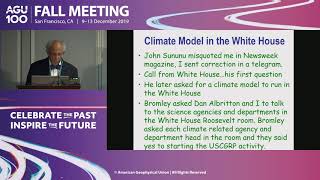
WCRP: Progress in Earth System Climate Science and Predictions
Showcases USGCRP contributions to Earth system climate science, highlighting research milestones, predictability advancements, and model development. Includes agency presentations and community discussions on priorities.

Stephen Schneider Memorial Lecture on Global Environmental Change
Explore the legacy of Dr. Stephen Schneider in environmental science through this memorial lecture, highlighting his interdisciplinary approach and contributions to climate change research.
Climate Change and El Niño: Predicting Future Effects - Workshop
Experts discuss global warming's impact on El Niño and tropical oceans, using modern and ancient climate evidence to predict future effects on vulnerable communities and ecosystems.
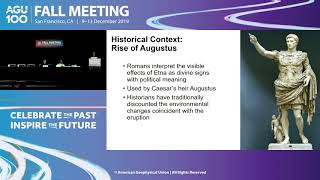
Etna Eruption's Global Impact and Influence on Roman History - 44 BCE
Explore new evidence linking Mt. Etna's eruption to global effects in 44 BCE and uncover the mysterious fate of Santorini's residents after a catastrophic eruption 3,500 years ago.
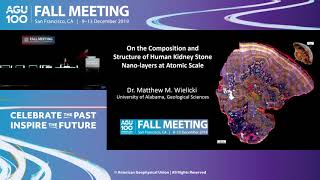
Geoscience Grab Bag - Infrasound, Planetary Raindrops, and Kidney Stones - Fall Meeting 2019
Explore diverse geoscience topics: infrasound's impact on geology, planetary raindrop characteristics, and human kidney stone structure. Gain insights from cutting-edge research across Earth and space sciences.
Future Water: Challenges and Innovations in Hydrology - Lightning Talks II
Explore the future of water through expert perspectives on global consumption, groundwater, ecohydrology, management approaches, and advanced hydrologic modeling. Gain insights into adapting water science for evolving cycles.
Arctic Report Card 2019 - Environmental Observations and Analysis
Experts present findings on Arctic climate change, focusing on disruptions in the Bering Sea, fisheries shifts, and impacts on indigenous communities. Key environmental observations and analysis are discussed.
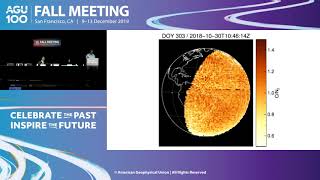
New Images from Earth's Ionosphere - Discoveries from ICON and GOLD Missions
New images from Earth's ionosphere reveal colorful processes with implications for near-Earth space. Featuring first captures from NASA's ICON spacecraft, discoveries from GOLD mission, and observations of a novel aurora type.
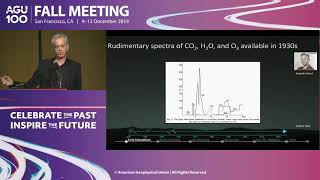
Tyndall History of Global Environmental Change Lecture
Explore the historical perspective on global environmental change, honoring John Tyndall's groundbreaking work on the greenhouse effect in this annual lecture by AGU.
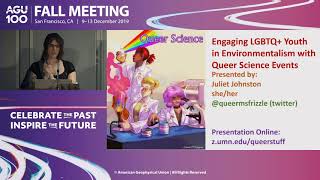
Demonstrating the Value of Earth and Space Science Through Community Engagement
Explore innovative projects showcasing Earth and space science's impact through education and public engagement. Learn from global initiatives that promote scientific value and community involvement.
Enacting Change Through Edible Education
Alice Waters discusses sustainable agriculture, free school lunches, and food education, sharing insights from her Edible Schoolyard foundation and advocating for conscious, healthy eating in public schools.
This Land is Your Land - Protecting Wild Spaces for Climate and Conservation
Explore the importance of protecting wild spaces for conservation, climate goals, and human-nature relationships. Experts discuss land preservation strategies and indigenous involvement in ecosystem management.
Thirty Years of Climate Change: Lessons and Future Prospects
Explore 30 years of climate change insights, future projections, and the evolving relationship between humans and Earth's climate system. Discuss effective communication, policy challenges, and global energy transitions.
Resurrecting the Woolly Mammoth and Other Climate Moonshots
Explore unconventional climate solutions, from atmospheric aerosols to resurrecting woolly mammoths, as scientists discuss innovative approaches to combat ecological collapse and preserve Arctic permafrost.
How the Ocean Shapes Our World - Understanding the Blue Machine
Explore the ocean's complex systems, from currents to underwater waterfalls, and its crucial role in shaping our world. Discover how understanding marine science is vital for addressing environmental threats.
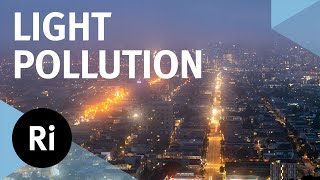
Why Light Pollution Threatens Life - Environmental and Ecological Impacts
Explore the impact of light pollution on ecosystems, wildlife, and human health. Learn about the importance of darkness and discover solutions for reducing artificial light's harmful effects.
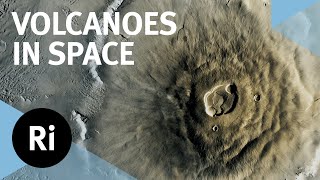
The Volcanoes of our Solar System
Explore the fascinating world of volcanoes beyond Earth, from icy eruptions on distant moons to massive Martian mountains, and discover the role of volcanism in shaping our cosmic neighborhood.

Water World - Earth's Heating and Plumbing Systems - Christmas Lecture 2020
Explore Earth's heating and plumbing systems with physicist Helen Czerski as she reveals how ocean currents distribute heat and nutrients, shaping our planet's climate and ecosystems.

Engine Earth - Christmas Lectures 2020 - Lecture 1
Geologist Chris Jackson explores Earth's climate history, revealing how ancient rocks and fossils tell a story of radical changes and how volcanoes have controlled atmospheric carbon dioxide levels throughout time.